

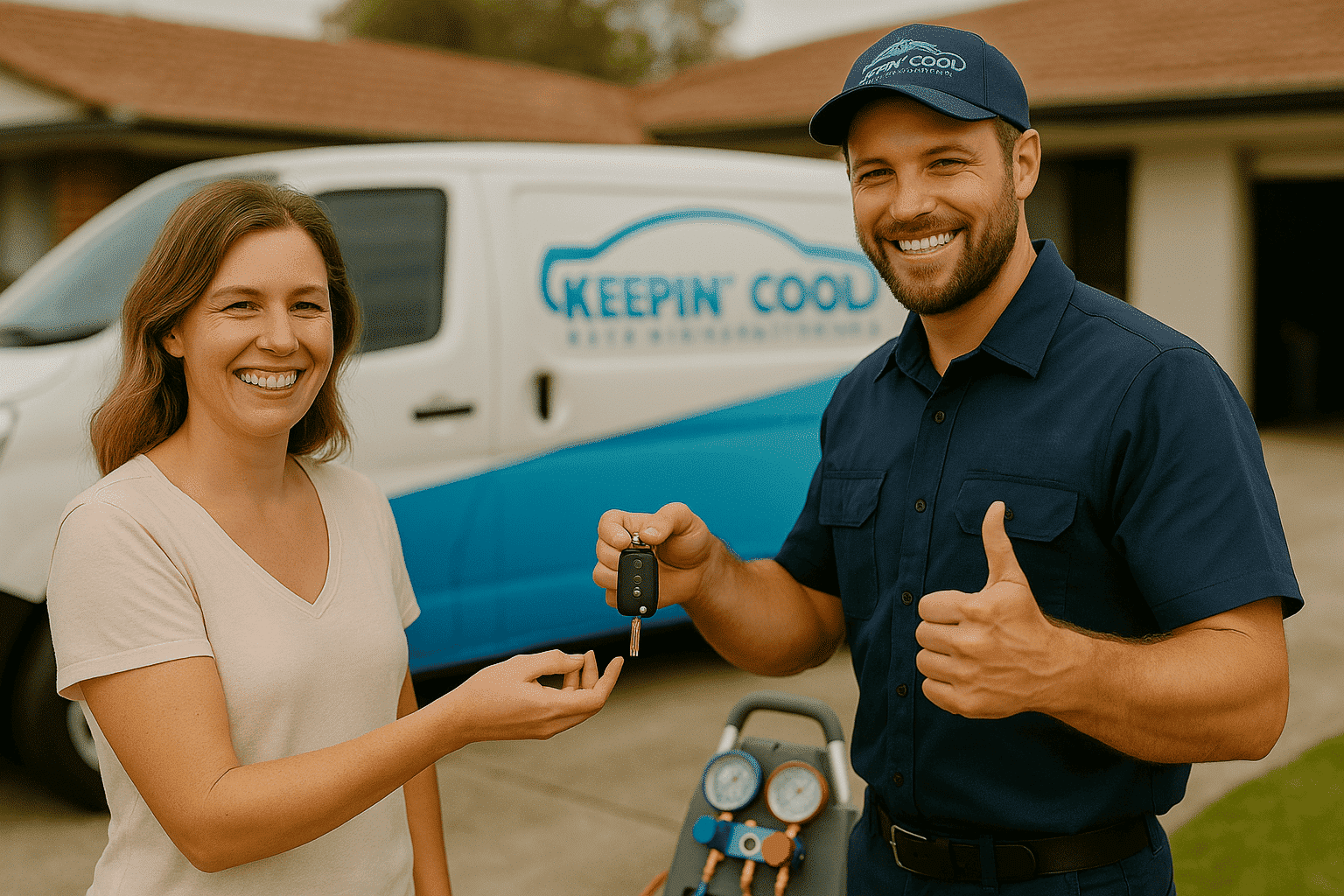
17 Aug Local Mobile Auto Air Conditioning Repairs
Brisbane’s Choice for Mobile Car AC Repairs & Regas
There’s nothing quite like the Brisbane heat. You get into your car after it’s been sitting in the sun, turn the key, and crank the air conditioning, expecting that blast of icy relief. But instead, you get a puff of lukewarm, stale air. It’s a frustrating moment every car owner in Brisbane’s Bayside and Redland City suburbs dreads. When your car’s AC fails, you need a fix that’s fast, reliable, and doesn’t involve losing your car to a workshop for a day. When you need Local Mobile Auto Air Conditioning repairs, you need a solution that comes to you.
My name is Jamie Ruf, and with over 39 years of hands-on experience in this industry, I founded Keepin Cool Auto Air Conditioning Specialist to be that solution. We are a fully mobile service, bringing expert diagnostics, repairs, and regassing directly to your home or workplace. This guide is designed to help you understand why your car’s AC might be failing, what’s involved in a professional repair, and why a certified, experienced local expert is always your best choice.
What is the best way to get car air conditioning repairs in the Brisbane Bayside and Redlands area?
The most convenient and reliable method is to use a certified mobile service. An expert technician comes to your home or workplace, saving you time and avoiding workshop queues. For Local Mobile Auto Air Conditioning repairs, ensure the technician is ARCtick certified (like Keepin Cool, AU13448), has extensive experience with all vehicle makes, and can handle both older () and newer () refrigerant systems. This approach guarantees a professional, legal, and efficient repair.
While you read, feel free to explore our services:
- Home Page: Visit our home page for more infomation.
- About Us: Learn more About Keepin Cool Auto Air.
- Our Expertise: See why we’re the top mobile car ac specialist.
- Social Media: Follow us on Facebook.
- Contact Us: Get in touch directly via our Contact Us page.
Why Is My Car AC Failing? 5 Common Signs in Brisbane Vehicles
When your car’s air conditioning starts to fail, it will give you warning signs. Recognising them early can help you avoid more significant and costly repairs down the road. Here are the five most common symptoms we see every day across the Redlands and Bayside suburbs.
- Warm Air Instead of Cold This is the most obvious sign and the number one reason we get called out. If your AC is blowing air that’s barely cooler than the outside temperature, it’s almost always a sign that the refrigerant level is low. However, it’s crucial to understand that your car’s AC is a sealed system. If the refrigerant is low, it means it has leaked out. Simply “topping it up” without finding and fixing the leak is a waste of your money and harmful to the environment.
- Weak or Reduced Airflow If you have to turn the fan up to full blast just to feel a trickle of air, the problem might not be with the cooling itself but with the airflow. More often than not, this is caused by a cabin air filter that is completely clogged with dust, pollen, and debris. In other cases, it could point to a failing blower motor or even a buildup of mould and mildew on the evaporator core, which physically blocks the air.
- Strange Noises (Rattling, Grinding, Squealing) Your AC system should run quietly. If you hear a loud grinding or squealing noise when you turn the AC on, it’s a serious warning sign that the compressor—the heart of the system—may be failing. A rattling noise could indicate a failing compressor clutch or that debris has found its way into the system. If you hear these sounds, it’s best to turn the AC off immediately and call a professional.
- Unpleasant Odours (Musty or Chemical Smell) A musty, “old socks” smell coming from your vents is a tell-tale sign of mould or bacteria growing in the dark, damp environment of your evaporator core. This isn’t just unpleasant; it can be a health concern. A faint chemical smell, on the other hand, could indicate a refrigerant leak inside the cabin, which also requires immediate attention.
- Water Leaking Inside the Cabin Have you noticed a damp patch on the passenger-side floor mat? This is usually caused by a blocked evaporator drain hose. The AC system naturally removes humidity from the air, which condenses into water and is supposed to drain out underneath your car. If this drain tube gets clogged with debris, the water backs up and overflows into the cabin.
The Mechanic’s View: Understanding Your Car’s AC System
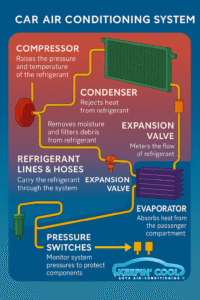
To understand what’s going wrong, it helps to know a little about how your car’s AC system works. It’s not magic; it’s a clever process of heat exchange that relies on three key components and a special gas called refrigerant.
The Three Key Players: Compressor, Condenser, and Evaporator
Think of these three parts as the workhorses of your AC system.
- The Compressor: This is the heart of the system. Driven by a belt connected to your engine, the compressor’s job is to pump and pressurise the refrigerant gas. This process gets the refrigerant flowing and also makes it very hot. If the compressor fails, the entire system stops working.
- The Condenser: This acts like a radiator specifically for your AC system. It’s located at the very front of your car, right in front of the engine’s radiator. Hot, high-pressure refrigerant gas from the compressor flows into the condenser. As air passes over its fins, the heat is released, and the refrigerant cools down, turning back into a liquid.
- The Evaporator: This is the chiller that does the real cooling. Tucked away inside your dashboard, the cold, low-pressure liquid refrigerant flows into the evaporator’s coils. Your car’s fan blows cabin air across these icy-cold coils. The refrigerant absorbs the heat from the air, turning back into a gas, and the result is the refreshing, cold air that comes out of your vents.
The Refrigerant Difference: R134a vs. The Newer HFO-1234yf
The refrigerant is the lifeblood of the system, and the type your car uses depends on its age. Understanding the difference is key to understanding the service and cost.
- R134a: This was the industry standard refrigerant for most vehicles manufactured from the mid-1990s up until about 2016. While effective, it has a high Global Warming Potential (GWP) of 1,430, meaning it has a significant impact on the environment if it leaks into the atmosphere.
- HFO-1234yf: This is the new, environmentally friendly standard for all modern vehicles. It has an ultra-low GWP of less than 1, making it a much greener alternative. However, it is a more complex and expensive gas to produce. It is also classified as mildly flammable, which means it requires specialised, different service equipment and handling procedures to be used safely. This is the primary reason why a regas service for a newer car is more expensive than for an older one.
At Keepin Cool, we are fully certified and equipped to handle both R134a and the newer HFO-1234yf systems, ensuring your vehicle gets the correct and legally required service.
More Than a “Top-Up”: Our 5-Step Professional Regas Service
Many people think a “regas” is just a quick top-up of refrigerant. This is a dangerous misconception. A professional regas is a comprehensive service designed to restore your system’s health, not just a temporary fix. Because a car’s AC is a sealed system, low gas always means there is a leak. Under Australian law, it is illegal to simply top up a system that is known to be leaking. That’s why our process is meticulous and designed to do the job right the first time.
Here is the 5-step process we follow for all Local Mobile Auto Air Conditioning repairs and regas services:
- Initial System Inspection & Assessment: We don’t just connect the gauges. We start with a full visual inspection of the AC components, including the hoses, belts, and compressor, looking for any obvious signs of physical damage, oil stains, or leaks. We then connect our gauges to test the system’s current static and operating pressures to get an initial diagnosis.
- Refrigerant & Oil Recovery: Using our specialised, ARCtick-approved recovery machine, we safely and legally remove all of the old refrigerant and oil from your system. We measure the exact amount that comes out, which gives us a crucial clue as to how severe the leak might be.
- The All-Important Vacuum Test: This is the critical step that unqualified operators and DIY kits skip. We place the entire AC system under a deep vacuum for a minimum of 30 minutes. This process has two vital functions: it boils off any moisture that may have entered the system (moisture mixed with refrigerant creates a corrosive acid that destroys components from the inside), and it serves as a highly effective leak test. If the system cannot hold this vacuum, we know there is a leak that must be repaired before we can legally proceed.
- UV Leak Dye, Oil & Refrigerant Recharge: Once the system has passed the vacuum test and is proven to be sealed, we inject a small amount of UV dye. This dye is harmless to the system but will make any future, slow leaks easy to spot with a black light. We then add the precise type and amount of new compressor oil, followed by recharging the system with the exact weight of R134a or HFO-1234yf refrigerant as specified by your vehicle’s manufacturer.
- Final Performance Testing & Analysis: With the system fully recharged, we start the car and run the AC at full capacity. We conduct a final series of tests, checking the high and low-side pressures, measuring the temperature at the vents to ensure it’s ice-cold, and confirming the compressor clutch is cycling correctly. We don’t consider the job done until your system is performing perfectly.
Why Redlands & Bayside Locals Choose Our Mobile Service
Choosing the right technician is about more than just getting the job done; it’s about trust, safety, and local knowledge. Here’s why your neighbours in the Redlands and Brisbane Bayside consistently choose Keepin Cool.
Over 39 Years of Hands-On Experience in Brisbane
With over 39 years of dedicated experience servicing vehicles right here in the Redlands and Bayside suburbs, I’ve seen it all. From the corrosive, salty air in Wynnum and Manly affecting condensers to the stop-start traffic on Old Cleveland Road putting extra strain on compressors, we understand the unique demands our local climate places on your car’s AC. This isn’t just a job for us; it’s a craft honed over decades of working on every type of vehicle, from family sedans and 4WDs to classic cars and light commercial vehicles.
ARCtick Certified (AU13448): Your Guarantee of Safety & Quality
That ARCtick logo isn’t just a sticker on our van; it’s your guarantee that you’re dealing with a licensed and insured professional. In Australia, it is illegal for anyone to handle refrigerants without this federal government authorisation. Using an unlicensed technician puts you at risk. They may use the wrong type of gas, or even dangerous, highly flammable hydrocarbon refrigerants that can put you and your family in danger. It also risks severe fines and environmental damage. Our ARCtick certification (AU13448) is your peace of mind that the job will be done legally, safely, and to the highest industry standards.
Real Examples from Your Neighbours
- Case Study 1 (Leak Detection): Just last week, we visited a customer in a 2017 Toyota Kluger in Victoria Point. The AC was blowing warm. A quick top-up from someone else would have been a waste of money. Our UV dye test and electronic sniffer quickly revealed a tiny pinhole leak in the condenser, likely from a stone chip on the motorway. We organised a quality replacement part, performed a full vacuum and regas, and now their AC is ice-cold for the school run. This is a typical example of the Local Mobile Auto Air Conditioning repairs we handle daily.
- Case Study 2 (Compressor Failure): A client in Capalaba with a 2014 Holden Commodore reported a loud grinding noise whenever the AC was on. It was clear the compressor had failed internally. We sourced a quality new compressor, thoroughly flushed the entire system to remove any metal fragments from the old unit, replaced the receiver/drier (a critical step), and completed the full repair right in their driveway. This saved them the hassle of a tow truck and a long wait at a traditional workshop.
The Ultimate Convenience: We Come to You!
Your time is valuable. That’s why our entire business is built around convenience. There’s no need to take a day off work, arrange for a lift, or sit around in a workshop waiting room. Whether you’re at home in Cleveland or at your office in Wakerley, we bring our fully equipped mobile workshop to you. Most jobs, including a full regas service or minor repairs, are completed in just 1-2 hours.
Your Essential Car AC Maintenance & Troubleshooting Guide
A little bit of preventative care can go a long way in extending the life of your car’s air conditioning system and helping you avoid costly breakdowns.
The 4 “Do’s” of Car AC Care
- DO Run It Regularly: Even in the middle of winter, run your AC on cold for about 10 minutes at least once a week. This circulates the refrigerant and oil, which keeps the seals and O-rings lubricated and prevents them from drying out, cracking, and causing leaks.
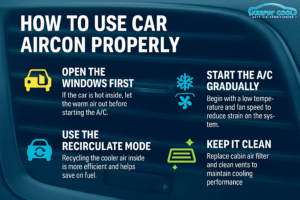
- DO Use the Coldest Setting: It is actually more efficient for your car to set the temperature to its coldest setting and then use the fan speed to control your comfort level. On warmer temperature settings, the system sometimes has to cool the air and then slightly re-heat it, which uses more fuel.
- DO Replace Your Cabin Air Filter: This is one of the easiest and most effective maintenance tasks. A clogged cabin air filter severely restricts airflow, making the system work much harder to cool the car. We recommend checking it annually or replacing it every 20,000 km.
- DO Park in the Shade: Whenever possible, parking in the shade or using a reflective windscreen sunshade dramatically reduces the initial temperature inside your car. A cooler cabin means your AC system doesn’t have to work nearly as hard to bring the temperature down, saving fuel and reducing wear and tear.
The 4 “Don’ts” to Avoid Costly Repairs
- DON’T Pre-Cool at Idle: Your car’s AC system is most efficient when the engine is running at driving speeds, as this turns the compressor faster. Letting your car idle for 10 minutes to “pre-cool” it is highly inefficient and puts unnecessary strain on the system. A better method is to open the windows for the first 30-60 seconds of your drive to flush the super-heated air out, then close them and let the AC take over.
- DON’T Ignore Smells: That musty, damp smell is a clear sign of bacteria and mould growing on your evaporator. Don’t just put up with it. It’s unhealthy to breathe in and needs to be treated professionally.
- DON’T Use DIY Regas Kits: It is illegal in Australia for an unlicensed person to handle refrigerant. These DIY kits are not only illegal but also dangerous. They cannot perform the essential vacuum test to remove moisture, they risk overcharging or undercharging the system (both of which cause damage), and many contain harmful sealants that can clog and destroy expensive AC components.
- DON’T Just “Top Up” Refrigerant: This is the most important “don’t”. If your system is low on gas, there is a leak. Period. Simply adding more refrigerant is like putting air in a punctured tyre—it’s a temporary fix that doesn’t solve the root problem. You are wasting money and releasing harmful gases into the environment. The leak must be found and properly repaired.
5 Common AC Issues & How to Troubleshoot Them
Before you call a technician, there are a few simple checks you can perform yourself. This can help you provide us with more accurate information, leading to a faster diagnosis.
- Problem: AC Blows Warm Air.
- Troubleshooting: With the engine running and AC on, listen for a “click” from the engine bay every 30 seconds or so—this is the compressor clutch engaging. If you don’t hear it, there could be an electrical issue or the system is too low on refrigerant to allow the compressor to turn on. Also, look at the front of the car to ensure the electric cooling fans are running.
- Solution: This almost always requires professional diagnosis to find the leak or electrical fault. This is a job for Local Mobile Auto Air Conditioning repairs.
- Problem: Weak Airflow.
- Troubleshooting: Check your owner’s manual to find the location of your cabin air filter (it’s usually behind the glove box). Carefully remove it and inspect it. If it’s grey or black with dirt, leaves, and bugs, it’s definitely restricting airflow.
- Solution: Replacing a cabin air filter is a simple task most car owners can do in a few minutes. If a new filter doesn’t solve the problem, the issue is likely a faulty blower motor or resistor, which will require a professional.
- Problem: AC Works Intermittently (Goes from Cold to Warm).
- Troubleshooting: This can be a symptom of the system freezing up due to moisture inside, or an electrical component that is failing when it gets hot. Check that the condenser at the very front of the car isn’t blocked by a plastic bag, leaves, or mud, as this will cause the system to overheat and shut down.
- Solution: This requires a professional to connect gauges and analyse the system’s pressures while it’s running. It often points to a problem with the expansion valve or a failing pressure switch.
- Problem: Musty Smell from Vents.
- Troubleshooting: The first step is always to replace the cabin air filter. If the smell remains after a few days, the problem is deeper in the system.
- Solution: The evaporator core needs a professional anti-bacterial treatment. At Keepin Cool, we use a specialised Ozone machine that effectively kills mould and bacteria, eliminating the odour at its source.
- Problem: Loud Grinding or Squealing Noise.
- Troubleshooting: Turn the AC system off immediately. If the noise disappears, it is almost certainly coming from the AC compressor or its clutch.
- Solution: Do not run the AC again. This requires immediate professional attention to prevent the compressor from seizing completely, which can shred the engine belt and leave you stranded. The compressor will likely need to be replaced.
Our Complete Range of Local Mobile Auto Air Conditioning repairs
We are specialists. This means we focus solely on car air conditioning and have the tools and expertise to handle any issue, big or small. Our comprehensive mobile services include:
- Mobile Car AC Regassing (R134a & HFO-1234yf): Our full 5-step professional service for all cars, 4WDs, and light commercial vehicles.
- Mobile Car AC Repairs: Expert diagnosis and repair of all air conditioning components, from pressure switches to control modules.
- Mobile Car AC Compressor Replacement: Sourcing and fitting high-quality new compressors, including a full system flush to remove contaminants.
- Mobile Car AC Hose Repairs & Replacement: Repairing and replacing leaking or damaged refrigerant hoses, often right on-site.
- Mobile Car AC Leak Detection: Utilising advanced methods like UV dye and electronic refrigerant “sniffers” to accurately pinpoint even the smallest leaks.
- AC System Inspection & Diagnostics: Full performance testing and fault-finding to give you a clear understanding of your system’s health.
- AC Odour & Bacteria Removal: Our specialised Ozone treatment to eliminate musty smells and sanitise your entire system, leaving your cabin air fresh and clean.
Transparent Pricing for Our Mobile Services in Brisbane
We believe in being upfront and honest about our pricing. As a mobile service, we have lower overheads than a traditional workshop, which allows us to provide expert service at a fair and competitive price. Below are the starting prices for our most common services in the Brisbane Bayside and Redland City areas.
- R13a Regas Service: from $250
- HFO-1234yf Regas Service: from $590
- Car Aircon Leak Detection: from $170
- Full System Diagnostics: from $170
- Car AC Compressor Replacement: from $1,150
- Car AC Hose Repair/Replacement: from $180
Please note that the higher price for HFO-1234yf services reflects the significantly higher cost of the gas itself and the specialised equipment required to handle it. A compressor replacement is a major repair, and our pricing includes a quality new unit, a system flush, a new receiver/drier, and all associated labour to ensure a lasting repair.
Your Questions Answered: Brisbane Car AC FAQ
How often should I get a car air conditioner regas?
While some recommend it every 1-2 years, a healthy, properly sealed AC system should not require regular regassing. The best indicator is performance. If you notice a gradual decline in cooling, it’s time for a professional inspection. If it’s been over two years and the performance is weak, a service is a good idea to check for slow leaks and keep components lubricated.
Will a regas fix my car’s AC?
A regas will only fix your AC if the only issue is low refrigerant. However, since low refrigerant is always caused by a leak, a simple regas is not a permanent fix. Professional service that includes finding and repairing the source of the leak is the only way to ensure a long-term solution.
Can I regas my car AC myself in Australia?
No. It is illegal to buy, handle, or dispose of automotive refrigerants in Australia without a valid ARCtick license. This is due to the significant environmental damage these gases can cause and the personal safety risks involved. DIY kits cannot perform the legally required vacuum test and can easily damage your system. Always use a certified professional for Local Mobile Auto Air Conditioning repairs.
Why is my car AC not cold after a regas?
This is a common and frustrating problem. It usually means the underlying issue was not correctly diagnosed or fixed before the new gas was added. The most likely causes are an ongoing leak that wasn’t repaired, a faulty compressor that isn’t pumping, a blocked condenser preventing heat exchange, or an electrical problem stopping the system from working correctly.
What’s the difference between a car AC regas and a service?
A “regas” specifically refers to the process of recovering old refrigerant and recharging the system with new gas. A full “service” is a more comprehensive process that includes the regas but also involves a thorough inspection of all components, including belts, hoses, the compressor, and electrical connections, as well as performance testing. At Keepin Cool, our regas procedure is a comprehensive service.
How long does a mobile car AC regas take?
A professional and thorough regas service, which includes the essential 30-minute vacuum test, typically takes between 1 and 1.5 hours from start to finish. This is significantly faster and more convenient than having to leave your car at a workshop for the entire day.
Why is the new HFO-1234yf refrigerant so much more expensive?
HFO-1234yf is a much more complex gas to manufacture than the older R134a. Its purpose is to be far less harmful to the environment, with a Global Warming Potential of less than 1, compared to over 1,400 for R134a. This advanced, greener technology, combined with the need for different, more expensive service equipment, is reflected in the higher cost of the service.
Book Your Mobile Car AC Service in Brisbane Today
Don’t suffer through another hot and sticky Brisbane drive. Get expert, convenient Local Mobile Auto Air Conditioning repairs from a trusted local specialist with over 39 years of dedicated experience. We service the entire Brisbane Bayside and Redland City region, from Wynnum and Manly to Redland Bay, Capalaba, Cleveland, and everywhere in between.
Ready to beat the Brisbane heat? We’ve made getting a quote simple. Click on our Quick SMS Quote form. Just enter a few details (your suburb, vehicle make/model/year, and the symptoms), and you’ll get a price texted back to you in no time. It’s the most direct way to get answers and book your service!