

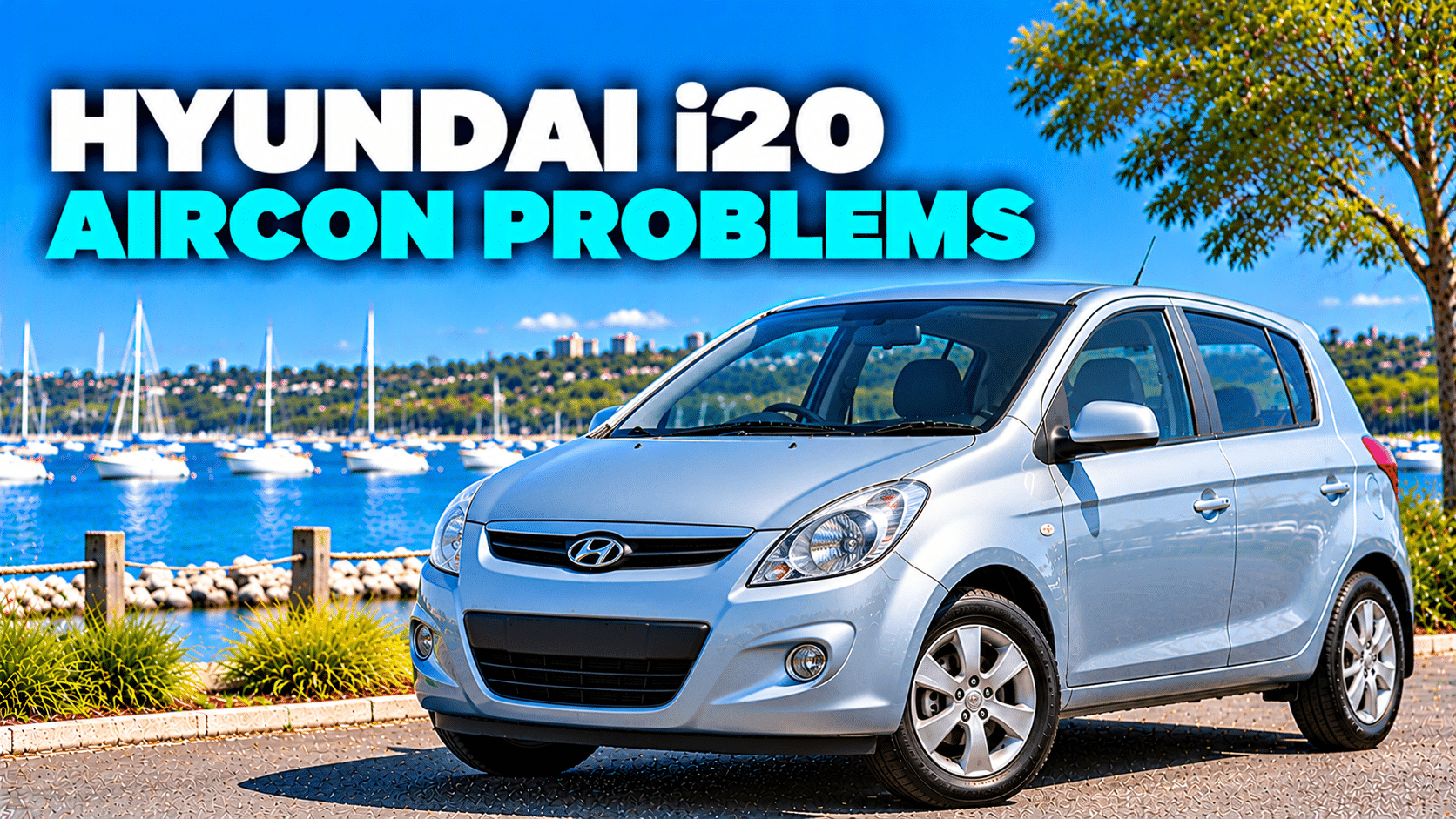
12 Aug Hyundai i20 Aircon Problems
Hyundai i20 Aircon Problems – Why Your AC Is Not Cooling
Is your Hyundai i20 air conditioning blowing warm air, working intermittently or struggling to cool on a hot Brisbane day?
Hyundai i20 aircon problems can involve refrigerant leaks, compressor clutch faults, failed electrical relays, condenser damage, pressure sensors or cabin ventilation problems.
On the earlier Australian Hyundai i20 PB, the compressor clutch, refrigerant pressure transducer and evaporator temperature sensor are particularly useful components to investigate when cooling stops unexpectedly.
However, poor cooling does not automatically mean the compressor has failed or that the system needs more refrigerant.
At Keepin Cool Auto Air, we provide mobile Hyundai i20 air conditioning diagnostics, refrigerant leak detection, regassing and suitable repairs throughout Brisbane Bayside and Redland City.
With over 40 years of hands-on automotive air conditioning experience, Jamie focuses on identifying the actual fault before recommending unnecessary regassing or replacement components.
This guide covers Australian Hyundai i20 air conditioning faults, practical warning signs, the differences between the original i20 and the newer i20 N, and how we determine the right repair.
Common Hyundai i20 Aircon Problems at a Glance
| Hyundai i20 symptom | Possible cause |
|---|---|
| Aircon blowing warm air | Refrigerant leak, compressor or electrical fault |
| Aircon gradually losing cooling | Leaking hose, condenser, seal or evaporator |
| AC light on but compressor not engaging | Clutch coil, relay, pressure sensor or wiring |
| Aircon suddenly stops cooling | Electrical control, compressor or pressure-related problem |
| Cold while driving but warm at idle | Condenser airflow, cooling fan or compressor performance |
| Aircon stops after 20 minutes | Intermittent clutch, sensor fault or evaporator icing |
| Grinding or squealing near compressor | Pulley bearing, belt-drive or internal compressor fault |
| Blower only works on certain speeds | Resistor, electronic controller or blower wiring |
| Airflow gradually becomes weaker | Evaporator icing or ventilation restriction |
| Warm air despite cold being selected | Air-mix control or refrigeration-system fault |
| Cooling fails again after regassing | Unresolved refrigerant leak or another fault |
These symptoms provide useful clues, but several different faults can produce the same result.
A professional inspection helps establish whether the problem involves refrigerant loss, compressor operation, electrical controls or cabin airflow.
Australian Hyundai i20 Models – PB and i20 N Differences
There are two important types of Hyundai i20 vehicles to distinguish in Australia.
Hyundai i20 PB – 2010 to 2015
The first-generation Hyundai i20 PB arrived in Australia in July 2010.
Early Australian vehicles were available with 1.4-litre and 1.6-litre petrol engines, although the local range was later simplified.
These vehicles now have ageing refrigerant hoses, seals, compressor components and electrical connections that deserve careful inspection when cooling performance deteriorates.
The i20 PB uses a system incorporating a compressor, refrigerant pressure monitoring, evaporator temperature sensing and electric cooling fan controls.
Hyundai i20 N – From 2021
The high-performance Hyundai i20 N arrived in Australia in 2021.
It uses a newer vehicle platform and a 1.6-litre turbocharged petrol engine.
Its compressor, electrical controls, refrigerant specification and replacement components should not automatically be treated as identical to the earlier i20 PB.
Keepin Cool can assess suitable conventional petrol i20 N vehicles after confirming the model and required work.
Correct vehicle identification is essential before ordering compressor parts or selecting a refrigerant.
1. Hyundai i20 Aircon Discharge Hose Leaks
One fault worth investigating on an ageing Hyundai i20 is refrigerant leakage from the compressor discharge hose.
This hose carries hot, high-pressure refrigerant from the compressor towards the condenser.
Its flexible rubber section and metal fittings must tolerate engine movement, vibration, temperature changes and refrigerant pressure.
With age, leakage may develop around the rubber section, crimped ferrules or pipe connections.
Signs of a Possible Hyundai i20 Hose Leak
You may notice:
- Cooling gradually becoming less effective.
- Refrigerant loss confirmed during inspection.
- Oily staining around a hose fitting.
- Air conditioning temporarily improving after previous regassing.
- Leak testing identifying a damaged crimp or connection.
Refrigerant circulates with compressor oil, so oily residue may help identify a suspected leak location.
However, staining alone does not prove that the hose is leaking. The actual source should be confirmed before recommending repairs.
Can a Hyundai i20 Aircon Hose Be Repaired?
Some suitable air conditioning hose assemblies can be professionally repaired by renewing damaged rubber sections and compatible fittings.
Others require complete replacement because of their construction or condition.
At Keepin Cool, we inspect the hose and confirm the leak before explaining the most appropriate option.
Learn more about our Car AC Hose Repairs service.
A refrigerant regas will not repair a damaged hose. The underlying leak must be addressed before reliable cooling can be restored.
2. Hyundai i20 Compressor Clutch Not Engaging
On Hyundai i20 compressors fitted with an electromagnetic clutch, the clutch engages when cooling is requested and the vehicle’s control system permits operation.
The pulley may continue rotating with the engine belt even when the clutch is disengaged.
If the clutch coil or engagement mechanism fails, the compressor may no longer circulate refrigerant correctly.
Symptoms of a Possible Compressor Clutch Fault
Possible signs include:
- Aircon suddenly blowing warm air.
- Compressor clutch failing to engage.
- Cooling operating intermittently.
- Clutch operation changing as the engine compartment warms up.
- Clicking, squealing or unusual noises near the compressor.
- Electrical testing identifying abnormal clutch operation.
However, a non-engaging compressor clutch is not automatically defective.
Low refrigerant pressure, a failed relay, damaged wiring or a control-system input may prevent the clutch from receiving power.
Does the Complete Compressor Need Replacing?
Not necessarily.
Some compressor assemblies have separately serviceable clutch components.
If the compressor remains mechanically sound and suitable replacement components are available, a separate clutch repair may be possible.
However, internal compressor damage, major wear or unsuitable parts availability can make complete replacement necessary.
The correct diagnosis should come before expensive replacement parts are ordered.
Visit our Car AC Compressor Replacement service for further information.
3. Hyundai i20 AC Compressor Relay Problems
The air conditioning compressor depends on the correct electrical supply and control signals.
On applicable i20 PB configurations, a relay forms part of the compressor clutch control circuit.
If the relay, fuse or associated wiring develops a fault, compressor operation may be interrupted.
Possible Compressor Relay Symptoms
These can include:
- AC button illuminating but no cold air.
- Compressor clutch failing to engage.
- Air conditioning stopping suddenly.
- Intermittent cooling.
- Incorrect electrical supply at the compressor.
- Electrical testing identifying a relay or wiring fault.
A relay fault is one possible explanation, but the vehicle may also be deliberately preventing compressor engagement because refrigerant pressure or another operating condition is outside specification.
Testing should establish whether the relay is faulty, whether it receives the correct command and whether power reaches the compressor.
A failed relay does not mean the entire compressor needs replacing.
4. Hyundai i20 Refrigerant Pressure Sensor Problems
The refrigerant pressure transducer monitors pressure within the air conditioning circuit.
The vehicle’s control system uses this information when managing compressor and cooling fan operation.
If refrigerant pressure is unsuitable, the system may restrict compressor operation to protect its components.
When Should the Pressure Sensor Be Checked?
Possible symptoms include:
- Compressor not engaging.
- Air conditioning stopping unexpectedly.
- Cooling becoming intermittent.
- Pressure-sensor readings appearing incorrect.
- Electrical faults affecting the sensor circuit.
- Compressor operation being restricted.
However, a pressure sensor may be reporting a genuine problem correctly.
For example, a leaking condenser or damaged refrigerant hose may cause low system pressure and prevent normal cooling.
Does the Pressure Sensor Need Replacing?
Only when testing confirms that it is defective.
The technician should compare actual operating pressures with the sensor’s electrical information and investigate relevant wiring.
Replacing a pressure sensor will not repair a refrigerant leak or a mechanically damaged compressor.
This is why refrigerant and electrical testing need to work together.
5. Hyundai i20 Condenser Leaks and Cooling Fan Problems
The condenser sits towards the front of the vehicle, where outside airflow removes heat from the refrigerant.
Its position makes it vulnerable to stone impacts, road debris and corrosion.
A small puncture, damaged tube or leaking connection can allow refrigerant to escape.
Signs of a Possible Condenser Leak
Possible clues include:
- Gradually worsening cooling.
- Refrigerant loss confirmed during testing.
- Oily staining around condenser connections.
- Visible impact damage.
- Cooling deteriorating after a previous regas.
These symptoms can also result from leaking hoses, compressor seals or other components.
The condenser should only be replaced once testing identifies it as the actual leak source.
Why Is My i20 Cold While Driving but Warm at Idle?
If your i20 cools reasonably well while moving but becomes warm at traffic lights, condenser airflow is worth investigating.
When driving, air naturally passes through the condenser.
When stationary, the electric cooling fan system becomes more important.
Hyundai technical information for the i20 PB identifies a cooling fan with low- and high-speed relay control on applicable systems.
Possible causes of poor cooling at idle include:
- Cooling fan motor or relay faults.
- Damaged electrical connections.
- Blocked condenser fins.
- Incorrect refrigerant charge.
- Abnormal high-side refrigerant pressure.
- Reduced compressor performance.
Fan operation and refrigerant pressures should be assessed together.
Adding refrigerant without confirming the fault can leave the underlying problem unresolved.
6. Hyundai i20 Evaporator Temperature Sensor Faults
The evaporator is the cooling component located inside the dashboard’s heating and ventilation housing.
On the Hyundai i20 PB, an evaporator temperature sensor helps monitor the cooling core and prevent excessive ice formation.
If the sensor or its wiring develops a fault, compressor operation may be interrupted or controlled incorrectly.
Symptoms of a Possible Evaporator Sensor Problem
These may include:
- Cooling becoming intermittent.
- Compressor operation stopping unexpectedly.
- Cooling performance changing during longer drives.
- Incorrect evaporator temperature information.
- Air conditioning behaving as though the evaporator is excessively cold.
However, these symptoms can also involve refrigerant charge, other electrical controls or compressor performance.
The sensor needs testing rather than being replaced solely because cooling is intermittent.
What Do Hyundai i20 Fault Codes B1241 and B1242 Mean?
On applicable Hyundai i20 PB diagnostic systems:
- B1241 relates to an evaporator temperature sensor signal indicating a short or low-voltage condition.
- B1242 relates to an evaporator temperature sensor signal indicating an open or high-voltage condition.
These codes provide useful diagnostic direction.
They do not automatically prove that the sensor itself has failed. Wiring and the relevant control circuit must also be checked using the correct vehicle specifications.
7. Hyundai i20 Aircon Stops Cooling After 20 Minutes
Intermittent cooling can be frustrating because the system may operate normally when first started.
Some drivers notice cold air for 15–30 minutes before cooling deteriorates.
A particularly useful clue is whether the volume of airflow changes when the problem occurs.
Strong Airflow but Warm Air
If the blower continues delivering normal airflow, possible causes include:
- Intermittent compressor clutch operation.
- Faulty relay or wiring.
- Refrigerant pressure-related shutdown.
- Evaporator temperature sensor problems.
- Compressor mechanical faults.
Testing while the fault is actually occurring can help identify problems that disappear after components cool down.
Airflow Gradually Becomes Weaker
If the blower continues running but progressively less air reaches the vents, evaporator icing is one possible cause.
Ice accumulating on the cooling core can obstruct airflow.
In some cases, airflow returns after switching the air conditioning off long enough for the ice to melt.
However, a blocked cabin filter or ventilation restriction can produce similar symptoms.
Warm air with normal airflow and airflow gradually disappearing are different problems requiring different checks.
8. Hyundai i20 Compressor Noise and Pulley Bearing Problems
Unusual noise near the compressor should be investigated before it becomes more serious.
On a clutch-equipped compressor, the pulley bearing allows the pulley to rotate while the compressor is disengaged.
A worn bearing can produce abnormal noise even when the air conditioning is switched off.
Possible Warning Signs
You may notice:
- Rumbling or grinding around the compressor.
- Squealing from the engine accessory belt.
- Noise changing when the AC is switched on.
- Excessive pulley movement.
- Noise increasing with engine speed.
- Cooling performance deteriorating alongside the noise.
The cause may involve the pulley bearing, clutch, belt tensioner or another engine-driven component.
A noisy pulley bearing is not the same as internal compressor failure.
Depending on the compressor design, a separate drive-component repair may be possible.
If severe grinding, smoke, a burning smell or belt damage occurs, stop using the air conditioning and arrange an inspection promptly.
9. Hyundai i20 Evaporator Leaks and Cabin Ventilation Problems
A leaking evaporator can cause refrigerant loss, although it should not be assumed to be faulty simply because the air conditioning is warm.
Because the evaporator is concealed inside the dashboard, locating a small leak may require more investigation than checking an accessible hose or condenser.
Major evaporator replacement can involve substantial dashboard dismantling.
At Keepin Cool, we investigate accessible refrigerant components and use suitable leak detection methods before recommending extensive work.
Our Car AC Leak Detection service explains how suspected refrigerant leaks are investigated.
Blower Fan Only Works on Certain Speeds
Some Hyundai i20 configurations use resistor-based blower speed control, while others use electronic control components.
Possible blower-related symptoms include:
- Fan operating on high speed but not lower settings.
- One or more fan speeds not working.
- Blower operation becoming intermittent.
- No airflow from the dashboard vents.
- Fan speed failing to respond correctly.
The blower motor, control component, fuses and wiring should be checked according to the actual vehicle configuration.
A faulty blower resistor or controller cannot be repaired by regassing the refrigeration system.
Blocked Cabin Filter and Air-Mix Problems
A contaminated cabin filter can reduce airflow and make the air conditioning feel ineffective.
A faulty air-mix actuator or temperature-control mechanism can also allow unwanted warm air into the cabin.
These are ventilation problems rather than proof of refrigerant loss.
Testing helps distinguish a refrigeration-system fault from restricted airflow or incorrect temperature-door operation.
10. What About Hyundai i20 N Aircon Problems?
The Hyundai i20 N is a newer performance hatchback with different mechanical and electronic equipment from the original i20 PB.
While it is a conventional petrol vehicle, its air conditioning system should be identified independently.
Important Differences to Check
Depending on the model year and equipment:
- The compressor and mounting arrangement may differ.
- Electrical controls and diagnostic procedures may be different.
- Refrigerant specification and charge quantity require confirmation.
- Replacement parts must suit the exact vehicle.
- Climate-control and sensor arrangements may differ from older i20 models.
Faults described in an early i20 PB should not automatically be presented as established defects affecting the i20 N.
Keepin Cool can assess suitable conventional i20 N vehicles within our normal mobile service scope.
Please provide the exact model year and refrigerant information when enquiring.
11. How Keepin Cool Diagnoses Hyundai i20 Aircon Problems
At Keepin Cool Auto Air, we follow a diagnostic-first approach before recommending regassing or replacement components.
Initial Inspection
We identify the Hyundai i20 model, engine and air conditioning configuration, then inspect accessible refrigerant hoses, compressor components and condenser connections.
Cooling Performance Testing
Where appropriate, we assess vent temperatures, compressor engagement, refrigerant pressures and cooling fan operation.
Electrical Fault Diagnosis
If the compressor does not engage or cooling stops intermittently, we investigate relevant clutch, relay, pressure-sensor and electrical-control circuits.
Professional Refrigerant Leak Detection
Where refrigerant loss is suspected, we use suitable specialist techniques, including Trace-A-Gas testing where appropriate.
Repair Recommendations
We explain the findings and quote suitable repairs before proceeding.
Some extensive dashboard work, concealed evaporator repairs or major component failures may require specialist workshop facilities.
For further details, visit our Car AC Inspection & Fault Diagnostics service.
Does My Hyundai i20 Need an Aircon Regas?
A Hyundai i20 may require regassing when testing confirms that the refrigerant charge needs correction and the system is otherwise suitable for recharging.
However, warm air does not automatically mean more refrigerant is needed.
Automotive air conditioning is designed as a sealed refrigeration system.
If refrigerant has escaped, the cause should be investigated before recharging.
Does the Hyundai i20 Use R134a or R1234yf?
Australian first-generation Hyundai i20 PB vehicles generally use R134a refrigerant in their factory systems.
Newer models, including the i20 N, must be checked individually using the vehicle’s air conditioning identification label and approved service information.
Keepin Cool services suitable conventional vehicles using R134a and HFO-R1234yf refrigerants.
The two refrigerants are not interchangeable.
Our Inspection-First Regas Process
Where regassing is appropriate, we inspect and leak-test first.
The process can include recovering remaining refrigerant, evacuating the system, completing appropriate checks and recharging to the manufacturer’s specified weight using suitable compressor oil and UV dye.
We then test compressor operation, refrigerant pressures and cabin cooling performance.
If a fault prevents regassing, we explain the required repair before proceeding.
Keepin Cool recommends considering air conditioning servicing every 2–4 years, with inspection and leak testing first. A correctly operating system does not automatically require additional refrigerant at every inspection.
For our complete service pricing, visit Car Air Conditioning Prices Brisbane.
Is It Worth Repairing an Older Hyundai i20 Aircon?
Many first-generation Hyundai i20 vehicles remain practical small cars.
However, with these models now more than ten years old, the cost and suitability of major repairs deserve consideration.
A faulty relay, electrical connection or leaking hose may be a different repair proposition from an internally damaged compressor or leaking dashboard-mounted evaporator.
Factors Worth Considering
- The actual diagnosed fault.
- Overall condition of the vehicle.
- Availability of compatible replacement parts.
- Labour required for the repair.
- Whether other air conditioning components are damaged.
- How long you intend to keep the vehicle.
A professional inspection helps establish the available repair options before money is spent on unnecessary components.
We explain the findings so you can make an informed decision about proceeding.
Hyundai i20 Aircon Problems – Frequently Asked Questions
Why is my Hyundai i20 aircon not working?
Possible causes include refrigerant leakage, compressor clutch faults, failed relays, pressure-sensor problems or condenser airflow issues. Testing is required to identify the cause.
Why does the Hyundai i20 AC light come on but the air stay warm?
The AC light indicates that air conditioning has been selected. It does not prove the compressor is operating or that the refrigeration system is cooling correctly.
Why won’t my Hyundai i20 compressor engage?
Possible causes include low refrigerant pressure, a faulty clutch coil, relay failure, wiring problems or incorrect control-system inputs.
Can the Hyundai i20 compressor clutch be repaired separately?
Some compressor designs have serviceable clutch components. Whether a separate repair is practical depends on the compressor fitted, its condition and parts availability.
What are Hyundai i20 fault codes B1241 and B1242?
On applicable i20 PB diagnostic systems, these codes relate to evaporator temperature sensor electrical circuit conditions. Further testing is required to identify the failed component.
Why is my Hyundai i20 aircon cold while driving but warm at idle?
Condenser airflow, cooling fan operation, refrigerant pressures or compressor performance may be responsible.
Why does my Hyundai i20 aircon stop cooling after 20 minutes?
Intermittent clutch operation, electrical faults, refrigerant pressure problems or evaporator icing may be involved. Note whether airflow also decreases.
Why does my Hyundai i20 blower only work on high speed?
A failed blower resistor is one possibility on compatible systems. The switch, blower motor, electronic controller and wiring may also need checking.
Can a Hyundai i20 aircon hose be repaired?
Some suitable hose assemblies can be professionally repaired by renewing damaged sections and fittings. Other assemblies require complete replacement.
Does my Hyundai i20 use R134a refrigerant?
Australian first-generation i20 PB vehicles generally use R134a. The correct refrigerant for a newer i20 N should be confirmed from its identification label.
Will a regas fix my Hyundai i20 air conditioning?
Only if regassing is suitable for the diagnosed problem. A regas cannot repair a damaged hose, failed relay, faulty clutch or other mechanical or electrical fault.
Can Keepin Cool service my Hyundai i20 N?
Suitable conventional petrol i20 N vehicles may be eligible. We confirm the model, refrigerant specification and type of work before accepting a booking.
Can you inspect my Hyundai i20 at home?
Yes. We provide mobile air conditioning diagnosis, refrigerant leak detection, regassing and suitable repairs at homes and workplaces across Brisbane Bayside and Redland City.
Mobile Hyundai i20 Aircon Repairs – Brisbane Bayside & Redland City
Keepin Cool Auto Air provides owner-operated mobile car air conditioning services at suitable homes and workplaces throughout Brisbane Bayside and Redland City.
Our service area includes Cleveland, Capalaba, Alexandra Hills, Birkdale, Wellington Point, Ormiston, Thornlands, Victoria Point, Redland Bay, Wynnum, Manly, Lota, Tingalpa and surrounding serviced suburbs.
We specialise in suitable conventional petrol and diesel cars, SUVs, utes, 4WDs and light commercial vehicles manufactured from 1999 onwards.
Hybrid, plug-in hybrid and electric vehicle air conditioning systems are excluded from our mobile service.
With over 40 years of hands-on automotive air conditioning experience, our focus is accurate fault diagnosis, professional refrigerant leak detection and appropriate repairs.
Keepin Cool holds ARCtick authorisation AU13448, which customers can verify through the official ARCtick Business Search.
For other Hyundai vehicles, see our Hyundai Air Con Problems guide.
You can also explore our Brisbane Bayside Car Air Conditioning and Redland City Car Air Conditioning service-area pages.
Book Your Hyundai i20 Aircon Inspection or Repair
If your Hyundai i20 air conditioning is blowing warm air, losing refrigerant, stopping intermittently or showing signs of a compressor or electrical problem, professional diagnosis can help determine the correct repair.
Call or SMS Jamie on 0415 761 019, or use the existing GET A QUICK SMS QUOTE button on our website.
Please include your suburb, Hyundai i20 model and build year, and a brief description of the cooling problem.
Keepin Cool Auto Air — Mobile Hyundai i20 air conditioning diagnostics, refrigerant leak detection, regassing and repairs across Brisbane Bayside and Redland City.