

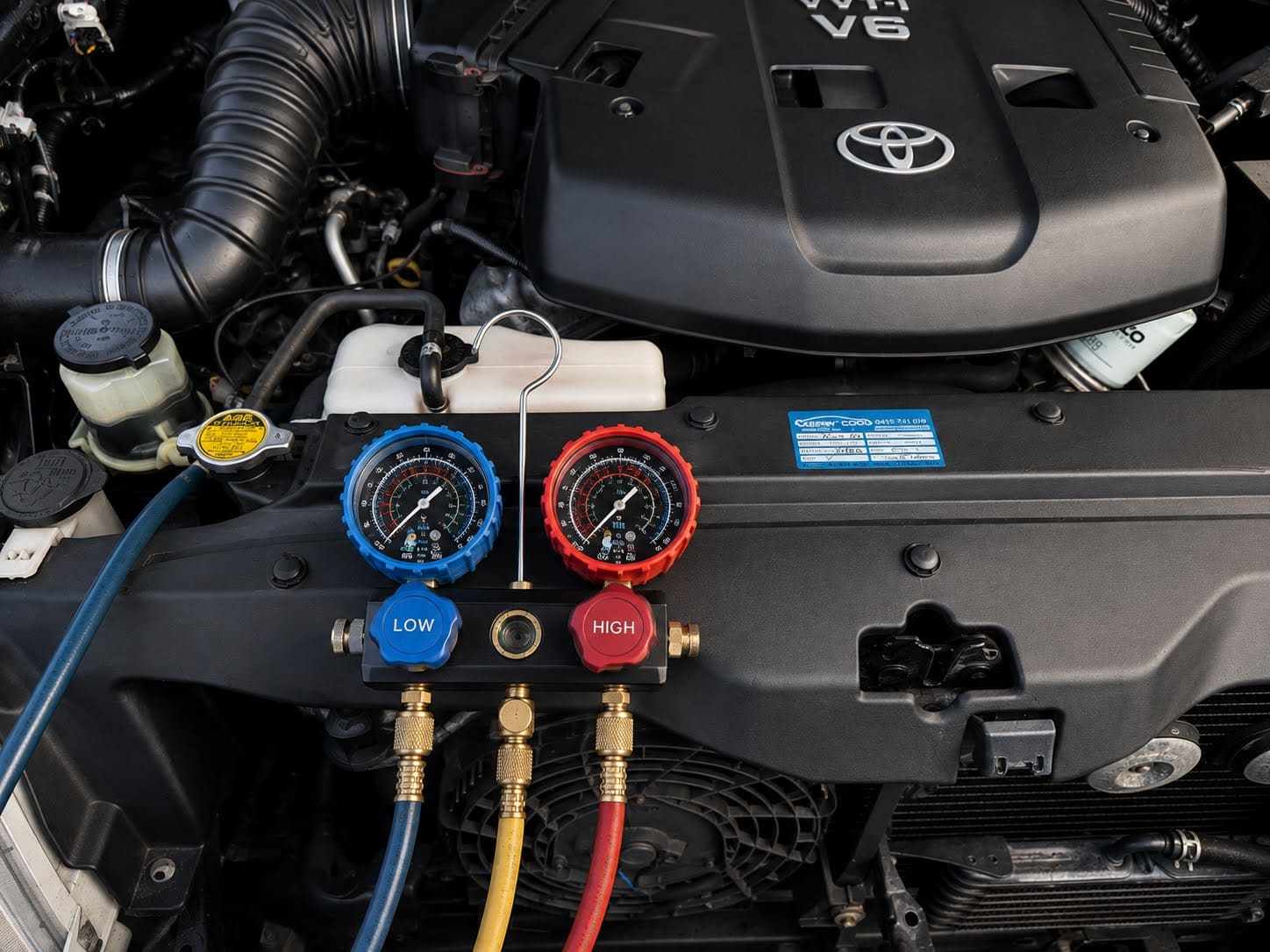
30 Oct Regassing Your Car Air Conditioner
Car Aircon Regassing Process – What Happens During a Professional Service?
Regassing your car air conditioner involves much more than adding refrigerant to make the vents blow cold again.
A professional car aircon regassing process includes checking the system, inspecting for refrigerant leaks, recovering the existing charge, removing air and moisture, and recharging with the correct refrigerant quantity.
If your vehicle has stopped cooling, it’s important to understand that a regas isn’t always the answer. Compressor faults, electrical problems, condenser damage and refrigerant leaks can produce similar symptoms.
At Keepin Cool Auto Air, we provide professional mobile car air conditioning inspections, Trace-A-Gas leak detection, regassing and suitable repairs across Brisbane Bayside and Redland City.
With more than 40 years of automotive air conditioning experience, our approach is straightforward: inspect and leak-test first, then regas if the system passes.
This guide explains what happens during a professional regas, why each stage matters and how we determine whether your vehicle actually needs refrigerant servicing.
What Does Regassing Your Car Air Conditioner Actually Mean?
Your car air conditioning operates as a sealed refrigeration system. Refrigerant circulates through the compressor, condenser, expansion device and evaporator to remove heat from the cabin.
Unlike engine oil or fuel, refrigerant isn’t consumed during normal operation.
However, ageing seals, damaged hoses, corroded condensers and other component faults can allow refrigerant to escape.
If the refrigerant charge becomes insufficient, cooling performance may deteriorate.
A professional regas involves recovering the refrigerant remaining in the system, performing appropriate checks, evacuating the system and recharging the correct quantity.
Importantly, a regas doesn’t repair a leaking condenser, failed compressor or electrical fault.
That’s why professional diagnosis is important before recommending refrigerant servicing.
What Happens During a Professional Car Aircon Regas?
Keepin Cool follows a structured servicing procedure rather than simply adding refrigerant.
Step 1 – Initial Air Conditioning Inspection
Before regassing, we assess the system’s condition and investigate the reported cooling problem.
Depending on the vehicle, this may involve checking:
- Air conditioning cooling performance.
- Compressor and compressor clutch operation.
- Refrigerant system pressures.
- Condenser and cooling fan operation.
- Accessible refrigerant hoses and connections.
- Electrical controls and pressure sensors.
- Signs of refrigerant leaks or component damage.
These checks help determine whether the vehicle is suitable for regassing.
For example, a faulty condenser fan may cause warm air while stationary, even when the system contains the correct refrigerant charge.
If another fault needs attention, we’ll explain the findings before proceeding.
For more information, visit our Car AC Inspection & Fault Diagnostics service page.
Step 2 – Professional Refrigerant Leak Testing
Refrigerant leaks are one of the most important issues to investigate before regassing.
Common leak locations include:
- Condenser cores and connections.
- Refrigerant hoses and crimped fittings.
- Compressor shaft seals.
- Service valves.
- Refrigerant pipes and O-rings.
- Evaporator assemblies.
A system may appear to operate normally after regassing but gradually lose cooling performance if an underlying leak remains.
Keepin Cool uses appropriate testing methods, including professional Trace-A-Gas leak detection where necessary.
If a leak is identified that requires repair, we’ll explain the problem and provide a quote before further work.
Step 3 – Recover the Existing Refrigerant
Any remaining refrigerant is recovered using dedicated automotive air conditioning servicing equipment.
This is different from releasing refrigerant into the atmosphere.
Recovery allows the technician to assess the amount removed and prepare the system for the appropriate checks and servicing.
The recovered quantity can provide useful information, but it must be interpreted alongside the system’s condition and manufacturer specifications.
If the existing charge is significantly below specification, further investigation may be required to determine whether refrigerant has escaped through a leak.
Step 4 – Check System Integrity and Evacuate Air and Moisture
Where appropriate, additional leak testing is performed after refrigerant recovery.
Once the system is suitable for servicing, a vacuum pump is used to evacuate air and moisture from the refrigerant circuit.
Air and moisture can affect refrigerant pressures, cooling efficiency and the condition of internal components.
The evacuation procedure must follow applicable Australian automotive servicing requirements and the vehicle manufacturer’s instructions.
A vacuum-hold check can assist with assessing system condition. However, passing a vacuum test alone doesn’t guarantee that every small leak has been eliminated.
This is why leak detection and proper system assessment remain important.
Step 5 – Recharge With the Correct Refrigerant and Oil
After the system passes the necessary checks, the correct refrigerant is added using professional equipment.
Every vehicle has a manufacturer-specified refrigerant type and charge quantity.
The quantity is measured by weight rather than estimated from dashboard vent temperature or pressure readings alone.
Both insufficient refrigerant and excessive refrigerant can affect system performance.
Keepin Cool also adds appropriate compressor oil and UV dye during regassing.
The correct oil type and quantity are important because different compressor designs and refrigerant systems may have specific lubrication requirements.
UV dye helps identify refrigerant leaks during future inspections.
Step 6 – Final Cooling and Performance Checks
Once the system has been recharged, we operate the air conditioning and assess its performance.
This may include checking:
- Refrigerant system pressures.
- Compressor operation.
- Dashboard vent temperatures.
- Condenser cooling fan operation.
- General cooling performance.
- Any remaining signs of abnormal operation.
The final performance check helps confirm that the system is operating as expected after servicing.
If further faults are identified, we’ll explain the findings and recommend the appropriate next step.
Why Trace-A-Gas Leak Testing Is Important Before Regassing
A small refrigerant leak can be difficult to locate, particularly when the damaged component is concealed or the leak occurs only under certain conditions.
At Keepin Cool, we use professional Trace-A-Gas testing where appropriate to assist with accurate leak detection.
How Trace-A-Gas Works
Following suitable refrigerant recovery and system preparation, a hydrogen/nitrogen trace-gas mixture can be introduced into the refrigerant circuit at an appropriate test pressure.
A specialist detector is then used to identify escaping tracer gas around accessible components.
This method can help locate leaks that may not be obvious during a visual inspection.
Trace-A-Gas is particularly useful when investigating:
- Condenser pinhole leaks.
- Leaking hose crimps.
- Pipe and O-ring connections.
- Compressor seals.
- Service valve leaks.
- Suspected evaporator leakage.
Additional methods may be required for components concealed behind the dashboard.
Professional leak detection helps prevent unnecessary regassing and reduces the risk of replacing the wrong component.
Learn more about our Car Air Conditioning Leak Detection service.
Why Simply Topping Up Your Car Aircon Isn’t Recommended
Some motorists assume that warm air means the refrigerant needs a quick top-up.
However, adding refrigerant to an existing charge without proper recovery, inspection and leak testing is not an appropriate servicing method.
The Australian Automotive Code of Practice requires refrigerant systems to be inspected and leak-tested and prohibits adding refrigerant to an existing charge as a simple top-up.
A known leaking system must be appropriately repaired before regassing.
Correct refrigerant handling also helps prevent unnecessary environmental emissions and reduces the risk of incompatible refrigerants being mixed.
You can read more about the requirements through the official ARCtick Australian Automotive Code of Practice.
At Keepin Cool, we don’t just add gas and hope the problem disappears.
We assess the system, explain any identified faults and perform the correct servicing procedure when appropriate.
R134a vs HFO-R1234yf – Which Refrigerant Does Your Car Use?
Different vehicles use different refrigerants, and the correct type must always be confirmed before servicing.
R134a Car Air Conditioning Systems
R134a is used in many established passenger cars, SUVs, utes and 4WDs.
Keepin Cool provides professional mobile R134a car aircon regassing for suitable vehicles.
This includes initial inspection, appropriate leak testing, refrigerant recovery, evacuation, recharge and performance testing.
HFO-R1234yf Car Air Conditioning Systems
HFO-R1234yf is used in many newer vehicles.
It has a substantially lower global warming potential than R134a and requires compatible servicing equipment and procedures.
Keepin Cool also provides HFO-R1234yf car aircon regassing for suitable vehicles.
Why Refrigerant Identification Matters
The vehicle manufacturer’s refrigerant specification must be followed.
Using an incorrect refrigerant can create safety concerns, affect performance and cause component damage.
Queensland Government guidance recommends using approved refrigerants and appropriately licensed technicians for vehicle air conditioning work.
For further information, visit Queensland Government – Vehicle Air Conditioning and Gas Safety.
If you’re unsure which refrigerant your car uses, we can confirm the specification before servicing.
Will Regassing Fix Every Car Air Conditioning Problem?
No. Regassing is only appropriate when refrigerant servicing is necessary and the system is suitable.
Several faults can cause poor cooling even when the refrigerant charge is correct.
| Air Conditioning Symptom | Possible Cause | Is Regassing Alone the Solution? |
|---|---|---|
| Warm air from vents | Low refrigerant or system fault | Only if refrigerant servicing is appropriate |
| Cold while driving, warm when stopped | Condenser airflow or cooling fan problem | Usually not |
| Compressor not operating | Electrical, pressure-control or mechanical fault | Diagnosis required |
| Cooling lost soon after regas | Refrigerant leak or unresolved fault | No, investigate the cause |
| Weak airflow from vents | Cabin filter, blower or ventilation problem | Usually not |
| Unusual compressor noise | Pulley, bearing or internal compressor problem | No |
These are examples of possible causes rather than definitive diagnoses.
For instance, a faulty compressor clutch can prevent cooling even when the system contains sufficient refrigerant.
Similarly, a damaged condenser may lose refrigerant shortly after a regas.
Diagnosing the fault first helps avoid unnecessary parts and repeated refrigerant servicing.
What If Your Car Has a Refrigerant Leak?
If testing identifies a leak that prevents regassing, the affected component must be assessed and repaired before the system can be correctly serviced.
Depending on the vehicle, the repair may involve:
- Replacing a leaking condenser.
- Repairing or replacing a refrigerant hose.
- Replacing damaged O-rings or fittings.
- Investigating compressor seal leakage.
- Repairing accessible pipe connections.
- Assessing a suspected evaporator leak.
Some repairs can be completed through our mobile service, while extensive dashboard or component dismantling may require workshop arrangements.
For compressor problems, visit our Car AC Compressor Replacement service page.
We explain the fault and quote the necessary repair before proceeding.
If you choose not to proceed with required repairs, the applicable inspection fee applies instead of charging for a regas that could not be successfully completed.
How Long Does Regassing Your Car Air Conditioner Take?
The time required depends on the vehicle, refrigerant system condition and whether additional testing is necessary.
A straightforward mobile appointment is often relatively short, while more complicated diagnostic work or repairs take longer.
Proper refrigerant recovery, leak testing, evacuation and final operating checks should not be rushed simply to meet a fixed appointment duration.
If an inspection identifies an electrical fault, refrigerant leak or damaged component, additional diagnosis or repair may be required before regassing can proceed.
How Much Does a Professional Car Aircon Regas Cost?
The cost of regassing depends on the refrigerant your vehicle uses and whether the system requires additional repairs.
R134a and HFO-R1234yf require different servicing equipment and have different refrigerant costs.
Rather than repeating figures across multiple technical articles, Keepin Cool maintains one dedicated Car Air Conditioning Prices Brisbane page.
This provides our current charges for regassing, inspection, diagnostics and common repairs.
Our approach remains the same regardless of refrigerant type: inspect and leak-test first, then regas if the system passes.
Does Your Car Need Regassing Every Two Years?
Not automatically.
A car air conditioning system is designed to retain its refrigerant charge.
Keepin Cool recommends preventative air conditioning inspections approximately every two years and no later than four years, or sooner if cooling performance deteriorates.
However, a scheduled inspection doesn’t automatically mean the refrigerant needs replacing.
Regassing should depend on the vehicle’s condition and the findings of a professional assessment.
For a more detailed explanation of servicing intervals, see our Car Air Conditioning Regas Schedule guide.
Mobile Car Air Conditioning Regas Across Brisbane Bayside & Redland City
Keepin Cool Auto Air is a locally owned, owner-operated mobile car air conditioning specialist based in Mount Cotton.
We provide professional mobile inspections, Trace-A-Gas leak detection, refrigerant recovery, regassing and suitable repairs throughout Brisbane Bayside and Redland City.
Our regular service areas include:
- Cleveland, Capalaba and Alexandra Hills.
- Thornlands, Victoria Point and Redland Bay.
- Birkdale, Wellington Point and Ormiston.
- Mount Cotton and surrounding serviced Redland City suburbs.
- Wynnum, Manly, Lota and Tingalpa.
- Other selected suburbs within Brisbane Bayside.
We come to suitable homes and workplaces, eliminating the need to leave your vehicle at a workshop for routine inspections and eligible repairs.
We service suitable conventional petrol and diesel vehicles manufactured from 1999 onwards, including cars, SUVs, utes, 4WDs and selected light commercial vehicles.
Hybrid and electric vehicles are outside our current service scope.
Check our Car Air Conditioning Service Areas page for more information.
Why Choose Keepin Cool Auto Air?
Keepin Cool has been providing specialist automotive air conditioning services since 2006.
With over 40 years of hands-on experience, Jamie focuses on identifying the actual cause of poor cooling before recommending repairs or regassing.
Our mobile service offers:
- Professional inspection and system assessment.
- Trace-A-Gas leak detection where appropriate.
- Accurate refrigerant recovery and recharging.
- R134a and HFO-R1234yf servicing.
- Compressor, condenser and hose fault diagnosis.
- Clear repair explanations and upfront quotes.
- Convenient appointments throughout our service area.
Keepin Cool operates under ARCtick business authorisation AU13448.
You can check authorised automotive air conditioning businesses through the official ARCtick Business Search.
Frequently Asked Questions About Car Aircon Regassing
Is a car aircon regas the same as a refrigerant top-up?
No. Professional regassing includes inspection, recovery where applicable, leak testing, evacuation, accurate refrigerant charging and final performance checks.
Simply adding refrigerant to an existing charge isn’t the correct servicing procedure.
How do you know how much refrigerant my car needs?
The required quantity is specified by the vehicle manufacturer. We use the correct specification and professional charging equipment to recharge the system by weight.
Does a regas include leak testing?
Yes. Keepin Cool inspects and performs appropriate leak testing before regassing. Additional specialist investigation may be required if faults are identified.
Why does my aircon lose cooling after being regassed?
A refrigerant leak or unresolved mechanical or electrical fault may be responsible. Further inspection is necessary before another regas.
Will regassing fix a noisy compressor?
No. A mechanically damaged compressor, pulley or bearing requires diagnosis and appropriate repair. Additional refrigerant won’t correct mechanical damage.
Does a car need regassing every two years?
Not automatically. We recommend periodic inspections, but regassing should be based on system condition and diagnostic findings rather than a fixed replacement interval.
Can you regas my car at home?
Yes. Keepin Cool provides mobile air conditioning inspections, regassing, leak detection and suitable repairs at accessible homes and workplaces throughout Brisbane Bayside and Redland City.
Do you service both R134a and HFO-R1234yf?
Yes. We have suitable servicing equipment for both refrigerant types and confirm the correct refrigerant specification before proceeding.
What happens if my car fails the leak test?
We’ll explain the identified problem and quote the necessary repair. If you decide not to proceed, the applicable inspection fee applies instead of charging for a regas that couldn’t be completed.
Ready to Book Your Car Aircon Service?
If your vehicle isn’t cooling properly, professional inspection can help determine whether it needs a regas, leak repair or further diagnosis.
Keepin Cool Auto Air provides expert mobile car air conditioning inspections, Trace-A-Gas leak detection, regassing and suitable repairs across Brisbane Bayside and Redland City.
Call or SMS Jamie on 0415 761 019, or use the website’s existing Quick SMS Quote button.
Please include your suburb, vehicle make, model, year and a brief description of the air conditioning problem.
Keepin Cool Auto Air
100% Mobile | ARCtick AU13448 | 40+ Years Experience