

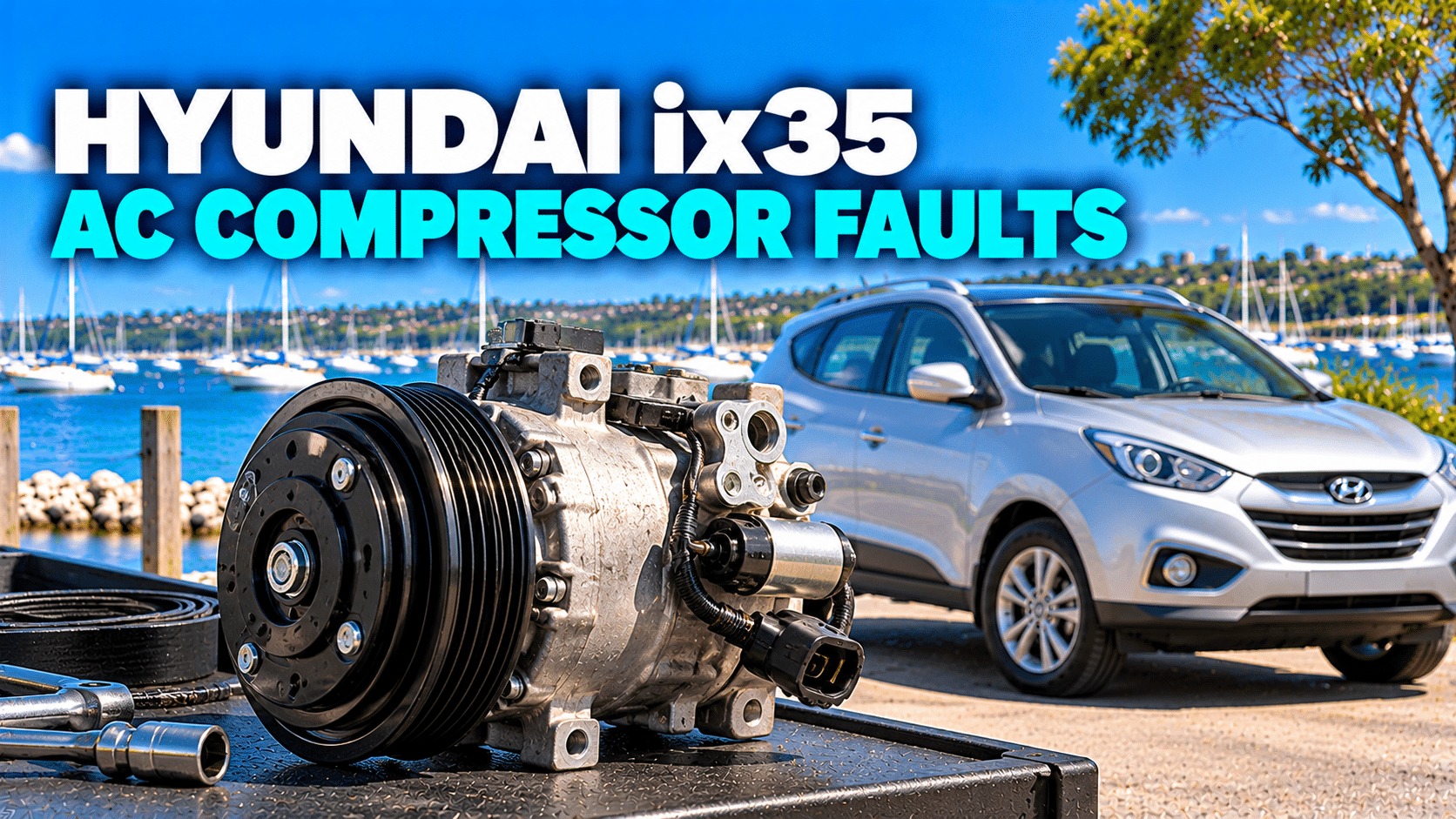
23 Jan Hyundai ix35 AC Compressor Faults
Hyundai ix35 AC Compressor Faults – ECV, Torque Limiter & Repairs
Is your Hyundai ix35 air conditioning compressor running but not producing cold air, or has your aircon suddenly stopped working?
Hyundai ix35 AC compressor faults can involve an electronic control valve (ECV), torque-limiter drive failure, refrigerant leakage, electrical problems or internal compressor damage.
These faults can produce similar symptoms, but they do not necessarily require the same repair.
On some ix35 models, a compressor control valve can be repaired separately. On others, mechanical damage or refrigerant leakage may make complete compressor replacement necessary.
At Keepin Cool Auto Air, we provide mobile Hyundai ix35 compressor fault diagnosis, refrigerant leak detection, regassing and suitable repairs throughout Brisbane Bayside and Redland City.
With over 40 years of hands-on automotive air conditioning experience, Jamie focuses on identifying the actual problem before recommending expensive replacement components.
This guide explains how the ix35 compressor works, the differences between electronic and mechanical faults, and how we determine whether repair or replacement is appropriate.
Hyundai ix35 Compressor Faults – Common Symptoms
| What your Hyundai ix35 is doing | Possible cause |
|---|---|
| Compressor pulley rotates but no cold air | ECV regulation, refrigerant charge or internal compressor fault |
| Pulley turns but compressor shaft is not driven | Failed torque limiter on applicable designs |
| Aircon suddenly stops cooling | Compressor drive, electrical or pressure-related fault |
| Aircon produces slightly cool air | ECV, refrigerant charge or compressor performance |
| Cooling works intermittently | ECV control, wiring, sensor or electrical fault |
| Grinding or rumbling around compressor | Pulley bearing, drive component or internal mechanical damage |
| Oil staining around the compressor | Possible seal, connection or compressor refrigerant leak |
| Cold while driving but warm at idle | Condenser airflow, cooling fan or compressor regulation |
| Cooling deteriorates after regassing | An unresolved leak or another system fault |
These symptoms help guide diagnosis, but they do not establish which component has failed.
A professional inspection considers compressor operation, refrigerant pressures, electrical commands and the overall condition of the air conditioning system.
Which AC Compressor Does the Australian Hyundai ix35 Use?
The Hyundai ix35 LM was sold in Australia between approximately 2010 and 2015.
Australian models included different petrol and diesel engines, with compressor arrangements varying according to engine type and production date.
Australian parts suppliers identify Doowon DVE16 compressor applications on certain petrol ix35 models, while other configurations use different compressor assemblies.
For example, some later 2.0-litre petrol ix35 vehicles use a DVE16 compressor, but that identification cannot automatically be applied to every model.
Why the Correct Compressor Identification Matters
Different compressor assemblies can have different:
- Mounting arrangements.
- Pulley and drive components.
- Electronic control valves.
- Electrical connectors.
- Refrigerant pipe connections.
- Compressor oil specifications.
- Internal mechanical designs.
Some use electronically controlled variable displacement, while others have different operating arrangements.
A fault-finding procedure or replacement valve suitable for one ix35 compressor may not apply to another.
Before ordering parts or testing an ECV, the actual compressor and vehicle specifications should be identified.
1. Hyundai ix35 Electronic Compressor Control Valve Problems
An important component on certain ix35 compressors is the external control valve, commonly called an ECV.
Unlike a conventional fixed-displacement compressor, a variable-displacement compressor can adjust how much refrigerant it circulates.
The ECV helps regulate this pumping capacity according to the vehicle’s cooling requirements.
If the valve or its electrical control fails, the compressor may continue being driven without producing enough cooling.
Signs of a Possible ECV Fault
You may notice:
- Air conditioning blowing warm or mildly cool air.
- Compressor drive appearing to operate normally.
- Poor cooling even when maximum AC is selected.
- High- and low-side refrigerant pressures not responding as expected.
- Cooling performance changing intermittently.
- Compressor output failing to respond to cooling demand.
These symptoms can also result from an incorrect refrigerant charge, electrical fault or internal compressor damage.
How Does Keepin Cool Diagnose ECV Problems?
Depending on the compressor fitted, diagnosis can include:
- Confirming the compressor model.
- Checking actual refrigerant-system condition.
- Assessing high- and low-side pressure behaviour.
- Inspecting the ECV electrical connection.
- Checking the control signal supplied to the valve.
- Evaluating whether compressor output changes when commanded.
- Investigating pressure sensors and other system controls.
The results must be considered together.
A compressor that fails to produce the expected pressure difference may have a control-valve problem, but it could also have mechanical wear or another refrigeration-system fault.
Why We Don’t Use One Universal ECV Resistance Figure
Different electronic compressor control valves can have different electrical specifications.
Resistance readings also vary with component temperature.
An electrical test must therefore use the correct specification for the particular compressor.
Furthermore, a valve can sometimes have an acceptable resistance reading but still fail to regulate compressor output mechanically.
Electrical resistance alone does not confirm that an ECV is operating correctly.
Professional diagnosis should combine electrical testing with refrigerant-system performance checks.
Can the Hyundai ix35 ECV Be Replaced Separately?
On suitable compressors, yes.
If the electronic control valve is separately serviceable, the appropriate part is available, and the compressor is otherwise mechanically sound, a valve-only repair may be an option.
However, replacing the valve will not repair:
- Internal compressor seizure.
- Severe compressor mechanical wear.
- A damaged compressor housing.
- Significant refrigerant leakage from the compressor.
- Metal contamination caused by internal failure.
The appropriate repair depends on the confirmed fault rather than assuming every compressor needs replacing.
2. Hyundai ix35 Compressor Torque-Limiter Failure
Another important fault on applicable ix35 compressor designs involves the torque limiter.
Some variable-displacement compressors have a protective drive mechanism incorporated into the pulley assembly.
Its purpose is to help protect the engine accessory belt system when excessive mechanical loading occurs.
For example, if a compressor seizes internally, the torque limiter may separate its driving connection.
This can allow the external pulley to continue rotating while the compressor shaft is no longer being driven correctly.
Signs of a Possible Torque-Limiter Fault
Symptoms can include:
- Air conditioning suddenly stopping.
- Compressor pulley continuing to rotate.
- Compressor shaft no longer being driven.
- Little or no expected refrigerant pressure difference.
- Damage around the compressor drive assembly.
- Evidence of compressor mechanical binding.
The important distinction is that a failed torque limiter is a drive problem rather than an electronic control-valve problem.
Does a Failed Torque Limiter Always Mean the Compressor Has Seized?
Not necessarily.
Compressor seizure is one possible cause, but abnormal belt-drive loading, vibration and other mechanical conditions can also contribute to limiter failure.
The failed component and the reason for the failure must be investigated.
Simply replacing a damaged drive component without identifying the cause may lead to another failure.
Can the Pulley Rotate While the Compressor Is Not Turning?
Yes, on applicable designs.
This is why seeing the pulley rotate is not enough to establish that the compressor is functioning.
The compressor’s drive arrangement and actual refrigerant pumping performance must be assessed.
For safety, inspections around moving belts, pulleys and compressor drive components should be performed by a suitably equipped technician.
3. ECV Fault, Torque-Limiter Failure or Internal Compressor Damage?
Although these problems can all result in warm air, they affect different parts of the compressor system.
| Suspected fault | What is affected | Repair consideration |
|---|---|---|
| Electronic control valve | Compressor displacement regulation | Separate valve repair may be possible |
| ECV wiring or connector | Electrical command to compressor | Repair the electrical fault |
| Failed torque limiter | Compressor mechanical drive | Investigate drive and compressor condition |
| Internal compressor seizure | Compressor moving components | Complete compressor replacement generally required |
| Compressor refrigerant leak | Compressor seal, housing or connection | Repair or replacement depending on location |
| Low refrigerant from another component | Refrigerant charge and system operation | Locate and repair the leak |
The correct decision depends on testing and component identification.
A replacement compressor should not be recommended simply because the air conditioning is not producing cold air.
4. Genuine Hyundai ix35 Compressor Replacement by Keepin Cool
One valuable example from our own automotive air conditioning repair experience involved a Hyundai ix35 with poor cabin cooling.
The owner contacted Keepin Cool because the air conditioning was not performing correctly.
Rather than simply adding refrigerant, we carried out performance checks and professional refrigerant leak testing.
What We Found
Our inspection identified two problems with the compressor:
- Refrigerant leakage from the compressor.
- Incorrect electronic compressor control-valve operation.
The compressor was therefore not only regulating incorrectly; it also had a confirmed refrigerant leak.
Why We Replaced the Compressor
In this particular case, replacing the electronic control valve alone would not have repaired the refrigerant leak.
Complete compressor replacement was selected because testing identified more than one fault.
Following replacement, the refrigerant system was serviced, evacuated and recharged to the appropriate specification, with suitable compressor oil and UV dye.
Final cooling checks confirmed that cold air had been restored.
What This Real Repair Demonstrates
An ix35 can have more than one air conditioning fault at the same time.
Even when an ECV problem is identified, other compressor components must be assessed before deciding on a valve-only repair.
This is why accurate diagnosis is important before authorising a costly compressor replacement.
For broader troubleshooting, including hoses, condensers and cooling fans, read our Hyundai ix35 Aircon Problems guide.
5. Hyundai ix35 Compressor Refrigerant Leaks
Not every ix35 compressor fault involves the electronic control valve or torque limiter.
The compressor can also develop refrigerant leakage.
Potential leak locations include:
- Compressor shaft seals.
- Compressor housing joints.
- Refrigerant pipe connections.
- O-ring seals.
- Damaged compressor components.
Signs of a Possible Compressor Leak
You may notice gradually declining cooling, repeated refrigerant loss or oily staining around the compressor.
Refrigerant circulates with compressor oil, so oil residue may help indicate a suspected leak location.
However, a nearby leaking hose fitting can resemble compressor leakage.
The exact source needs confirmation before replacement.
Can a Leaking Compressor Be Repaired?
Sometimes.
A serviceable pipe connection or O-ring may be repairable.
However, a damaged shaft seal, non-serviceable housing leak or additional compressor fault may require replacement of the entire unit.
At Keepin Cool, we investigate suspected refrigerant leaks using suitable methods, including Trace-A-Gas testing where appropriate.
Our Car Air Conditioning Leak Detection service explains why locating the actual leak is essential.
6. Hyundai ix35 Compressor Pressure and Electrical Testing
Refrigerant pressure readings are important when assessing compressor performance.
A working compressor should produce the expected pressure difference between the suction and discharge sides under appropriate conditions.
However, there is no single set of gauge readings suitable for every diagnostic situation.
What Affects the Pressure Readings?
- Ambient temperature.
- Engine speed.
- Condenser airflow.
- Refrigerant charge quantity.
- Compressor displacement.
- Electronic control-valve commands.
- Cabin cooling demand.
- Expansion-valve operation.
- Restrictions elsewhere in the refrigerant circuit.
For example, poor condenser airflow can increase high-side pressure even when the compressor itself is mechanically sound.
A low refrigerant charge can also change pressure behaviour and prevent normal operation.
What About the Compressor Wiring?
The compressor’s ECV depends on correct electrical commands.
Possible electrical problems include:
- Damaged ECV connector.
- Loose or corroded wiring terminals.
- Faulty control signals.
- Refrigerant pressure-sensor faults.
- Climate-control electrical problems.
- Related control-system faults.
If the ECV is not receiving the correct command, replacing the valve may not restore cooling.
Pressure testing and electrical diagnosis should be considered together before condemning the compressor.
7. Cooling Fan Problems Can Look Like Compressor Failure
If an ix35 produces cold air while driving but becomes warm in traffic, condenser airflow deserves investigation.
At road speed, outside air naturally passes through the condenser.
When stationary, the vehicle relies more heavily on its electric cooling fans.
Possible problems include:
- Cooling fan motor failure.
- Fan relay or electrical-control faults.
- Blocked condenser fins.
- Debris between cooling components.
- Incorrect refrigerant charge.
- Abnormal system pressures.
Inadequate condenser cooling can affect compressor operation and pressure readings.
This is another reason to assess the entire system before recommending compressor replacement.
Our Car AC Inspection & Fault Diagnostics service covers these fault-finding checks.
8. What Happens if the Hyundai ix35 Compressor Seizes?
Internal compressor seizure is different from an electronic control-valve fault.
Severe internal wear or mechanical binding may prevent the compressor from operating and can damage its drive arrangement.
In some failures, internal metal particles and contaminated lubricant can enter the refrigerant circuit.
Why Compressor Contamination Matters
Installing a new compressor into a contaminated system can cause another failure.
Depending on the extent of damage and the manufacturer’s requirements, additional work may include:
- Inspecting refrigerant lines for contamination.
- Checking the condenser and other components.
- Flushing suitable serviceable components.
- Replacing components that cannot be cleaned effectively.
- Renewing the receiver-drier or desiccant components where required.
- Replacing damaged seals and fittings.
- Using the correct compressor oil and refrigerant charge.
Some modern condenser designs cannot be reliably flushed after severe contamination and may require replacement.
The necessary work depends on the failure and system design.
A seized compressor is not repaired by fitting an electronic control valve.
9. Should You Repair or Replace a Hyundai ix35 AC Compressor?
The decision depends on the diagnosed fault and the compressor’s overall condition.
Repair May Be Appropriate When
- The ECV is faulty but separately serviceable.
- The compressor remains mechanically sound.
- A serviceable connection or seal is leaking.
- An external electrical problem is responsible.
- A suitable pulley or drive component can be repaired safely.
Replacement May Be Necessary When
- Internal compressor damage is confirmed.
- The compressor has seized.
- The compressor is leaking from a non-serviceable area.
- The refrigerant circuit contains contamination from compressor failure.
- Replacement components are unavailable or unsuitable.
The age and condition of the vehicle should also be considered.
Australian Hyundai ix35 models were sold between 2010 and 2015, so repair decisions may involve weighing component availability and the overall value of the vehicle.
For a broader explanation of repair decisions, visit our Car AC Compressor Repair or Replace guide.
10. What Happens During Hyundai ix35 Compressor Replacement?
Once compressor replacement has been confirmed as necessary, the repair involves more than removing the old component.
Depending on the diagnosed failure, our procedure can include:
- Confirming the fault: Establish that the compressor requires replacement.
- Identifying the correct component: Match the replacement compressor to the ix35 engine, build details and original equipment.
- Refrigerant recovery: Recover existing refrigerant using appropriate equipment.
- Assessing contamination: Inspect the failed compressor and relevant refrigeration components.
- Replacing required parts: Fit the compressor, appropriate seals and any supporting components required.
- Professional leak testing: Check the repaired system for refrigerant leakage.
- Evacuation and recharge: Remove air and moisture, then recharge with the correct refrigerant quantity and suitable compressor oil.
- Final testing: Confirm compressor operation, operating pressures and cabin cooling performance.
Not every compressor replacement requires the same supporting parts or labour.
A compressor with an electrical problem may require different work from a compressor that has seized internally.
Our Car AC Compressor Replacement service provides further information.
11. Hyundai ix35 Regassing and Refrigerant Requirements
Australian Hyundai ix35 LM vehicles generally use R134a refrigerant in their original air conditioning systems.
However, the correct refrigerant charge quantity and compressor lubricant must be verified for the individual vehicle.
Refrigerant should not be added simply because the air conditioning is blowing warm air.
A properly functioning sealed system should retain its specified charge.
If refrigerant has escaped, the cause needs investigating before regassing.
At Keepin Cool, we recommend considering air conditioning servicing every 2–4 years, with inspection and leak testing first.
A correctly operating system does not automatically need refrigerant added at every inspection.
For compatible vehicles, our R134a Car Air Conditioning Regas service includes appropriate system inspection, refrigerant recovery and evacuation as required, recharging to the specified weight, suitable oil and UV dye, and final cooling checks.
For our complete service pricing, visit Car Air Conditioning Prices Brisbane.
Hyundai ix35 AC Compressor Faults – Frequently Asked Questions
Why is my Hyundai ix35 AC compressor running but not cooling?
An ECV problem, incorrect refrigerant charge, internal compressor damage or another refrigeration-system fault may be responsible. Pulley rotation alone does not confirm proper compressor output.
What is the Hyundai ix35 external control valve?
The ECV regulates compressor displacement on compatible variable-displacement compressors, helping adjust refrigerant output according to cooling demand.
Can the Hyundai ix35 ECV be replaced separately?
On certain compressor designs, yes. The compressor must be identified and tested before deciding whether valve replacement is suitable.
What is a Hyundai ix35 compressor torque limiter?
It is a protective drive component on applicable compressor designs. It can separate the compressor’s driving connection when excessive mechanical loading occurs.
Can the pulley rotate if the compressor has seized?
Yes, on some compressors with a failed torque limiter. The external pulley may continue rotating without driving the compressor shaft.
Does a failed torque limiter always mean the compressor has seized?
No. Compressor seizure is one possibility, but other abnormal drive loads can contribute. The cause needs investigation.
Can an ECV have normal electrical resistance and still be faulty?
Yes. Resistance is only one test. Electrical commands and actual compressor performance also need assessment.
Does low high-side pressure prove the compressor is defective?
No. Refrigerant charge, control-valve operation, operating conditions and other system faults can affect pressure readings.
Can a leaking ix35 compressor be repaired?
Some serviceable connections or seals can be repaired. Other leaks or internal compressor failures require complete replacement.
Do petrol and diesel Hyundai ix35 vehicles use the same compressor?
Not necessarily. Compressor type, mounting, drive arrangement and electrical connections can differ. Parts must be matched to the exact vehicle.
Will regassing repair an ix35 compressor fault?
No. Regassing cannot repair a failed ECV, seized compressor or mechanical drive fault. Testing is required to determine whether the refrigerant charge is also incorrect.
Can Keepin Cool diagnose my Hyundai ix35 compressor at home?
Yes. We provide mobile compressor fault diagnosis, refrigerant leak detection, regassing and suitable repairs at homes and workplaces across Brisbane Bayside and Redland City.
Mobile Hyundai ix35 Compressor Repairs – Brisbane Bayside & Redland City
Keepin Cool Auto Air provides owner-operated mobile car air conditioning services at suitable homes and workplaces throughout Brisbane Bayside and Redland City.
Our service area includes Cleveland, Capalaba, Alexandra Hills, Birkdale, Wellington Point, Ormiston, Thornlands, Victoria Point, Redland Bay, Wynnum, Manly, Lota, Tingalpa and surrounding serviced suburbs.
We specialise in suitable conventional petrol and diesel vehicles manufactured from 1999 onwards.
With over 40 years of automotive air conditioning experience, we focus on accurate compressor diagnosis, professional leak testing and appropriate repairs.
Keepin Cool holds ARCtick authorisation AU13448, which customers can verify through the official ARCtick Business Search.
Book Your Hyundai ix35 Compressor Inspection or Repair
If your Hyundai ix35 air conditioning is blowing warm air, making unusual compressor noises or showing signs of an ECV or compressor drive problem, professional diagnosis can help determine the correct repair.
Call or SMS Jamie on 0415 761 019, or use the existing GET A QUICK SMS QUOTE button on our website.
Please include your suburb, ix35 build year, engine type and a brief description of the air conditioning problem.
Keepin Cool Auto Air — Mobile Hyundai ix35 compressor diagnostics, ECV fault testing and air conditioning repairs across Brisbane Bayside and Redland City.