

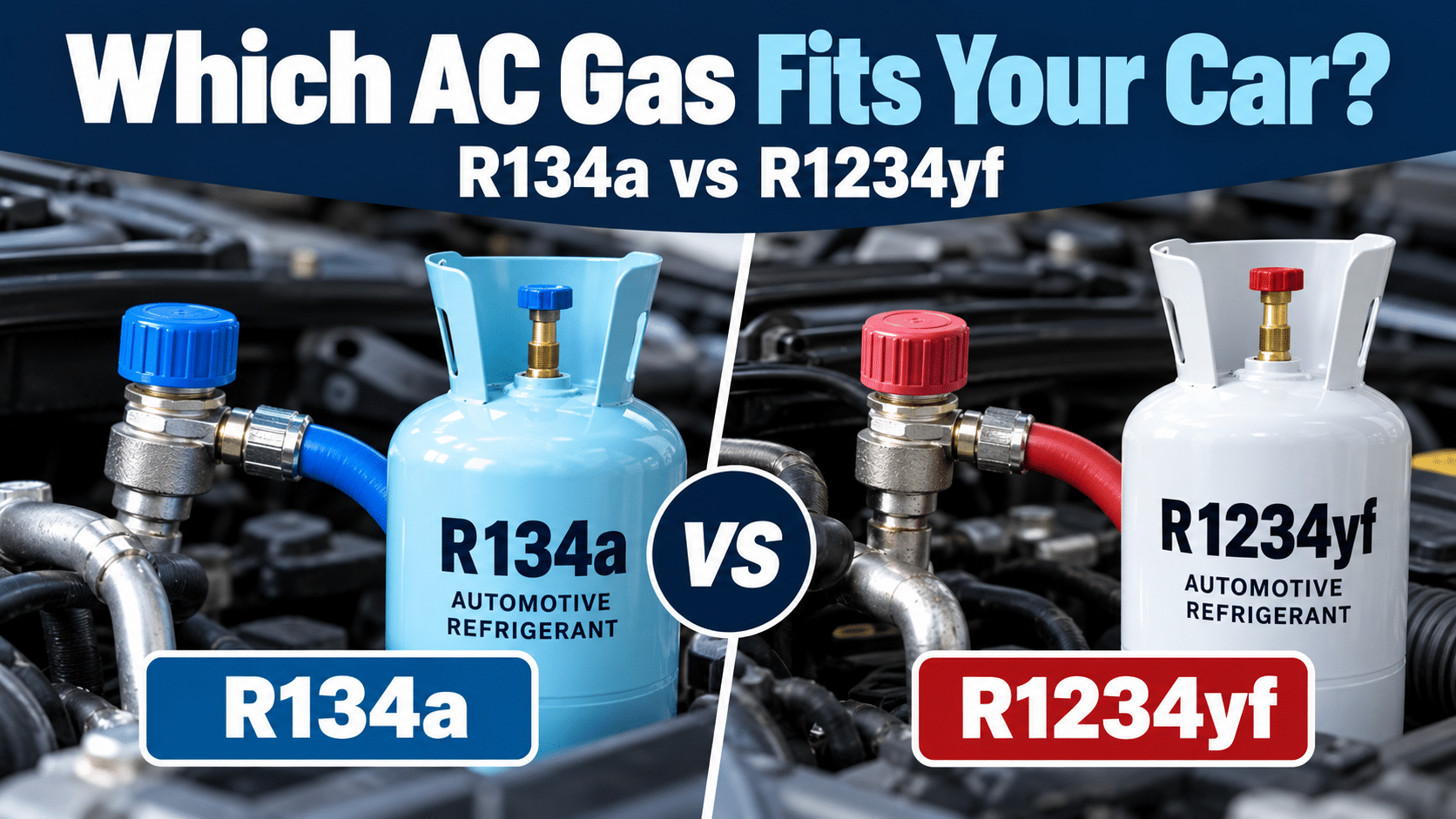
21 May Which AC Gas Fits Your Car? R134a vs R1234yf
Which AC Gas Does My Car Use? R134a vs R1234yf Explained
Wondering which AC gas fits your car? Whether you’re booking an air conditioning regas, arranging repairs or trying to understand why your aircon isn’t cooling, identifying the correct refrigerant is an important first step.
Most conventional passenger vehicles on Australian roads use one of two automotive air conditioning refrigerants: R134a or HFO-1234yf (R1234yf).
Both are designed to remove heat from your vehicle’s cabin, but they have different environmental characteristics, servicing requirements and safety classifications.
The correct refrigerant depends on your vehicle’s original specifications—not simply its age or make.
At Keepin Cool Auto Air, we provide owner-operated mobile car air conditioning servicing throughout Brisbane Bayside and Redland City.
With over 40 years of hands-on experience, Jamie works with both R134a and HFO-1234yf systems, using specialist equipment and a diagnostic-first approach.
This guide explains how to identify the correct AC gas, understand the differences between refrigerants and avoid costly mistakes when arranging a regas.
Quick Answer: Which Air Conditioning Gas Fits My Car?
The most reliable starting point is the vehicle manufacturer’s air conditioning specification.
| What you find | What it means |
|---|---|
| Label marked R134a or HFC-134a | The system was designed for R134a |
| Label marked R1234yf or HFO-1234yf | The system was designed for R1234yf |
| Label marked R744 or CO₂ | The system uses a different, high-pressure refrigerant |
| No visible refrigerant label | Check manufacturer information before servicing |
| Vehicle has been modified or incorrectly serviced | The actual contents may need specialist refrigerant analysis |
Important: The manufacturer’s label identifies the specified refrigerant. It cannot guarantee that the system still contains the correct gas after previous repairs or servicing.
Never choose a refrigerant based solely on the vehicle’s registration year, the appearance of the service fittings or advice from a generic model-year chart.
How to Find Out Which AC Gas Your Vehicle Uses
There are several practical ways to determine which refrigerant your vehicle was designed to use.
1. Check the Air Conditioning Label Under the Bonnet
Many vehicles have a refrigerant information label in the engine compartment.
Possible locations include:
- Underneath the bonnet.
- On the radiator support panel.
- Near the condenser or refrigerant pipework.
- On an engine-bay panel.
- Another location specified by the manufacturer.
The label may identify the refrigerant, refrigerant charge quantity and compressor oil specification.
For example, an R134a system might have a label displaying:
Refrigerant: R134a
Charge quantity: [manufacturer-specified amount in grams]
The charge quantity is specific to the vehicle. It must not be copied from another model.
2. Check the Owner’s Manual
Some vehicle manuals include the refrigerant and lubricant specifications in their technical information section.
However, a manual covering several vehicle markets may list different refrigerants.
If your manual shows both R134a and R1234yf, further confirmation may be required.
3. Check Manufacturer Service Information
The vehicle identification number (VIN), build date and engine specification can help identify the correct factory refrigerant through manufacturer service information.
This is particularly useful when a model was manufactured with different air conditioning systems.
4. Ask an Automotive Air Conditioning Specialist
If the label is missing or the specification remains uncertain, an automotive air conditioning specialist can help establish the original system requirements.
If previous refrigerant contamination is suspected, the actual contents may need testing with a suitable refrigerant analyser before servicing.
R134a vs R1234yf: What’s the Difference?
Both refrigerants perform a similar cooling function, but they are not interchangeable.
| Feature | R134a | HFO-1234yf |
|---|---|---|
| Refrigerant family | HFC | HFO |
| Common application | Many older and some newer vehicles | Many newer vehicles |
| Global warming potential | Relatively high | Very low |
| Safety classification | A1 | A2L |
| Flammability classification | Non-flammable under standard classification | Mildly flammable |
| Service connections | R134a-specific | R1234yf-specific |
| Servicing equipment | Suitable R134a equipment | Suitable R1234yf equipment |
| Can the gases be mixed? | No | No |
Although the refrigerants have similar cooling characteristics, their safety classifications, service equipment and associated system requirements differ.
That’s why professional servicing must follow the vehicle manufacturer’s specifications.
What Is R134a Car Air Conditioning Gas?
R134a became widely used in automotive air conditioning systems after the industry moved away from the older R12 refrigerant.
It was fitted to millions of cars, SUVs, utes and light commercial vehicles.
R134a has no ozone-depletion potential, but it has a relatively high global warming potential.
Many vehicles on Australian roads continue to use R134a, and the refrigerant remains important for maintaining systems originally designed for it.
Keepin Cool provides professional R134a Car Aircon Regas services for suitable vehicles.
For more information specifically about identifying an R134a vehicle, read our Does Your Car Use R134a Refrigerant? guide.
What Is HFO-1234yf Car Air Conditioning Gas?
HFO-1234yf, also called R1234yf, is a lower-global-warming refrigerant increasingly used in modern vehicle air conditioning systems.
It was adopted by vehicle manufacturers as part of efforts to reduce the environmental impact of automotive refrigerants.
R1234yf has a very low global warming potential compared with R134a.
However, it is classified as A2L mildly flammable, meaning appropriate servicing equipment and safety procedures are essential.
Vehicles designed for R1234yf also have refrigerant-specific service connections.
Keepin Cool uses dedicated equipment for suitable HFO-1234yf vehicle servicing.
Learn more about our R1234yf Car Aircon Regas service.
Does the Vehicle’s Year Tell You Which AC Gas It Uses?
Not reliably.
Different manufacturers introduced R1234yf at different times, and the same model may use different refrigerants depending on the country or production specification.
A newer car is not guaranteed to use R1234yf, and a vehicle manufactured during the transition period cannot be identified accurately using its year alone.
Australian-market vehicle specifications may also differ from overseas models.
For example, a model sold in Australia may not have the same refrigerant specification as an otherwise similar vehicle sold in Europe.
Our recommendation: Use the model year as background information, but confirm the refrigerant using the manufacturer’s specification.
We deliberately avoid publishing a universal vehicle-year chart because it could lead customers to select the wrong gas.
Can You Identify the Refrigerant From the Service Fittings?
R134a and R1234yf systems use different service connections to help prevent incompatible servicing equipment from being attached.
However, the fittings indicate the system’s intended configuration—not necessarily what refrigerant is currently inside.
Problems can arise if a vehicle has previously been serviced incorrectly or modified.
A system might contain a contaminated refrigerant mixture even though its original fittings remain unchanged.
Professional identification may therefore involve checking manufacturer records and, where there are concerns about the actual contents, using an appropriate refrigerant analyser.
For a more detailed explanation, see our R134a vs R1234yf Car AC Fittings Guide.
Why You Should Never Mix R134a and R1234yf
R134a and R1234yf must not be mixed.
Adding the wrong refrigerant can cause problems with system operation, servicing equipment and refrigerant recovery.
Possible consequences include:
- Contamination of the refrigerant circuit.
- Reduced or unpredictable cooling performance.
- Incorrect servicing procedures.
- Problems with refrigerant recovery and recycling.
- Additional costs to investigate and correct contamination.
- Potential component compatibility and reliability issues.
If a system is suspected of containing the wrong refrigerant, it should be assessed before normal recovery or regassing equipment is connected.
Appropriate refrigerant identification and handling procedures help prevent the contamination from spreading to servicing equipment.
A refrigerant should never be deliberately vented into the atmosphere to determine what gas is present.
Can You Change an R134a Vehicle to R1234yf?
An R134a vehicle should not simply be recharged with R1234yf.
Systems designed for R1234yf incorporate specific safety and design requirements because the refrigerant is classified as mildly flammable.
An R134a system was not originally designed to meet those requirements.
The Australian Refrigeration Council advises against converting R134a vehicle systems to R1234yf.
For vehicles originally designed for R134a, the normal approach is to continue servicing them with the correct specified refrigerant.
Never assume that fitting different service adapters makes a conversion safe or acceptable.
For further information, see the Australian Refrigeration Council’s R1234yf guidance.
What About R744 and Other Automotive Refrigerants?
Some vehicle manufacturers have also adopted R744 (carbon dioxide) air conditioning systems.
These operate at considerably higher pressures than conventional R134a or R1234yf systems and require different specialist equipment.
Older vehicles may have been manufactured with R12 or subsequently converted to other refrigerants.
These systems should not be treated as interchangeable with R134a or R1234yf.
Keepin Cool’s mobile regas service focuses on suitable conventional vehicles using R134a or HFO-1234yf.
We do not provide R744 servicing.
If your vehicle uses a different refrigerant, the appropriate specialist equipment and service provider will be required.
Why Does R1234yf Regassing Cost More Than R134a?
R1234yf refrigerant generally costs substantially more than R134a.
It also requires equipment suitable for its different safety classification.
This contributes to the price difference between the two types of regassing.
At Keepin Cool, our current mobile regas prices are:
| Service | Price |
|---|---|
| R134a car aircon regas | $270 |
| HFO-1234yf car aircon regas | From $590 |
| Car AC inspection and diagnostics | $170 |
The R1234yf starting price covers suitable systems requiring up to 600 grams of refrigerant. Additional refrigerant charges may apply where the specified quantity is greater.
Our $270 R134a regas includes Trace-A-Gas leak testing, vacuum evacuation, compressor oil as required, UV dye and final cooling checks.
The regas charge only applies when the service can be successfully completed.
If a significant leak or another fault prevents regassing and you choose not to proceed with the necessary repairs, a $170 inspection fee applies.
Additional repairs and diagnostic work are discussed before proceeding.
View our complete Car Air Conditioning Prices Brisbane service page for further information.
Does Your Car Need Regassing or Is Something Else Wrong?
Knowing which refrigerant your vehicle uses is important, but it doesn’t explain why the air conditioning has stopped cooling.
A vehicle can blow warm air for several different reasons.
These include:
Refrigerant leaks: A leaking condenser, hose, fitting or evaporator can cause refrigerant loss.
Compressor problems: A faulty compressor clutch, electronic control valve or internal component may prevent correct cooling.
Electrical faults: Wiring, pressure sensors, control modules and other electrical problems can affect system operation.
Condenser airflow problems: A faulty cooling fan can reduce cooling performance, particularly when stopped in traffic.
Ventilation problems: A restricted cabin filter or airflow fault can reduce the air reaching the cabin.
Simply adding refrigerant will not repair those faults.
That’s why Keepin Cool inspects and tests the air conditioning system before recommending a regas.
Read more about our Car AC Inspection & Fault Diagnostics and Car AC Leak Detection services.
What Happens During a Professional Car Aircon Regas?
A professional regas involves more than connecting a refrigerant cylinder.
When the vehicle and system are suitable, our process includes:
- Confirming the vehicle’s refrigerant requirements.
- Inspecting the system and checking for relevant faults.
- Performing appropriate refrigerant leak testing.
- Recovering remaining refrigerant where required.
- Evacuating the system under vacuum.
- Adding the correct refrigerant charge and compressor oil as required.
- Checking cooling performance and system operation.
The system is charged according to the manufacturer’s specifications rather than relying on a general estimate.
If testing reveals a fault, we explain the findings and available repair options.
We do not recommend regassing a system with a significant unresolved leak.
What Does ARCtick Authorisation Mean?
The Australian Refrigeration Council administers refrigerant handling licences and refrigerant trading authorisations under the Australian regulatory framework.
R134a is a controlled HFC refrigerant, and the applicable Commonwealth licensing and authorisation requirements apply to businesses and technicians handling it.
Pure R1234yf is not controlled under the same Commonwealth ozone and synthetic greenhouse gas licensing provisions. However, it still requires appropriate flammable-refrigerant safety practices, suitable equipment and compliance with other applicable obligations.
Keepin Cool Auto Air holds ARCtick authorisation AU13448.
For business authorisation information, visit the official ARCtick authorised business search.
Correct refrigerant handling is important for vehicle safety, environmental protection and preventing system contamination.
Common Mistakes When Choosing Car AC Refrigerant
Guessing From the Vehicle’s Age
A vehicle’s build year alone is not reliable enough to identify its refrigerant.
Assuming All Modern Cars Use R1234yf
Refrigerant specifications vary by make, model and market.
Relying Only on Service Fittings
The fittings show how the system was designed, but not necessarily whether its contents have been contaminated.
Adding Refrigerant Without Investigating Poor Cooling
Warm air can result from compressor, electrical and airflow faults—not just low refrigerant.
Using an Incorrect Refrigerant or Oil
Wrong refrigerant or incompatible lubricant can create expensive servicing and reliability problems.
Regassing a System With an Unresolved Leak
If refrigerant is escaping, simply recharging it does not repair the leaking component.
Correct identification and diagnosis should always come before refrigerant charging.
Frequently Asked Questions About Car AC Gas
How do I know if my car uses R134a or R1234yf?
Check the vehicle manufacturer’s refrigerant label, owner’s manual or model-specific service information. If the system has been modified or contaminated, the actual refrigerant may need specialist testing.
Do all cars built after 2016 use R1234yf?
No. Manufacturers adopted R1234yf at different times, and specifications vary between vehicles and markets. Always verify the specific vehicle.
Can I put R134a in an R1234yf system?
No. The two refrigerants are not interchangeable and should not be mixed.
Is R1234yf dangerous because it’s flammable?
R1234yf is classified as A2L mildly flammable. Vehicle systems designed for it incorporate relevant safety requirements, and servicing must use suitable equipment and procedures.
Can I tell which gas is in my car by looking at the pressure?
No. Pressure readings alone cannot reliably identify the refrigerant or confirm whether the system contains a contaminated mixture.
What should I do if my car has the wrong refrigerant?
Stop further regassing attempts and seek specialist refrigerant identification and assessment. The appropriate recovery and repair process depends on what’s present in the system.
Is R134a still used in Australian cars?
Yes. Many existing vehicles were designed for R134a, and those systems continue to require appropriate maintenance and servicing.
Why does a R1234yf regas cost more?
The refrigerant is more expensive, and suitable dedicated equipment and specific safety practices are required.
How often should my car air conditioning be regassed?
At Keepin Cool, we recommend having your car air conditioning regassed every two years and no later than four years. Before regassing, we inspect the system for leaks or faults to ensure it’s suitable for recharging.
Do you service electric vehicles or hybrids?
No. Keepin Cool focuses on suitable conventional passenger cars, SUVs, utes and 4WDs. We don’t service electric vehicles, hybrids or trucks.
Why Choose Keepin Cool Auto Air?
Keepin Cool is an owner-operated mobile automotive air conditioning specialist established in 2006.
With over 40 years of hands-on experience, Jamie provides professional air conditioning regassing, refrigerant leak detection, fault diagnostics and repairs.
Customers benefit from:
- Direct contact with the technician servicing their vehicle.
- Specialist R134a and HFO-1234yf equipment.
- A diagnostic-first approach.
- Professional refrigerant leak testing.
- Clear advice before repairs proceed.
- Mobile servicing at suitable homes and workplaces.
- ARCtick authorisation AU13448.
We focus on identifying the correct vehicle requirements and the actual cooling fault before recommending work.
Mobile Car Air Conditioning Across Brisbane Bayside & Redland City
Keepin Cool provides mobile automotive air conditioning services across Brisbane Bayside and Redland City.
Our coverage includes selected suburbs such as Wynnum, Manly, Lota, Tingalpa, Capalaba, Cleveland, Birkdale, Alexandra Hills, Wellington Point, Victoria Point, Thornlands and Redland Bay.
Explore our regional service areas:
Our mobile service is available by appointment at suitable homes and workplaces.
Not Sure Which AC Gas Fits Your Car?
If you’re unsure whether your vehicle uses R134a or HFO-1234yf, don’t guess or purchase refrigerant based on the model year alone.
Keepin Cool Auto Air can help establish your vehicle’s specified refrigerant requirements and arrange suitable mobile air conditioning servicing.
Call or SMS Jamie on 0415 761 019.
Alternatively, use our Quick SMS Quote Form.
Please include your name, suburb, vehicle make, model, year and a brief description of any air conditioning problems.
Keepin Cool Auto Air — Owner-operated mobile car air conditioning specialists with over 40 years of experience.