

08 Aug Does Your Car Use R134a Refrigerant? How to Check
Does Your Car Use R134a Refrigerant? Here’s How to Tell
Does your car use R134a refrigerant or the newer HFO-1234yf gas? If you’re booking an air conditioning regas or repair, identifying the correct refrigerant is important.
R134a was widely used in passenger vehicle air conditioning systems for many years. More recently, vehicle manufacturers have introduced HFO-1234yf, which has a much lower environmental impact.
The difficulty is that you cannot reliably identify the refrigerant from the vehicle’s age alone. Different manufacturers changed refrigerants at different times, and specifications can vary between vehicle models and markets.
At Keepin Cool Auto Air, we have over 40 years of hands-on experience servicing automotive air conditioning systems. Our owner-operated mobile service covers Brisbane Bayside and Redland City.
This guide explains how to check whether your vehicle was designed to use R134a, where to find the manufacturer’s refrigerant information and what to do if the label is missing.
Quick Answer: How Do I Know If My Car Uses R134a?
The best starting point is the manufacturer’s air conditioning information.
You can usually determine the specified refrigerant by:
- Checking the refrigerant label under the bonnet.
- Looking in the vehicle owner’s manual or manufacturer’s service information.
- Confirming the specification using the vehicle identification number (VIN).
- Having an automotive AC specialist verify the vehicle’s refrigerant requirements.
The air conditioning label may display R134a, R-134a or the alternative designation HFC-134a.
Some newer vehicles instead specify R1234yf or HFO-1234yf.
The label identifies what the system was designed to use. However, if the vehicle has previously been incorrectly serviced, modified or contaminated, a professional refrigerant identifier may be needed to confirm the actual gas inside.
Don’t rely on the model year or service-port appearance alone when deciding which refrigerant to use.
1. Check Your Vehicle’s Air Conditioning Label
The first place to look is under the bonnet.
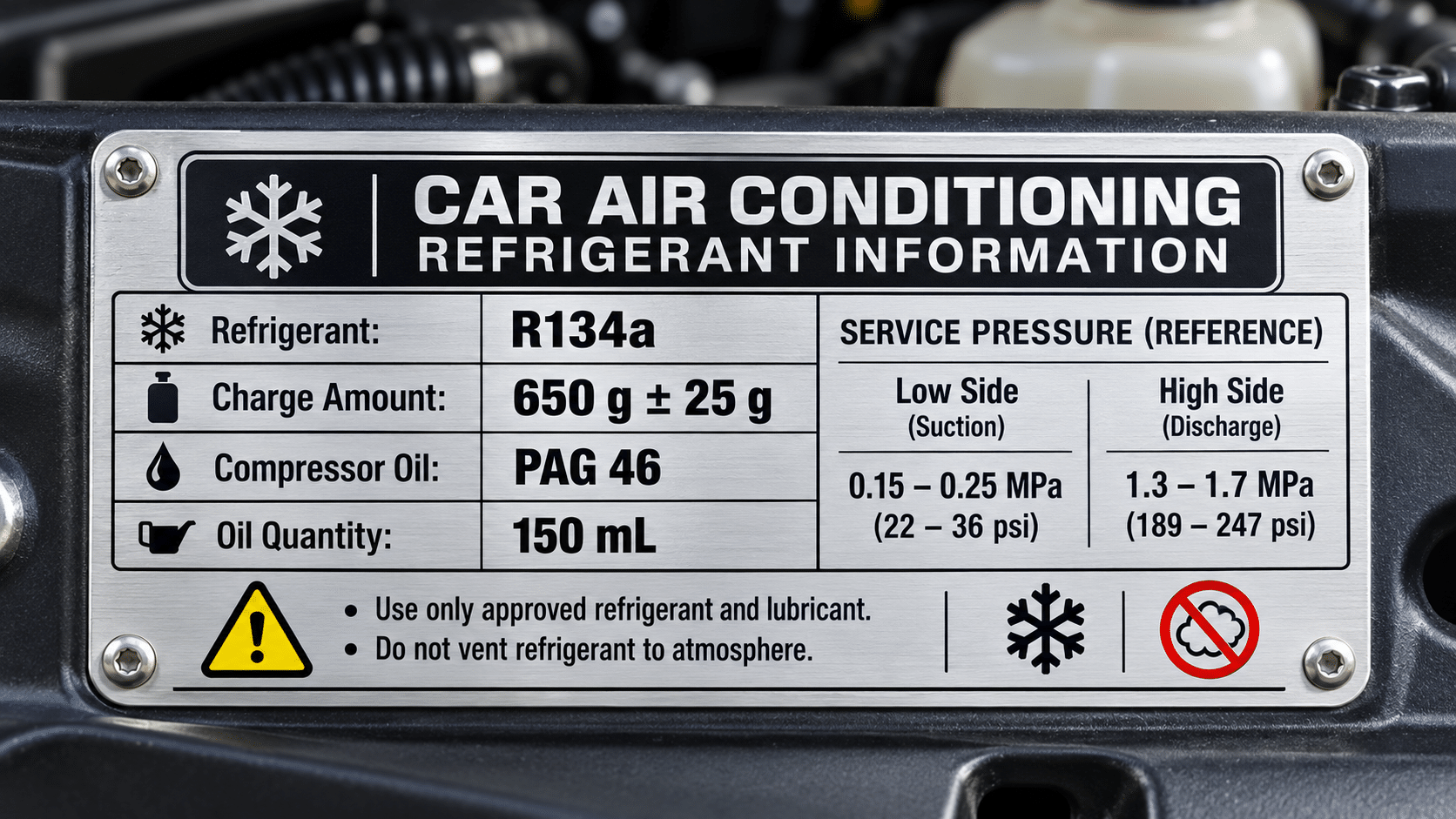
Many vehicles have a label showing the air conditioning refrigerant specification and factory charge quantity.
Depending on the make and model, the label may be located:
- On the underside of the bonnet.
- On the radiator support panel.
- On an engine-bay panel.
- Near the air conditioning components.
- In another manufacturer-specified location.
What Does an R134a Label Look Like?
The important information is the refrigerant designation.
Look for wording such as:
Refrigerant: R134a
The label may also display:
- Refrigerant charge quantity in grams.
- Compressor oil specification.
- Oil quantity or system lubrication information.
- Air conditioning servicing warnings.
- Manufacturer part or specification numbers.
For example, a label might specify an R134a charge quantity expressed in grams. That quantity belongs to the particular vehicle and shouldn’t be applied to another model.
What If You Cannot Find the Label?
Not every vehicle has a visible, legible refrigerant label.
Labels can become damaged, obscured, removed or difficult to locate after repairs.
If yours is missing, use the owner’s manual or manufacturer service information to determine the correct specification.
If you’re still unsure, have the vehicle checked by an automotive air conditioning specialist before regassing.
2. Can You Tell Whether a Car Uses R134a From Its Year?
The vehicle’s year can provide a clue, but it’s not a reliable way to confirm the refrigerant.
R134a became widely used in vehicles during the 1990s and remained common for many years.
HFO-1234yf was introduced progressively as manufacturers adopted lower-global-warming refrigerants.
General Guide
| Vehicle category | What you should know |
|---|---|
| Many vehicles built during the 1990s and 2000s | R134a was widely used |
| Vehicles built during the refrigerant transition | Either R134a or R1234yf may be specified |
| Many newer vehicles | R1234yf is increasingly common, but not universal |
| Vehicles with previous AC modifications | Manufacturer specifications and actual contents may differ |
These are general observations, not a refrigerant identification chart.
The correct refrigerant can vary with the vehicle’s make, model, build date and country of manufacture.
The safest approach is to check the actual vehicle specification instead of assuming every car changed to R1234yf in the same year.
3. Check the Owner’s Manual and Vehicle Identification Number
If the under-bonnet label is missing, the vehicle manufacturer’s documentation may help.
The owner’s manual sometimes lists the air conditioning refrigerant and lubricant specifications.
Where the manual covers several markets or vehicle versions, it may list more than one refrigerant.
In that situation, the vehicle identification number (VIN) can help identify the exact factory specification through manufacturer parts or service information.
When requesting a mobile air conditioning quote, providing your vehicle make, model and year is a good starting point.
If the refrigerant specification is uncertain, further vehicle information may be required.
4. Can You Identify R134a From the Service Fittings?
R134a and R1234yf air conditioning systems use different service fittings.
These fittings are deliberately designed to reduce the risk of connecting incompatible servicing equipment.
On most conventional vehicle systems, the service ports are located on the high-pressure and low-pressure sides of the refrigerant circuit.
However, service-port appearance is not sufficient proof of the refrigerant inside the system.
A vehicle may have been incorrectly charged, modified or serviced with unsuitable equipment.
For that reason, the specified refrigerant should be checked using the appropriate vehicle information, with refrigerant analysis where the actual system contents are uncertain.
For more technical information, read our R134a vs R1234yf Car AC Fittings Guide.
5. What Is R134a Refrigerant?
R134a is a hydrofluorocarbon (HFC) refrigerant used extensively in automotive air conditioning systems.
It replaced the older R12 refrigerant in many vehicles and became a standard choice for passenger-car air conditioning.
R134a offers effective cooling when used in a correctly designed and maintained system.
However, it has a relatively high global warming potential compared with newer alternatives.
Its properties include:
- Hydrofluorocarbon refrigerant.
- Zero ozone-depletion potential.
- A1 safety classification under standard conditions.
- Widely used in older automotive air conditioning systems.
- Requires appropriate refrigerant-handling and servicing equipment.
Although manufacturers have increasingly adopted newer refrigerants, R134a remains an important refrigerant for vehicles already designed to use it.
Keepin Cool provides specialist R134a Car Aircon Regas services across Brisbane Bayside and Redland City.
6. How Is R134a Different From R1234yf?
Both refrigerants are used to transfer heat from the vehicle cabin to the outside air.
However, they differ in environmental impact, safety classification, service fittings and servicing requirements.
| Feature | R134a | HFO-1234yf |
|---|---|---|
| Refrigerant family | HFC | HFO |
| Cooling purpose | Automotive air conditioning | Automotive air conditioning |
| Global warming potential | Relatively high | Very low |
| Safety classification | A1 | A2L, mildly flammable |
| Service fittings | R134a-specific | R1234yf-specific |
| Servicing equipment | Suitable R134a equipment | Suitable R1234yf equipment |
| Interchangeable? | No | No |
R1234yf was developed as a lower-global-warming alternative for modern vehicle air conditioning systems.
Although the refrigerants have similar operating characteristics, they are not interchangeable.
Their systems may use different components, oils and safety requirements.
Using the wrong refrigerant can contaminate servicing equipment, create safety risks and affect air conditioning reliability.
7. Can R134a and R1234yf Be Mixed?
No. R134a and R1234yf must not be mixed.
Each air conditioning system must be serviced using the refrigerant specified for its design, subject to applicable manufacturer and regulatory requirements.
Mixing refrigerants can create problems involving:
- Incorrect system composition.
- Contaminated refrigerant recovery equipment.
- Unsuitable servicing procedures.
- Component and lubricant compatibility.
- Reduced system reliability.
- Additional repair and recovery costs.
If there is reason to suspect that a vehicle contains the wrong refrigerant, an appropriate refrigerant identifier can help establish the system’s contents before recovery or servicing.
A refrigerant should never be deliberately released into the atmosphere to determine what is inside the system.
8. Can You Convert an R134a System to R1234yf?
Switching refrigerants isn’t as simple as replacing one gas with another.
A vehicle designed for R134a may have different refrigerant-system components, fittings, lubricant requirements and safety specifications from a vehicle designed for R1234yf.
An unauthorised or unsuitable conversion can affect safety and reliability.
Any proposed conversion must be assessed against manufacturer requirements and relevant Australian standards and regulations.
For most owners of conventional R134a vehicles, the practical approach is to maintain and repair the system using its specified refrigerant rather than assuming a conversion is necessary.
9. What Happens If Your R134a Car Air Conditioning Isn’t Cold?
If your vehicle uses R134a and the air conditioning is blowing warm air, the problem isn’t necessarily caused by low refrigerant.
Possible causes include:
Refrigerant leaks: Condensers, hoses, seals and other components may allow refrigerant to escape.
Compressor problems: A faulty clutch, control valve or internal compressor component can affect cooling.
Electrical faults: Sensors, wiring or other controls may prevent correct operation.
Cooling fan problems: Poor condenser airflow can reduce performance, especially when stationary.
Restricted airflow: Cabin filters or ventilation faults may reduce airflow through the dashboard vents.
A proper inspection can distinguish these faults before unnecessary refrigerant or replacement parts are purchased.
At Keepin Cool, we diagnose the problem first and explain whether the vehicle needs a regas, leak repair or further fault investigation.
For more information, see our Car AC Inspection & Fault Diagnostics service.
10. How Much Does an R134a Regas Cost?
At Keepin Cool, our mobile R134a car aircon regas costs $270.
The service includes:
- Initial air conditioning inspection.
- Trace-A-Gas leak testing.
- Refrigerant recovery where required.
- Vacuum evacuation.
- Compressor oil top-up as required.
- UV leak-detection dye where appropriate.
- Refrigerant recharge to manufacturer specification.
- Final cooling-performance checks.
The regas charge only applies when the regas can be successfully completed.
If a significant leak or another fault prevents regassing and you choose not to proceed with the required repair, a $170 inspection fee applies.
We explain additional repairs and charges before proceeding.
For vehicles designed for HFO-1234yf, R1234yf regassing starts from $590 for systems requiring up to 600 grams.
11. Why Professional Refrigerant Identification Matters
Correct refrigerant identification protects more than the air conditioning compressor.
It helps ensure that the right servicing equipment, refrigerant quantity, oil and safety procedures are used.
A professional automotive AC technician should establish the vehicle’s specified refrigerant before starting service work.
Where contamination or previous incorrect servicing is suspected, additional refrigerant identification may be necessary.
This is particularly important because the refrigerant label indicates what the manufacturer specified, not necessarily what another person may have added during previous servicing.
Keepin Cool takes a diagnostic-first approach to mobile automotive air conditioning servicing.
Our aim is to identify the correct system requirements and address any faults before proceeding with a recharge.
Frequently Asked Questions About R134a Refrigerant
Does my car use R134a or R1234yf?
Check the manufacturer’s air conditioning label, owner’s manual or relevant vehicle service information. The vehicle’s year alone cannot reliably identify the refrigerant.
Where is the R134a label on my car?
It may be located under the bonnet, on a radiator support panel or near the engine-bay air conditioning components. The location varies by vehicle.
What if my car doesn’t have a refrigerant label?
Check the manufacturer’s documentation or obtain professional assistance. If the system may have been modified or incorrectly charged, refrigerant analysis may also be needed.
Can a car built after 2017 still use R134a?
Yes. Refrigerant selection varies by manufacturer, model and market. Not every vehicle changed to R1234yf at the same time.
Can I put R1234yf into my R134a car?
Do not substitute refrigerants without a conversion that satisfies the applicable manufacturer requirements, standards and regulations. An R134a system should ordinarily be maintained using its specified refrigerant.
Do R134a and R1234yf use the same service ports?
No. These refrigerants use different service fittings. However, the fittings alone cannot establish whether the system’s actual contents have been contaminated.
Does R134a need to be topped up regularly?
Vehicle AC systems are designed to retain their refrigerant. If refrigerant is being lost repeatedly, the cause should be investigated rather than simply adding gas.
How often should my car air conditioning be regassed?
At Keepin Cool, we recommend having your car air conditioning regassed every two years and no later than four years. Before regassing, we inspect the system for leaks or faults to ensure it is suitable for recharging.
Can you regas my R134a vehicle at home?
Yes. Keepin Cool provides mobile R134a air conditioning servicing at suitable homes and workplaces throughout Brisbane Bayside and Redland City.
Why Choose Keepin Cool Auto Air?
Keepin Cool is an owner-operated automotive air conditioning specialist established in 2006.
With over 40 years of hands-on experience, Jamie provides professional mobile car air conditioning regassing, leak detection, diagnostics and repairs.
Our service includes:
- Specialist R134a and HFO-1234yf equipment.
- Vehicle refrigerant specification checks.
- Professional refrigerant leak detection.
- Trace-A-Gas pressure testing.
- Compressor and electrical fault diagnosis.
- Suitable car AC repairs.
- Clear pricing and repair recommendations.
Keepin Cool holds ARCtick authorisation AU13448.
You can check our credentials through the official ARCtick licence checker.
Mobile R134a Car Air Conditioning Service — Brisbane Bayside & Redlands
Keepin Cool provides mobile automotive air conditioning services throughout Brisbane Bayside and Redland City.
Our coverage includes selected suburbs such as Wynnum, Manly, Lota, Capalaba, Cleveland, Birkdale, Alexandra Hills, Wellington Point, Victoria Point, Thornlands and Redland Bay.
We focus on suitable conventional passenger cars, SUVs, utes and 4WDs.
We do not service trucks, hybrid vehicles or electric vehicles.
For local coverage information, visit:
Not Sure Which Refrigerant Your Car Uses?
If you’re unsure whether your vehicle requires R134a or HFO-1234yf, don’t guess.
Contact Keepin Cool Auto Air with your vehicle make, model, year and suburb.
We’ll help establish the vehicle’s refrigerant requirements and confirm whether it’s suitable for our mobile service.
Call or SMS Jamie on 0415 761 019.
Alternatively, use our Quick SMS Quote Form and include your vehicle details and any cooling problems you’re experiencing.
Keepin Cool Auto Air — Owner-operated mobile car air conditioning specialists servicing Brisbane Bayside and Redland City.