

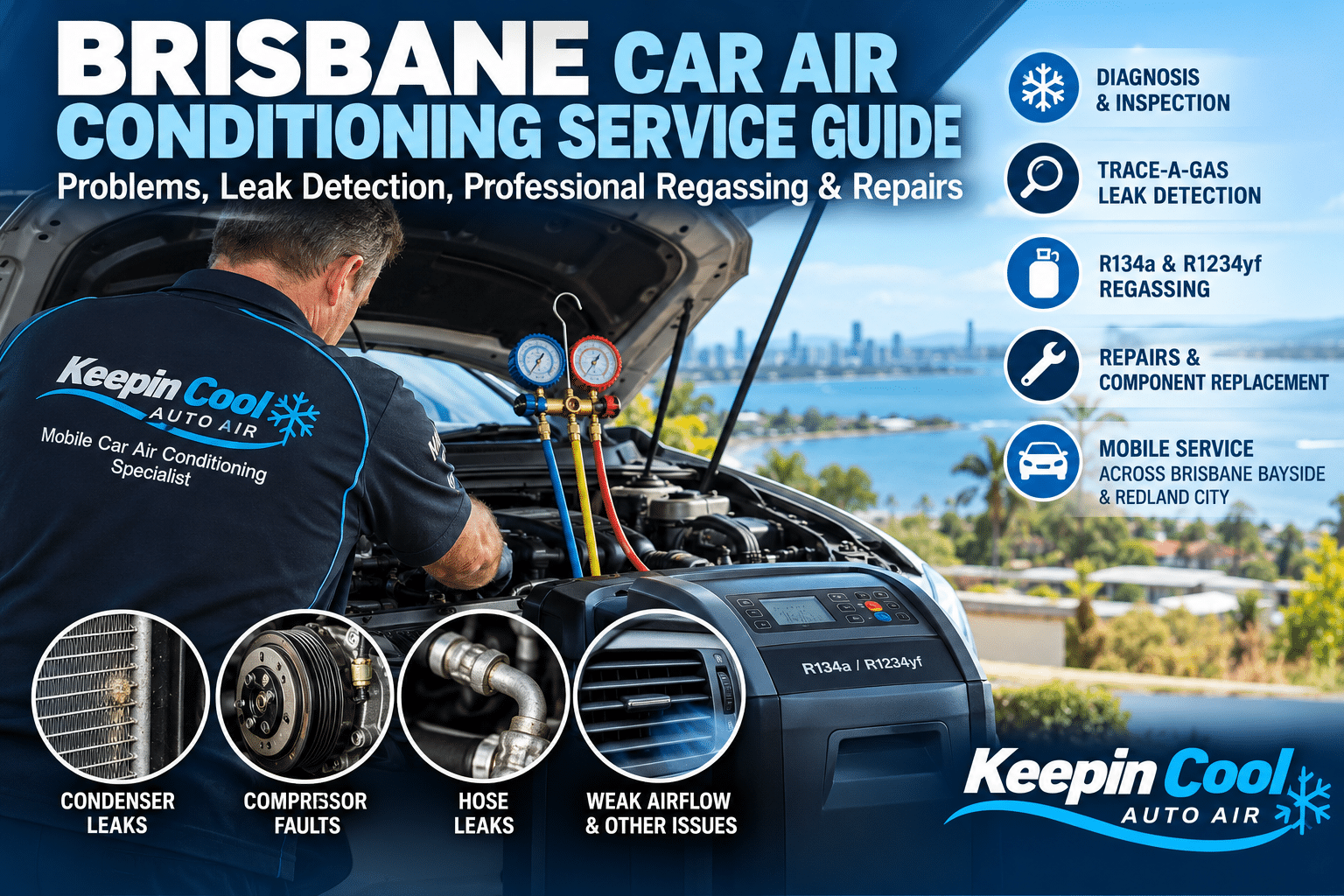
21 Aug Brisbane Car Air Conditioning Service Guide
Brisbane Car AC Guide – Problems, Leak Detection & Professional Regassing
If your car air conditioning is blowing warm air, cooling intermittently or struggling in Brisbane’s hot and humid weather, the answer isn’t always another regas.
This Brisbane car AC guide explains common automotive air conditioning faults, how professional technicians diagnose them and what to expect from a mobile air conditioning service.
A refrigerant leak, faulty compressor, blocked cabin filter or electrical problem can all affect cooling performance. However, each requires a different approach to diagnosis and repair.
At Keepin Cool Auto Air, we specialise in mobile car air conditioning inspections, Trace-A-Gas leak detection, regassing and suitable repairs throughout Brisbane Bayside and Redland City.
With over 40 years of hands-on automotive air conditioning experience, our approach is straightforward: inspect and leak-test first, then regas if the system passes.
Understanding the symptoms can help you avoid unnecessary repairs and make a more informed decision about your vehicle.
How Does Your Car Air Conditioning System Work?
Your vehicle’s air conditioning is a sealed refrigeration system designed to remove heat and moisture from the cabin.
Several components work together to circulate refrigerant and control the temperature of the air entering the vehicle.
The main components include:
- Compressor: Circulates refrigerant through the system and increases refrigerant pressure.
- Condenser: Located near the front of the vehicle, it releases heat from the refrigerant into the outside air.
- Receiver-drier or accumulator: Depending on system design, helps manage refrigerant flow and moisture.
- Expansion valve or orifice tube: Controls refrigerant flow and the pressure reduction entering the evaporator.
- Evaporator: Absorbs heat from cabin air as refrigerant evaporates.
- Blower motor and cabin filter: Move filtered air across the evaporator and through the dashboard vents.
The system also relies on pressure sensors, electrical controls and condenser airflow.
A fault in any of these areas can reduce cooling performance, even when the refrigerant charge is correct.
This is why checking the complete system is more useful than automatically assuming it needs additional gas.
Common Car Air Conditioning Problems in Brisbane
Different air conditioning faults often produce recognisable symptoms.
The following guide explains possible causes, although professional testing is needed to confirm the actual problem.
| What You Notice | Possible Causes |
|---|---|
| Aircon blowing warm air | Refrigerant leak, compressor fault, electrical problem |
| Cold while driving, warm when stopped | Condenser fan fault, poor airflow, pressure problem |
| Cold initially, then gradually warm | Intermittent compressor control, evaporator icing, electrical fault |
| Weak airflow from vents | Cabin filter restriction, blower motor or ventilation fault |
| Cooling lost soon after regassing | Refrigerant leak or unresolved system fault |
| Musty smell from vents | Cabin filter contamination or microbial build-up |
| Unusual noises when AC operates | Compressor, pulley, bearing or blower-related problems |
These are diagnostic clues, not definitive diagnoses. Several faults can produce similar symptoms.
1. Car Aircon Blowing Warm Air
Warm air from the dashboard vents is one of the most common reasons drivers request an air conditioning service.
A low refrigerant charge can reduce cooling performance, but other problems may produce the same result.
Possible causes include:
- Refrigerant loss through a leaking condenser or hose.
- Compressor clutch or control problems.
- Faulty refrigerant pressure sensors.
- Electrical relay or wiring faults.
- Expansion valve restrictions.
- Temperature blend-door problems.
Some modern vehicles use variable-displacement compressors that operate differently from traditional clutch-controlled compressors.
A compressor pulley turning doesn’t necessarily prove that the compressor is operating correctly.
Professional testing helps establish whether the problem involves refrigerant pressure, compressor control or another component.
2. Aircon Cold While Driving but Warm at Traffic Lights
Does your air conditioning work reasonably well on the road but become warm when stopped at traffic lights?
This often points towards a problem with condenser airflow.
While driving, air passes through the condenser at the front of the vehicle. When stationary, the electric cooling fan becomes particularly important.
If the fan isn’t operating correctly, the condenser may struggle to release heat, resulting in reduced cooling performance and abnormal refrigerant pressures.
Possible causes include a failed cooling fan motor, electrical relay, fan controller or restricted condenser airflow.
However, refrigerant charge and other system faults must also be considered.
3. Car Aircon Starts Cold Then Stops Cooling
Some vehicles produce cold air when first started but gradually lose cooling during longer journeys.
Possible causes include:
- Intermittent compressor clutch operation.
- Compressor control valve faults.
- Electrical components failing when hot.
- Evaporator icing and reduced airflow.
- Refrigerant flow or pressure control problems.
An important clue is whether airflow remains strong when the air becomes warm.
If airflow becomes weak, evaporator icing or a ventilation issue may be involved. If airflow remains strong but the air turns warm, refrigerant or compressor-control issues may require investigation.
Tell your technician how long the system operates before the problem develops and whether restarting it restores cooling.
4. Weak Airflow From the Dashboard Vents
Not every poor-cooling complaint involves the refrigeration system.
If air feels cold but airflow is weak, possible causes include a restricted cabin filter, faulty blower motor, fan-speed controller or ventilation flap.
A heavily contaminated cabin filter can make the air conditioning seem ineffective even when the refrigeration components are working normally.
Checking airflow and fan operation is an important part of diagnosing cabin cooling complaints.
5. Aircon Stops Cooling Soon After a Regas
If your vehicle was regassed recently but is already blowing warm air again, a refrigerant leak may be responsible.
Common leak locations include:
- Air conditioning condenser cores.
- Rubber hoses and crimped connections.
- Compressor seals.
- Refrigerant service valves.
- Pipe connections and O-rings.
- Evaporator assemblies.
A leaking system may initially cool normally after regassing but lose performance as refrigerant escapes.
Repeatedly adding refrigerant won’t repair the underlying leak.
Our professional car air conditioning leak detection service helps identify refrigerant loss before unnecessary replacement components are recommended.
Five Simple Checks Before Booking a Car AC Service
There are several safe checks you can make without opening or interfering with the refrigerant system.
1. Check the AC Controls
Make sure the air conditioning function is switched on and the temperature is set appropriately.
Select a suitable fan speed and briefly use recirculation mode to cool the air already inside the cabin.
2. Compare the Airflow
Check whether air flows normally from each dashboard vent.
Weak airflow may indicate a blocked cabin filter or a blower-related problem.
3. Notice When Cooling Changes
Does the problem occur only in traffic, after a long drive or during very hot weather?
These details can help distinguish airflow problems from intermittent compressor or electrical faults.
4. Check for Unusual Noises
Listen for abnormal rattling, squealing or grinding when the air conditioning is operating.
If a new or severe mechanical noise develops, switch the air conditioning off and arrange an inspection rather than continuing to operate it.
5. Check Your Vehicle’s Service History
If the system has been regassed recently, tell the technician when the work was completed and whether any repairs were carried out.
A repeated loss of cooling can indicate a fault that was not resolved during the earlier service.
Important: Never loosen refrigerant fittings, connect DIY charging cans or attempt to release refrigerant. Automotive air conditioning operates under pressure and requires appropriate equipment and expertise.
Why Professional Leak Detection Is Important
Refrigerant leaks can be difficult to identify, particularly when the leak is extremely small or concealed behind other vehicle components.
A system may lose refrigerant slowly over time without leaving an obvious visible mark.
At Keepin Cool, professional leak detection forms an important part of our diagnostic approach.
Trace-A-Gas Leak Detection
Trace-A-Gas uses a suitable hydrogen/nitrogen tracer mixture to help locate leaks in an evacuated refrigerant system.
The system is pressure-tested using appropriate equipment, and a specialist detector is used to identify escaping tracer gas.
This method can help investigate leaks around condensers, hose connections, fittings, compressor seals and other components.
Trace-A-Gas is especially useful when a refrigerant leak isn’t obvious during a visual inspection.
What About UV Dye?
UV dye can also assist leak detection.
When refrigerant and oil escape through a leak, fluorescent dye already circulating in the system may leave a visible trace.
Keepin Cool includes suitable UV dye during a successful regas to assist with future leak detection.
However, UV dye isn’t a substitute for proper initial leak testing, particularly where the system is empty or the dye hasn’t previously circulated.
Does Passing a Vacuum Test Mean There Are No Leaks?
Not necessarily.
A vacuum-hold test can help identify significant leaks and assess the system during evacuation, but it cannot guarantee that every small leak has been eliminated.
Some leaks may behave differently under vacuum and positive pressure.
This is why professional technicians use suitable testing methods based on the vehicle’s condition and suspected fault.
Find out more about our Trace-A-Gas car air conditioning leak detection.
What Happens During a Professional Car Aircon Regas?
Car air conditioning regassing involves more than adding refrigerant.
A professional service should determine whether the system is suitable for recharging and use the correct refrigerant and quantity.
Keepin Cool follows a diagnostic-first process.
Step 1 – Initial Inspection
We inspect the air conditioning system, assess the reported fault and check relevant operating components.
Depending on system condition, this may include compressor operation, electrical controls, pressures and visible component damage.
Step 2 – Refrigerant Leak Testing
We perform appropriate leak testing, including Trace-A-Gas where required.
If a fault must be repaired before regassing, we’ll explain the findings and provide a quote first.
Step 3 – Refrigerant Recovery
Where applicable, remaining refrigerant is recovered using suitable professional equipment rather than released into the atmosphere.
Step 4 – System Evacuation
The refrigerant circuit is evacuated using a vacuum pump to remove air and moisture.
Appropriate system checks are performed according to the vehicle and servicing procedure.
There is no single fixed vacuum duration suitable for every system.
Step 5 – Accurate Refrigerant Recharge
If the system passes inspection, we recharge it using the manufacturer’s specified refrigerant type and weight.
Appropriate compressor oil and UV dye are included as required.
Correct refrigerant quantity is important because both undercharging and overcharging can affect performance.
Step 6 – Final Cooling Performance Test
We check operating pressures, compressor function and cooling performance before completing the service.
If the vehicle cannot be successfully regassed because repairs are required and you choose not to proceed, the applicable inspection fee applies instead of the regas charge.
For details of our diagnosis process, see Car AC Inspection & Fault Diagnostics.
Why Simply Topping Up Your Car Aircon Isn’t the Answer
A vehicle air conditioning system is designed to retain its refrigerant charge.
If refrigerant has escaped, simply adding more without investigating the cause is not the correct servicing procedure.
Australia’s automotive refrigerant-handling code requires system inspection and leak testing and prohibits topping up an existing refrigerant charge.
This helps prevent unnecessary refrigerant emissions and reduces the risk of incorrect charging.
A proper service involves recovering refrigerant where necessary, assessing system integrity and recharging the correct quantity if the system is suitable.
You can read the official Australian Automotive Code of Practice through ARCtick.
For this reason, Keepin Cool doesn’t simply add gas to a system without inspection.
R134a vs HFO-R1234yf – Which Refrigerant Does Your Car Use?
Different vehicles use different refrigerants, and selecting the correct type is essential.
R134a Car Air Conditioning
R134a is used in many established passenger cars, SUVs, utes and 4WDs.
Keepin Cool provides professional R134a car air conditioning regassing for suitable vehicles.
HFO-R1234yf Car Air Conditioning
HFO-R1234yf is used in many newer vehicles and has a substantially lower global warming potential than R134a.
It requires compatible servicing equipment and appropriate handling procedures.
Keepin Cool also provides HFO-R1234yf car air conditioning regassing for suitable vehicles.
Why the Correct Refrigerant Matters
The manufacturer’s refrigerant specification must be followed.
R134a and HFO-R1234yf are not interchangeable and should never be mixed.
Queensland Government guidance also warns against using unapproved refrigerants in vehicle air conditioning systems because of safety and equipment risks.
For further information, read Queensland Government vehicle air conditioning gas safety.
If you’re unsure which refrigerant your vehicle uses, we can confirm the specification before servicing.
Common Car Air Conditioning Repairs
Not every vehicle with poor cooling requires regassing.
Depending on the diagnosis, a component may need repairing or replacing.
Air Conditioning Condenser Leaks
The condenser sits towards the front of the vehicle and is exposed to road debris, stones and environmental conditions.
Even a small pinhole can allow refrigerant to escape.
For example, Keepin Cool identified a condenser pinhole leak on a 2017 Toyota Kluger in Victoria Point.
Although the opening was small, the refrigerant leak affected the integrity of the system and required a repair decision rather than simply adding more gas.
Compressor Problems
Compressor faults can involve electrical controls, clutches, bearings, internal mechanical damage or electronically controlled displacement mechanisms.
A compressor that isn’t operating doesn’t automatically need complete replacement.
Professional testing helps determine whether the fault is electrical, mechanical or caused by another part of the system.
Learn about our car AC compressor replacement service.
Refrigerant Hose Leaks
Air conditioning hoses can develop leaks at crimped fittings, rubber sections or damaged connections.
Depending on the design and condition, a hose may be suitable for repair rather than complete replacement.
Read about our car air conditioning hose repairs.
Evaporator and Expansion Valve Problems
Evaporators may develop refrigerant leaks, while expansion valve faults can affect refrigerant flow and cooling performance.
Because evaporators are commonly concealed behind the dashboard, access can be labour-intensive.
Accurate testing is especially important before recommending major dismantling.
Some complex repairs may require a specialist workshop rather than mobile servicing.
How Much Does Mobile Car Air Conditioning Service Cost?
Car air conditioning servicing costs depend on whether the vehicle needs a regas, leak diagnosis or component repair.
Different refrigerants also have different servicing costs.
Rather than repeating fixed prices throughout our technical articles, Keepin Cool maintains a dedicated Car Air Conditioning Prices Brisbane page.
This provides our current advertised charges for R134a, HFO-R1234yf, inspections and common repairs.
Our inspection-first process helps establish whether the vehicle can be regassed or requires a repair quote before proceeding.
Keeping Your Car Air Conditioning Working in Brisbane’s Heat
Brisbane’s hot, humid weather can make an underperforming air conditioning system especially noticeable.
There are several simple habits that can help maintain comfort and identify problems early.
- Ventilate a hot cabin: Briefly open windows after entering a vehicle that has been parked in the sun.
- Use recirculation appropriately: Cooling already conditioned cabin air can improve comfort once the initial heat has escaped.
- Check your cabin filter: Follow the manufacturer’s replacement schedule and inspect earlier if airflow is restricted.
- Use the air conditioning regularly: Occasional operation throughout the year helps keep the system active.
- Monitor cooling performance: Investigate a noticeable change rather than waiting until the system stops cooling completely.
- Keep the condenser area clear: Avoid allowing heavy debris to obstruct airflow, but don’t use high-pressure cleaning equipment on delicate condenser fins.
These habits can help maintain performance, but they won’t correct a refrigerant leak or failed component.
How Often Should Car Air Conditioning Be Checked?
Keepin Cool recommends checking car air conditioning performance approximately every two years, and no later than four years, or sooner if symptoms develop.
This is our preventative servicing recommendation, not an automatic regassing requirement.
A correctly operating system may retain its refrigerant charge for years.
An inspection helps determine whether servicing, diagnosis or repairs are necessary.
Mobile Car Air Conditioning Service Across Brisbane Bayside & Redland City
Keepin Cool Auto Air is a local, owner-operated automotive air conditioning specialist based in Mount Cotton.
We provide mobile inspections, leak detection, regassing and suitable repairs at accessible homes and workplaces throughout Brisbane Bayside and Redland City.
Our service areas include:
- Cleveland, Capalaba and Alexandra Hills.
- Birkdale, Wellington Point and Ormiston.
- Thornlands, Victoria Point and Redland Bay.
- Mount Cotton and surrounding serviced Redland City suburbs.
- Wynnum, Manly, Lota and Tingalpa.
- Other selected Brisbane Bayside suburbs within our service area.
We service suitable conventional petrol and diesel cars, SUVs, utes, 4WDs and selected light commercial vehicles manufactured from 1999 onwards.
Hybrid vehicles, electric vehicles and heavy trucks are outside our current service scope.
Visit our Car Air Conditioning Service Areas page for more information.
Why Choose Keepin Cool Auto Air?
Keepin Cool was established in 2006 and provides specialist mobile automotive air conditioning services throughout our local area.
With more than 40 years of hands-on automotive air conditioning experience, Jamie focuses on professional diagnosis, correct refrigerant handling and practical repair solutions.
Our service approach includes:
- Inspection before regassing: We investigate the system before proceeding.
- Trace-A-Gas leak detection: Professional pressure testing where appropriate.
- Accurate refrigerant charging: Manufacturer-specified refrigerant type and weight.
- Mobile convenience: Suitable work at your home or workplace.
- Clear repair recommendations: Required repairs are explained and quoted first.
- Specialist experience: Automotive air conditioning is our area of expertise.
Keepin Cool operates under ARCtick authorisation AU13448.
You can check authorised automotive air conditioning businesses using the official ARCtick business search.
Frequently Asked Questions About Car Air Conditioning Service
Does warm air always mean my car needs a regas?
No. Warm air may be caused by refrigerant loss, compressor faults, electrical problems, cooling fan failure or temperature-control issues. Diagnosis is needed before deciding on a regas.
Can you find a small refrigerant leak?
Yes. Keepin Cool uses appropriate leak detection methods, including Trace-A-Gas testing, to help locate leaks in condensers, hoses, seals and other components.
Why is my car aircon cold while driving but warm when stopped?
Insufficient condenser airflow is one possible cause. A failed cooling fan, restricted condenser or refrigerant pressure problem may be responsible.
Can I drive with a leaking car aircon?
The vehicle may remain driveable if its other systems are operating normally, but a known air conditioning refrigerant leak should be inspected and repaired. Avoid operating the air conditioning if unusual compressor noises or related problems develop.
Is water dripping underneath my car a refrigerant leak?
Usually not. Clear water dripping beneath the vehicle when the air conditioning operates is commonly condensation draining from the evaporator.
Refrigerant leaks generally cannot be identified simply by looking for water.
How long does a mobile car aircon regas take?
A straightforward inspection and regas generally takes approximately 30–40 minutes. Additional leak detection, diagnostics or repairs may require more time.
Do all vehicles need regular regassing?
No. Air conditioning systems don’t need automatic regassing at a fixed interval. Servicing should be based on the system’s condition and the manufacturer’s requirements.
Can you repair my air conditioning at home?
Yes. Keepin Cool provides mobile inspections, leak detection, regassing and suitable repairs at accessible homes and workplaces throughout Brisbane Bayside and Redland City.
Some extensive repairs may require workshop arrangements.
What happens if repairs are needed before regassing?
We’ll explain the diagnosed fault and provide a repair quote before proceeding.
If you choose not to proceed with the necessary repair, the applicable inspection fee applies instead of charging for an unsuccessful regas.
Ready to Book Your Car Aircon Service?
If your vehicle isn’t cooling properly, don’t assume another regas will solve the problem.
Keepin Cool Auto Air provides professional mobile car air conditioning inspections, Trace-A-Gas leak detection, regassing and suitable repairs throughout Brisbane Bayside and Redland City.
Call or SMS Jamie on 0415 761 019, or use the website’s existing Quick SMS Quote button.
Please include your suburb, vehicle make, model, year and a brief description of the problem.
Keepin Cool Auto Air
100% Mobile | ARCtick AU13448 | 40+ Years Experience