

20 Jun Car AC Regas Laws Australia
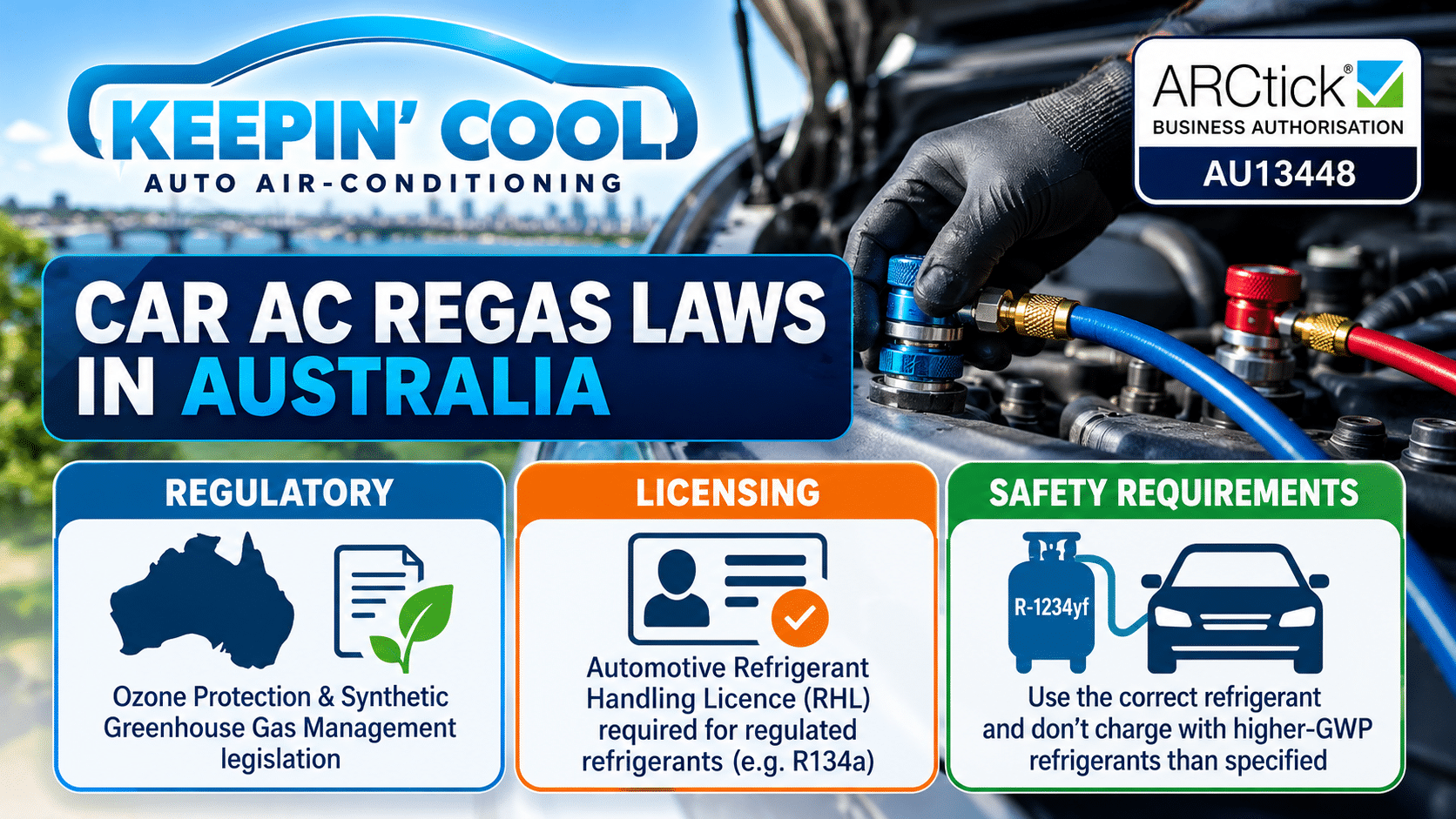
Car AC Regas Laws Australia – ARCtick Licensing & Safe Servicing
Understanding car AC regas laws in Australia is important when choosing someone to inspect, repair or regas your vehicle’s air conditioning.
Australia has national regulations controlling certain refrigerants, an automotive refrigerant-handling code of practice and additional state safety requirements.
These rules help reduce refrigerant emissions, encourage correct servicing procedures and protect motorists from unsuitable refrigerants and unsafe repairs.
At Keepin Cool Auto Air, we provide professional mobile car air conditioning inspections, Trace-A-Gas leak detection, regassing and suitable repairs throughout Brisbane Bayside and Redland City.
With over 40 years of automotive air conditioning experience and ARCtick business authorisation AU13448, we understand the importance of proper diagnosis, correct refrigerant identification and responsible servicing.
This guide explains the Australian requirements, the difference between technician licences and business authorisations, the risks of refrigerant top-ups and what Queensland drivers should know before booking a regas.
What Are the Car AC Regas Laws in Australia?
Automotive air conditioning refrigerant handling in Australia is governed by several overlapping requirements.
The main national legislation includes:
- The Ozone Protection and Synthetic Greenhouse Gas Management Act 1989.
- The Ozone Protection and Synthetic Greenhouse Gas Management Regulations 1995.
- The Australian Automotive Code of Practice 2008, applicable to automotive refrigerant servicing under the national scheme.
State and territory workplace safety, gas safety and consumer protection requirements may also apply.
Why Do These Rules Exist?
Automotive refrigerants must be handled carefully because improper servicing can create environmental, safety and equipment-damage risks.
R134a, a refrigerant used in many Australian vehicles, is a synthetic greenhouse gas.
Releasing it unnecessarily contributes to greenhouse gas emissions.
Other refrigerants, including HFO-R1234yf, have different safety characteristics and may require additional precautions during handling.
The aim is to ensure refrigerant is handled responsibly, systems are correctly serviced and inappropriate gas substitutions are avoided.
For official information, see the Australian Government refrigeration and air conditioning regulations.
Do You Need an ARCtick Licence to Regas a Car?
For work involving regulated fluorocarbon refrigerants such as R134a, the person handling refrigerant must hold an appropriate Refrigerant Handling Licence.
Automotive air conditioning technicians normally require the relevant automotive licence class for the work they perform.
However, there is an important distinction between a technician’s licence and a business authorisation.
Refrigerant Handling Licence – For Technicians
A Refrigerant Handling Licence (RHL) authorises an appropriately qualified individual to perform specified refrigerant-handling work.
The licence type determines the work the holder is permitted to perform.
For automotive air conditioning, the relevant category includes the AAC02 automotive refrigerant-handling licence.
A technician working with regulated refrigerant must have the appropriate licence or operate within a specifically permitted training arrangement.
Refrigerant Trading Authorisation – For Businesses
A Refrigerant Trading Authorisation (RTA) is a business-level authorisation.
It allows an authorised business to acquire, possess and dispose of regulated refrigerant under the relevant scheme.
Keepin Cool Auto Air holds ARCtick business authorisation AU13448.
This business authorisation is separate from an individual technician’s Refrigerant Handling Licence.
Both the technician’s appropriate licence and the business’s required authorisation are important when servicing systems containing regulated refrigerants.
You can check businesses through the official ARCtick authorised business search.
Does R1234yf Require the Same ARCtick Licence as R134a?
Not under the same Commonwealth refrigerant licensing provisions.
This is an important distinction often overlooked in general articles about car air conditioning laws.
R134a
R134a is an HFC refrigerant controlled under Australia’s national ozone and synthetic greenhouse gas legislation.
Appropriate ARC licensing and business authorisation requirements apply to regulated refrigerant handling and trading.
HFO-R1234yf
Pure HFO-R1234yf is not controlled under the Commonwealth ozone and synthetic greenhouse gas licensing scheme in the same way as R134a.
ARCtick confirms that its national refrigerant handling licence and trading authorisation are not required solely to purchase or handle pure R1234yf under that scheme.
However, this does not mean R1234yf is safe for untrained DIY servicing.
R1234yf is classified as an A2L mildly flammable refrigerant.
Suitable recovery and charging equipment, ventilation, appropriate personal protection, fire precautions and relevant state or territory requirements remain important.
If R1234yf is part of a mixture containing a regulated HFC, different requirements can apply.
For further information, see ARCtick’s official R1234yf refrigerant guidance.
Keepin Cool has appropriate equipment for servicing both R134a and HFO-R1234yf systems on suitable vehicles.
What Does the Australian Automotive Code of Practice Require?
Australia’s Automotive Code of Practice 2008 provides important requirements for the inspection, handling and servicing of automotive refrigerant systems.
The code covers procedures including refrigerant recovery, leak detection, evacuation, recharging and service documentation.
Inspection Before Regassing
The automotive code requires inspection and leak testing for signs of refrigerant leakage.
Relevant hoses, pipework and condenser airflow should also be assessed.
If there are concerns about the system’s integrity, necessary rectification work must be completed before regassing.
This is why diagnosing the system first is so important.
Refrigerant Recovery
Existing regulated refrigerant must be handled using suitable recovery equipment.
Deliberately releasing regulated refrigerant into the atmosphere is prohibited.
Recovering refrigerant helps reduce environmental emissions and allows the system to be properly prepared for further assessment.
Evacuation and Moisture Removal
Professional automotive air conditioning servicing involves evacuating the refrigerant circuit using suitable vacuum equipment.
This removes air and moisture that can affect system performance and component reliability.
The automotive code also contains recommended evacuation procedures and system-pressure checks.
A vacuum-hold check is useful, but it does not replace appropriate leak detection.
Accurate Refrigerant Recharging
The vehicle must be serviced using the correct refrigerant specification and manufacturer-specified charge quantity.
Incorrect charging can cause poor cooling performance and potentially damage components.
Final performance and leak checks are important before completing the service.
You can read the official Australian Automotive Code of Practice through ARCtick.
Is It Legal to Simply Top Up Your Car Aircon?
The Australian Automotive Code of Practice prohibits adding refrigerant to an existing system charge as a simple top-up.
This is different from a proper regas following inspection, refrigerant recovery, appropriate leak testing and system preparation.
Why Are Quick Top-Ups a Problem?
A quick top-up can create several problems:
- It doesn’t establish exactly how much refrigerant is already present.
- The system may become overcharged.
- A refrigerant leak may remain unresolved.
- Moisture or contamination may not be addressed.
- A faulty compressor or electrical component may remain undiagnosed.
- Refrigerant may continue escaping into the environment.
A sealed automotive air conditioning system should retain refrigerant sufficiently to operate as designed.
If the charge is low, the cause should be investigated rather than automatically adding more.
What If the System Has a Leak?
If a refrigerant leak is detected that affects system integrity, the necessary repair must be carried out before regassing.
The correct repair depends on the fault.
For example, a small condenser pinhole may require condenser replacement, while a damaged hose connection may be suitable for repair.
Keepin Cool uses professional car air conditioning leak detection, including Trace-A-Gas testing where appropriate, to help identify these problems.
Are DIY Car Aircon Regas Kits Legal in Australia?
For R134a and other regulated fluorocarbon refrigerants, DIY refrigerant handling by an unlicensed person does not meet the national licensing requirements.
Purchasing a basic charging kit does not provide the necessary authority to handle regulated refrigerant.
Even where a refrigerant falls outside the Commonwealth scheme, other safety and legal requirements may apply.
Why DIY Regassing Can Damage Your Car
A basic charging can and pressure gauge cannot reliably establish the exact refrigerant quantity already inside the system.
Potential problems include:
- Overcharging or undercharging.
- Introducing the wrong refrigerant.
- Mixing incompatible refrigerants.
- Incorrect compressor oil.
- Failing to identify an existing leak.
- Allowing air or moisture into the system.
- Damaging expensive compressor or refrigeration components.
Professional servicing uses suitable refrigerant recovery, testing, vacuum and charging equipment.
For motorists, having an experienced automotive air conditioning specialist assess the vehicle is the safer and more reliable approach.
Queensland Laws on Hydrocarbon Car Aircon Refrigerants
Queensland has additional gas safety requirements that motorists should understand.
Hydrocarbon refrigerants are sometimes advertised as inexpensive alternatives to conventional vehicle air conditioning refrigerants.
Some hydrocarbon gases are highly flammable.
Can Hydrocarbon Refrigerant Be Used in Any Car?
No.
Queensland law restricts hydrocarbon refrigerant use to appropriately approved equipment, and relevant gas work must be performed by appropriately licensed persons.
Installing hydrocarbon refrigerant into an unapproved vehicle air conditioning system is illegal.
An ordinary automotive air conditioning system designed for R134a cannot simply be filled with an unapproved hydrocarbon substitute.
Changing the refrigerant can introduce fire risks, compatibility problems and serious consequences for future servicing.
Why Motorists Should Be Careful
An unusually cheap regas advertisement doesn’t automatically mean a business is doing anything wrong.
However, if someone proposes using a substitute refrigerant, ask whether it is approved for your particular vehicle.
Never assume that a gas is suitable simply because an adapter allows it to enter the service connection.
The Queensland Government specifically warns against unapproved gases and unlicensed vehicle air conditioning work.
Read the official Queensland Government vehicle air conditioning gas safety advice.
Is It Legal to Put R134a Into an R1234yf Vehicle?
No. Australian charging rules prohibit charging a refrigeration or air conditioning system with a higher-global-warming-potential refrigerant than the equipment was designed to use, subject to the rules’ specified exceptions.
R134a has a substantially higher global warming potential than HFO-R1234yf.
A vehicle designed for R1234yf should not be filled with R134a as a cheaper substitute.
The two refrigerants also have different safety characteristics, service fittings and compatibility requirements.
Why Correct Refrigerant Identification Matters
The correct refrigerant may be identified using:
- The manufacturer’s under-bonnet refrigerant label.
- Vehicle service information.
- Manufacturer specifications.
- Appropriate refrigerant identification equipment where necessary.
Vehicle age alone isn’t enough because manufacturers adopted different refrigerants at different times.
Keepin Cool offers dedicated R134a regassing and HFO-R1234yf servicing for suitable vehicles.
For the official rules, see the Australian Government refrigerant charging requirements.
Why Trace-A-Gas Leak Detection Matters
A refrigerant system can develop small leaks that aren’t immediately obvious during a visual inspection.
Common leak locations include:
- Condenser cores and connections.
- Refrigerant hose crimps.
- Compressor seals.
- Service valves.
- Pipe joints and O-rings.
- Evaporator assemblies.
Trace-A-Gas is a professional leak detection method using a suitable tracer-gas mixture and specialist electronic detection equipment.
Where appropriate, it helps identify escaping gas from the tested system.
UV dye is also useful for future leak detection when suitable dye has circulated through the system.
However, neither UV dye nor a vacuum-hold test alone guarantees every small leak will be identified.
At Keepin Cool, the testing method is selected according to the condition of the vehicle and suspected fault.
This helps determine whether a repair is needed before regassing.
How Keepin Cool Carries Out Professional Mobile Regassing
Keepin Cool follows a diagnostic-first servicing process.
1. Initial System Inspection
We investigate the customer’s cooling complaint and assess relevant system components.
This may include checking compressor operation, electrical controls, condenser airflow and refrigerant-system performance.
2. Appropriate Leak Testing
We use suitable leak detection methods, including Trace-A-Gas where appropriate.
If a fault is identified that needs repairing before regassing, we’ll explain the problem and provide a quote first.
3. Refrigerant Recovery and System Preparation
Where applicable, remaining refrigerant is recovered using dedicated equipment.
The system is then prepared and evacuated according to the appropriate servicing procedures.
4. Correct Refrigerant Recharge
If the system passes inspection, we recharge using the manufacturer’s specified refrigerant type and weight.
Suitable compressor oil and UV dye are included during regassing as required.
5. Final Performance Testing
We assess operating pressures and cooling performance before completing the service.
If required repairs prevent regassing and you choose not to proceed, the applicable inspection fee applies instead of charging for an unsuccessful regas.
For more information, visit our car AC inspection and fault diagnostics page.
How Often Should You Regas Your Car Air Conditioning?
Keepin Cool recommends regassing car air conditioning every two to four years, subject to an appropriate inspection and leak test.
This is our preventative servicing recommendation, not a compulsory national legal interval.
A vehicle with a developing refrigerant leak or cooling fault may need attention earlier.
Likewise, a properly functioning system may not require additional refrigerant simply because a particular number of years has passed.
The appropriate service depends on system condition and the results of inspection.
You can read more in our car air conditioning regas schedule guide.
How Much Does a Legal, Professional Car AC Regas Cost?
The cost of professional regassing depends on the refrigerant used, vehicle requirements and whether the system requires repairs before servicing.
R134a and HFO-R1234yf have different refrigerant and servicing costs.
Rather than listing prices throughout our technical blogs, Keepin Cool maintains a central Car Air Conditioning Prices Brisbane page.
It contains our current regas, inspection and common repair charges, together with explanations of the inspection-first process.
This makes it easier for customers to understand what is included and what happens if repairs are required.
Why Choose Keepin Cool Auto Air?
Keepin Cool is a locally owned and operated mobile automotive air conditioning specialist established in 2006.
With more than 40 years of hands-on industry experience, Jamie provides automotive air conditioning diagnosis, professional leak testing, regassing and suitable repairs throughout Brisbane Bayside and Redland City.
Our service focuses on:
- Inspection and leak testing before regassing.
- Professional Trace-A-Gas leak detection.
- Correct refrigerant identification and handling.
- Dedicated R134a and HFO-R1234yf servicing equipment.
- Clear repair explanations and quotes.
- Accurate refrigerant charging to manufacturer specifications.
- Mobile appointments at suitable homes and workplaces.
Keepin Cool holds ARCtick business authorisation AU13448.
Our regular service areas include Cleveland, Capalaba, Alexandra Hills, Thornlands, Birkdale, Wellington Point, Ormiston, Victoria Point, Redland Bay, Mount Cotton, Wynnum, Manly, Lota and Tingalpa.
We service suitable conventional petrol and diesel cars, SUVs, utes, 4WDs and selected light commercial vehicles manufactured from 1999 onwards.
Hybrid and electric vehicles are outside our current service scope.
View our Brisbane Bayside and Redland City service areas for further information.
Frequently Asked Questions About Australian Car AC Regas Laws
Is an ARCtick business authorisation the same as a technician’s licence?
No. Business authorisation and individual technician licensing serve different purposes. AU13448 is Keepin Cool’s business authorisation number.
Do you need a licence to regas an R134a car in Australia?
Yes. Handling regulated R134a requires the appropriate refrigerant-handling licence, and businesses dealing with regulated refrigerant must hold the relevant authorisation.
Is pure R1234yf covered by the same ARC licensing requirements?
No. ARCtick confirms that pure HFO-R1234yf isn’t regulated under the same Commonwealth refrigerant licensing scheme. Appropriate safety precautions and other applicable requirements remain essential.
Is it legal to top up an existing car aircon refrigerant charge?
The Australian Automotive Code of Practice prohibits simply adding refrigerant to an existing charge as a top-up. Proper inspection, leak testing and servicing procedures must be followed.
Can I legally buy R134a and regas my own car?
Handling and acquiring regulated R134a are subject to the relevant national licensing and authorisation requirements. A DIY kit does not replace these permissions.
Can I put a cheaper hydrocarbon gas into my car aircon?
Not unless the equipment and work meet the relevant approval and licensing requirements. Queensland prohibits installing hydrocarbon refrigerants in unapproved systems.
Can R134a and R1234yf be mixed?
No. They are not interchangeable. The vehicle should be serviced using its manufacturer’s specified refrigerant.
How do I check whether an air conditioning business is authorised?
Use the official ARCtick business search or ask the provider for its authorisation details. For regulated refrigerant work, the technician must also hold the appropriate individual licence.
Does Keepin Cool service cars at home?
Yes. We provide mobile car air conditioning inspections, leak testing, regassing and suitable repairs at accessible homes and workplaces across Brisbane Bayside and Redland City.
Book Your Mobile Car Air Conditioning Service
If your vehicle is blowing warm air or needs professional refrigerant servicing, choose an automotive air conditioning specialist who understands correct refrigerant handling and diagnostic procedures.
Keepin Cool Auto Air provides mobile inspections, Trace-A-Gas leak detection, R134a and HFO-R1234yf regassing and suitable repairs throughout Brisbane Bayside and Redland City.
Call or SMS Jamie on 0415 761 019, or use the website’s existing Quick SMS Quote button.
Please include your suburb, vehicle make, model, year and a brief description of the air conditioning problem.
Keepin Cool Auto Air
100% Mobile | ARCtick AU13448 | 40+ Years Experience