

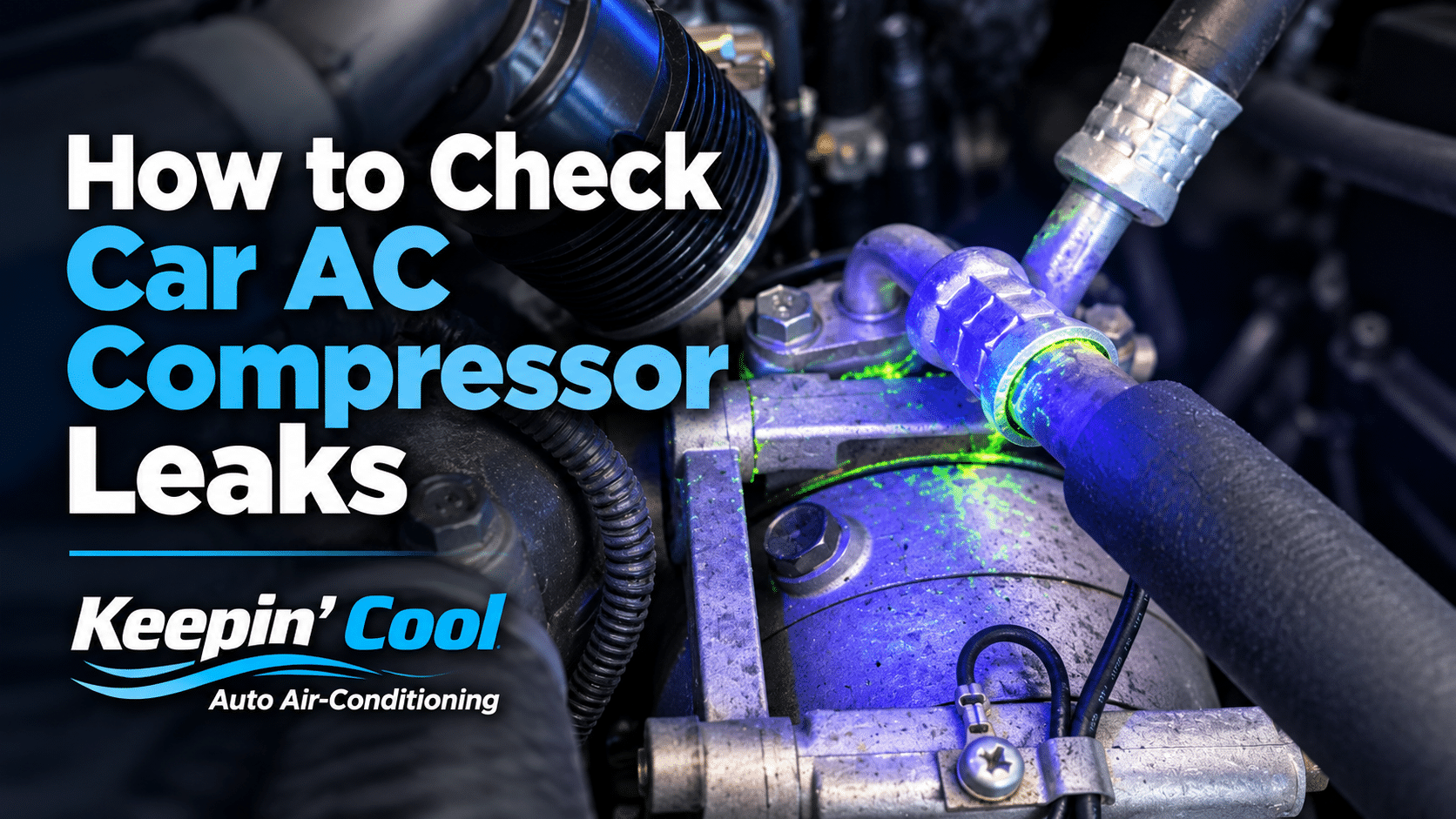
29 Dec How to Check Car AC Compressor Leaks
How to Check Car AC Compressor Leaks – Signs, Testing and Repair Options
Is your car air conditioning blowing warm air, gradually losing its cooling performance or needing regassing more often than expected? A car AC compressor leak could be responsible, but it’s important to confirm where the refrigerant is escaping before replacing expensive components.
The air conditioning compressor contains seals, fittings and connections that must retain refrigerant while the system operates.
A leak can develop around the compressor shaft seal, housing or refrigerant pipe connections. However, a leak near the compressor doesn’t always mean the compressor itself is faulty.
At Keepin Cool Auto Air, we provide professional mobile automotive air conditioning inspections, Trace-A-Gas leak detection, compressor diagnostics, regassing and suitable repairs across Brisbane Bayside and Redland City.
With over 40 years of hands-on experience, our approach is straightforward: inspect and leak-test first, identify the actual fault and explain the appropriate repair before proceeding.
This guide explains the signs of a possible compressor leak, where leaks commonly occur, what you can safely check and how professional testing helps determine whether the compressor needs replacing.
Can a Car Air Conditioning Compressor Leak Refrigerant?
Yes. A compressor can leak refrigerant through seals, fittings or damaged components.
Its job is to circulate refrigerant through the air conditioning circuit, allowing heat to be transferred out of the cabin.
The compressor is connected to other components through high-pressure and low-pressure refrigerant lines.
Depending on its design, it may contain:
- A rotating shaft seal.
- Housing seals and gaskets.
- Refrigerant inlet and outlet connections.
- Electronic control valve seals.
- Pressure relief components.
- Other manufacturer-specific sealing points.
These components are designed to retain refrigerant during normal operation.
Over time, a seal can deteriorate, a fitting can become damaged or an internal component may develop a fault.
If refrigerant escapes, the charge can fall and cooling performance may deteriorate.
However, a compressor may also stop cooling because of an electrical or mechanical problem without leaking any refrigerant.
That’s why identifying the actual fault matters.
Six Possible Signs of a Car AC Compressor Leak
Several symptoms may suggest refrigerant loss, although none confirms the compressor is responsible on its own.
1. Air Conditioning Gradually Loses Cooling
A slow refrigerant leak may cause the air conditioning to become less effective over time.
You might notice the cabin taking longer to cool or the dashboard vents no longer producing the temperatures you’re accustomed to.
However, low refrigerant can result from leaks anywhere in the system, including the condenser, hoses or evaporator.
Poor cooling alone doesn’t identify the compressor as the leaking component.
2. Cooling Stops Again After Regassing
If your air conditioning works immediately after regassing but becomes warm again, an unresolved leak may be responsible.
The leak might involve the compressor shaft seal or an adjacent refrigerant fitting.
It could also be somewhere completely different.
Professional leak testing is needed before recommending another regas or compressor replacement.
3. Oily Residue Around the Compressor
Refrigerant circulates with suitable compressor oil.
When a component leaks, small amounts of oil may sometimes escape and leave staining around the affected area.
Possible locations include:
- Compressor body joints.
- Refrigerant hose connections.
- Shaft seal areas.
- Electronic control valve connections.
- Nearby fittings.
However, compressors and surrounding engine components can also become contaminated by engine oil, road grime or fluid from another source.
Oil residue is a clue, not a confirmed refrigerant leak.
4. Visible Damage or Corrosion
Physical damage around the compressor housing or fittings may indicate a possible problem.
Corrosion, rubbing, damaged connections or previous incorrect repairs can sometimes affect component integrity.
The damaged area must be inspected before deciding whether refrigerant is escaping.
5. Compressor Operation Changes
Some vehicles prevent compressor operation when refrigerant pressure falls outside the permitted range.
A system with a significant leak may therefore stop cooling altogether.
However, a compressor that isn’t engaging may have an electrical, sensor or mechanical fault instead.
Some modern compressors also operate without a traditional on/off clutch.
A compressor pulley turning—or a clutch failing to engage—doesn’t establish whether the compressor is leaking.
6. Unusual Noises When the AC Operates
A grinding, rattling or squealing noise may indicate a compressor-related problem.
However, noise more commonly points towards a bearing, pulley, clutch, belt or internal mechanical issue than refrigerant leakage itself.
If a significant new noise develops, switch the air conditioning off and arrange an inspection.
A noisy compressor shouldn’t automatically be diagnosed as leaking.
Where Do Car AC Compressors Commonly Leak?
The location depends on the compressor design and the condition of its components.
Compressor Shaft Seal
Many belt-driven compressors have a shaft seal where the rotating shaft passes through the compressor housing.
This seal helps retain refrigerant and oil within the compressor.
Wear, damage or deterioration may allow leakage.
Shaft seal problems can sometimes be difficult to identify because of limited access or the way the leak behaves under different operating conditions.
A suspected shaft seal leak should be confirmed before recommending replacement.
Refrigerant Hose Connections
High-pressure and low-pressure refrigerant pipes connect to the compressor through suitable fittings.
These connections may use O-rings or other manufacturer-specified seals.
Leaks can occur because of:
- Damaged sealing surfaces.
- Deteriorated O-rings.
- Incorrect assembly.
- Corrosion.
- Mechanical damage.
- Vibration-related problems.
An O-ring or hose connection leak may be repairable without replacing the compressor.
This is one of the most important distinctions in compressor leak diagnosis.
Compressor Housing Seals
Some compressor designs use housing joints and seals that can deteriorate or become damaged.
A leak at the compressor body requires careful assessment.
Depending on the compressor, age, repairability and component availability, replacing the complete assembly may be the more suitable option.
Electronic Compressor Control Valve Seals
Certain variable-displacement compressors incorporate electronic control valves.
Depending on the design, these may have seals that can develop leaks.
A control valve may also fail electrically or mechanically without leaking refrigerant.
Both possibilities need to be distinguished through proper testing.
Pressure Relief Components
Some compressors include pressure relief devices.
If a relief device has discharged or is leaking, the reason must be investigated.
Abnormally high refrigerant pressures or other system conditions may have contributed.
Simply replacing a component without addressing the underlying cause may lead to another failure.
How to Safely Check for Possible Compressor Leaks
There are a few observations you can make before booking an inspection.
These checks don’t involve opening refrigerant pipes, handling refrigerant or connecting pressure-testing equipment.
Check Cooling Performance
Notice whether the vehicle:
- Takes longer to cool than previously.
- Produces warm air even with the AC selected.
- Cools normally for a short period before becoming warm.
- Lost cooling shortly after a previous regas.
These details help describe the problem, although they don’t confirm a compressor leak.
Look for Obvious Damage
With the engine switched off, the vehicle secure and components cool, you may be able to see damage or staining around accessible compressor connections.
Don’t reach near moving belts, hot components or pressurised fittings.
Avoid removing covers or dismantling components simply to investigate a suspected leak.
Notice Whether the Problem Is Intermittent
Does the air conditioning work in the morning but stop cooling when the engine compartment becomes hot?
Does it work again after the vehicle has been parked?
These observations can help distinguish a possible intermittent electrical or compressor-control problem from refrigerant loss.
Avoid DIY Refrigerant Testing
Don’t attempt to:
- Loosen compressor or hose connections.
- Release refrigerant to check pressure.
- Add refrigerant from a charging can.
- Introduce UV dye as an initial DIY diagnostic method.
- Pressurise the system with compressed air or unsuitable gas.
- Apply arbitrary pressure-testing values.
- Dismantle compressor seals while the system contains refrigerant.
Professional refrigerant handling and leak testing require appropriate equipment, procedures and training.
Australia’s automotive refrigerant-handling requirements also address leak testing, recovery and proper system servicing.
How Keepin Cool Tests for Compressor Refrigerant Leaks
At Keepin Cool, diagnosing a suspected compressor leak involves checking both the refrigeration system and the components around the compressor.
Step 1 – Initial System Inspection
We begin by assessing the reported fault.
Depending on the vehicle, this may include checking:
- Air conditioning operation.
- Vent temperatures.
- Compressor engagement or control.
- Relevant electrical signals.
- Refrigerant system pressures.
- Accessible compressor fittings.
- Possible oil staining or component damage.
This helps establish whether a refrigerant leak is a likely cause of the problem.
Step 2 – Inspect Compressor Connections
We investigate accessible connections, seals and refrigerant hoses.
A leak originating from a hose fitting may appear to come from the compressor because the components are mounted close together.
Correctly identifying the leaking connection can prevent unnecessary compressor replacement.
Step 3 – Professional Trace-A-Gas Leak Detection
Where appropriate, we use Trace-A-Gas, a suitable hydrogen/nitrogen tracer-gas mixture, together with specialist detection equipment.
Following the required system preparation and refrigerant recovery, the circuit can be tested at a suitable pressure.
The electronic detector is used to investigate escaping tracer gas around the suspected leak locations.
These may include:
- Compressor shaft seal areas.
- Refrigerant inlet and outlet fittings.
- Compressor housing joints.
- Control valve connections.
- Nearby hoses and pipework.
Trace-A-Gas can help locate small leaks that aren’t immediately obvious during visual inspection.
However, some intermittent or difficult-to-access leaks may require additional investigation.
Step 4 – Consider Other Leak Detection Methods
Other suitable methods may include electronic refrigerant detection, pressure testing and examination of existing UV dye residue.
The method depends on the vehicle, the refrigerant and the suspected fault.
Step 5 – Explain the Repair Options
Once the source has been established, we explain whether the fault involves:
- A hose connection.
- An O-ring or fitting.
- A compressor seal.
- The compressor assembly itself.
- Another component elsewhere in the system.
We’ll provide a quote for suitable repairs before proceeding.
Visit our Professional Car AC Leak Detection Brisbane page for more information about our mobile testing service.
Trace-A-Gas vs UV Dye for Compressor Leaks
These methods can help investigate refrigerant loss, but they aren’t identical.
Trace-A-Gas Testing
Trace-A-Gas uses a suitable tracer-gas mixture and sensitive electronic equipment to help locate escaping gas.
It can be useful when investigating a suspected compressor leak, especially where there isn’t obvious fluorescent residue.
Testing must be performed using the appropriate equipment and procedures.
UV Dye Inspection
Compatible UV dye can help identify leakage when the dye has already circulated through the system and left visible residue.
However, dye isn’t suitable as the first resort for diagnosing a suspected leak under the Australian Automotive Code of Practice.
Keepin Cool uses appropriate initial leak detection methods and adds compatible UV dye during successful regassing to assist with future leak identification.
Can a Vacuum Test Confirm the Compressor Doesn’t Leak?
Not conclusively.
A vacuum-hold check can help assess certain system conditions, but a system that holds vacuum may still leak under positive pressure.
Passing a vacuum test doesn’t prove that every compressor seal or fitting is leak-free.
The appropriate combination of tests depends on the fault being investigated.
You can read more in our Car AC Refrigerant Leaks: Signs, Causes & Detection guide.
Compressor Leak or Compressor Failure – What’s the Difference?
A compressor can leak refrigerant while still operating mechanically.
It can also fail mechanically or electrically without leaking at all.
This distinction is important because the repair options may be completely different.
| Possible fault | What it means |
|---|---|
| Compressor shaft seal leak | Refrigerant may be escaping through the shaft seal |
| Refrigerant fitting leak | A hose connection or seal may be faulty |
| Compressor clutch fault | The compressor may not be driven correctly |
| Electronic control valve fault | Refrigerant pumping may not be controlled correctly |
| Internal mechanical damage | The compressor may not produce the required operation |
| Pulley or bearing fault | A mechanical noise may occur without refrigerant leakage |
| Failed cooling fan | Poor cooling may occur even if the compressor is serviceable |
For example, a vehicle with a faulty compressor clutch may have no refrigerant leak at all.
Similarly, a vehicle with a leaking compressor connection may not require the complete compressor to be replaced.
Accurate diagnosis is the best way to avoid replacing the wrong component.
Can a Leaking Car AC Compressor Be Repaired?
Sometimes.
The correct repair depends on the location of the leak, compressor construction and whether suitable replacement parts are available.
Hose Connection or O-Ring Leak
If the leak is confirmed at an accessible fitting or sealing connection, repairing that connection may be appropriate.
The system must then be tested using suitable procedures.
Compressor Shaft Seal Leak
Some shaft seal problems may be repairable in specialised circumstances.
However, the compressor design, seal availability, component condition and labour involved influence whether a repair is practical.
Replacement may be recommended when the compressor isn’t suitable for reliable seal repair.
Compressor Housing Leak
A housing leak may require replacement of the compressor assembly, depending on its design and condition.
Compressor With Internal Mechanical Damage
If the compressor has suffered internal mechanical failure, replacement may be necessary.
Additional work may also be needed if debris has contaminated the refrigeration circuit.
The repair procedure should follow the relevant manufacturer’s guidance.
Keepin Cool provides Car AC Compressor Diagnosis and Replacement for suitable vehicles.
Some compressor models and extensive repairs are outside our mobile service scope.
Why a Regas Won’t Fix a Leaking Compressor
A regas restores the appropriate refrigerant charge when the system is suitable for servicing.
It doesn’t repair a damaged compressor seal or leaking refrigerant fitting.
If the leak remains, refrigerant may escape again and cooling performance may deteriorate.
This is why we inspect and leak-test before regassing.
If a compressor-related leak is confirmed and requires repair, we’ll explain the findings and quote the necessary work.
The regas charge applies only when the regas is successfully completed.
If repairs are necessary to proceed and you choose not to undertake them, the applicable inspection fee applies instead.
The Australian Automotive Code of Practice also prohibits simply topping up an existing refrigerant charge as a substitute for proper servicing.
For official technical guidance, see the ARCtick Automotive Code of Practice.
How Much Does a Car AC Compressor Leak Repair Cost?
The cost depends on whether the leak is caused by a fitting, hose connection, compressor seal or damaged compressor assembly.
For example:
- A suitable connection repair may be relatively straightforward.
- A damaged refrigerant hose may require professional repair or replacement.
- A failed compressor seal may require specialist work.
- Complete compressor replacement involves additional parts and servicing procedures.
- Internal mechanical failure can require further work if system contamination is present.
A leak near the compressor doesn’t automatically mean the most expensive repair is necessary.
Our priority is identifying the source before recommending replacement.
For current inspection, leak detection, regas and compressor replacement charges, visit our Official Keepin Cool Car Air Conditioning Prices Brisbane page.
We keep advertised charges on this central pricing page so our supporting guides don’t display outdated figures.
How Often Should Car Air Conditioning Be Checked?
Keepin Cool recommends regassing car air conditioning every two to four years, following an appropriate inspection and leak test.
This is our preventative servicing recommendation, not a requirement that every car automatically needs additional refrigerant.
If your system has developed a compressor leak or cooling fault, it should be investigated earlier.
A leaking component won’t be repaired by waiting for the next scheduled regas.
Regular attention may also help identify unusual noises, damaged connections and developing operating problems.
For further information, visit our Car Air Conditioning Regas Schedule guide.
Mobile Car AC Compressor Leak Detection Across Brisbane Bayside & Redland City
Keepin Cool Auto Air is an owner-operated mobile automotive air conditioning specialist based in Mount Cotton.
We provide professional inspections, Trace-A-Gas leak testing, compressor fault diagnosis, regassing and suitable repairs at accessible homes and workplaces.
Brisbane Bayside
Our service area includes Wynnum, Manly, Lota, Tingalpa, Wakerley, Hemmant and other selected Bayside suburbs.
Visit our Brisbane Bayside Car Air Conditioning page.
Redland City
We also service Cleveland, Capalaba, Alexandra Hills, Birkdale, Wellington Point, Ormiston, Thorneside, Thornlands, Victoria Point, Redland Bay, Mount Cotton and surrounding serviced suburbs.
Visit our Redland City Car Air Conditioning page.
Vehicles We Service
We work on suitable conventional petrol and diesel vehicles manufactured from 1999 onwards, including cars, SUVs, utes, 4WDs and selected light commercial vehicles.
Hybrid and electric vehicles are outside our current service scope.
Some compressor models and repairs requiring extensive dismantling aren’t suitable for our mobile service.
Why Choose Keepin Cool Auto Air?
Keepin Cool was established in 2006 and specialises in mobile automotive air conditioning services throughout Brisbane Bayside and Redland City.
With over 40 years of hands-on industry experience, Jamie focuses on finding the actual fault before recommending repairs or regassing.
Our services include:
- Professional compressor fault diagnosis.
- Trace-A-Gas refrigerant leak detection.
- Compressor hose and fitting inspections.
- Suitable compressor replacement.
- Electrical and control-system checks.
- R134a and HFO-R1234yf servicing.
- Clear repair explanations and quotes.
- Convenient owner-operated mobile appointments.
Keepin Cool holds ARCtick business authorisation AU13448, which is separate from an individual technician’s refrigerant-handling licence.
You can check authorised businesses through the ARCtick Business Search.
Frequently Asked Questions About Car AC Compressor Leaks
How do I know if my car AC compressor is leaking?
Possible signs include declining cooling performance, refrigerant loss and oil staining around compressor connections. However, these symptoms don’t confirm the compressor is responsible. Professional leak testing is required.
Can a compressor leak even if the aircon still works?
Yes. A small refrigerant leak may exist while the compressor continues operating. Cooling performance can deteriorate as the refrigerant charge falls.
Is oil around the compressor proof of a refrigerant leak?
No. Oil residue may suggest a leak, but engine oil, road grime or other contamination can produce similar staining.
Can an O-ring leak look like a compressor leak?
Yes. A leaking refrigerant pipe connection can make it appear that the compressor body is leaking. Identifying the exact source helps avoid unnecessary replacement.
Can Trace-A-Gas detect a compressor shaft seal leak?
It can help investigate leaks around compressor shaft seals and other accessible locations. Some intermittent leaks may require additional diagnostic work.
Does a noisy compressor mean it’s leaking?
Not necessarily. Noise often indicates a bearing, pulley, clutch or internal mechanical problem rather than refrigerant leakage.
Can a leaking compressor be repaired instead of replaced?
Sometimes. A suitable hose connection or seal may be repairable. Other faults may require replacement of the compressor assembly.
Can I use a DIY charging kit to test for a compressor leak?
DIY charging isn’t a suitable way to locate leaks. Regulated refrigerants require appropriate handling, and charging without proper testing can create additional problems.
Will regassing stop a compressor leak?
No. Regassing restores the correct refrigerant charge when the system is suitable. A leaking component must be appropriately assessed and repaired.
Do you replace all types of car AC compressors?
No. We service selected compressor models on suitable conventional vehicles. We assess the vehicle and fault before confirming whether the repair is within our mobile service scope.
How much does compressor leak detection cost?
Our current diagnostic, leak detection and repair charges are listed on our Official Keepin Cool Brisbane Pricing Page.
Can you test my compressor for leaks at home?
Yes. We provide mobile car air conditioning inspections and suitable leak detection at accessible homes and workplaces throughout Brisbane Bayside and Redland City.
Ready to Book Your Car AC Compressor Inspection?
If your car air conditioning has lost cooling performance or you suspect refrigerant is leaking near the compressor, professional diagnosis is the best starting point.
Keepin Cool Auto Air provides mobile car AC compressor inspections, Trace-A-Gas leak detection, regassing and suitable repairs throughout Brisbane Bayside and Redland City.
Call or SMS Jamie on 0415 761 019, or use the website’s existing Quick SMS Quote button.
Please include your suburb, vehicle make, model, year and a brief description of the air conditioning problem.
Keepin Cool Auto Air
100% Mobile | ARCtick AU13448 | 40+ Years Experience