

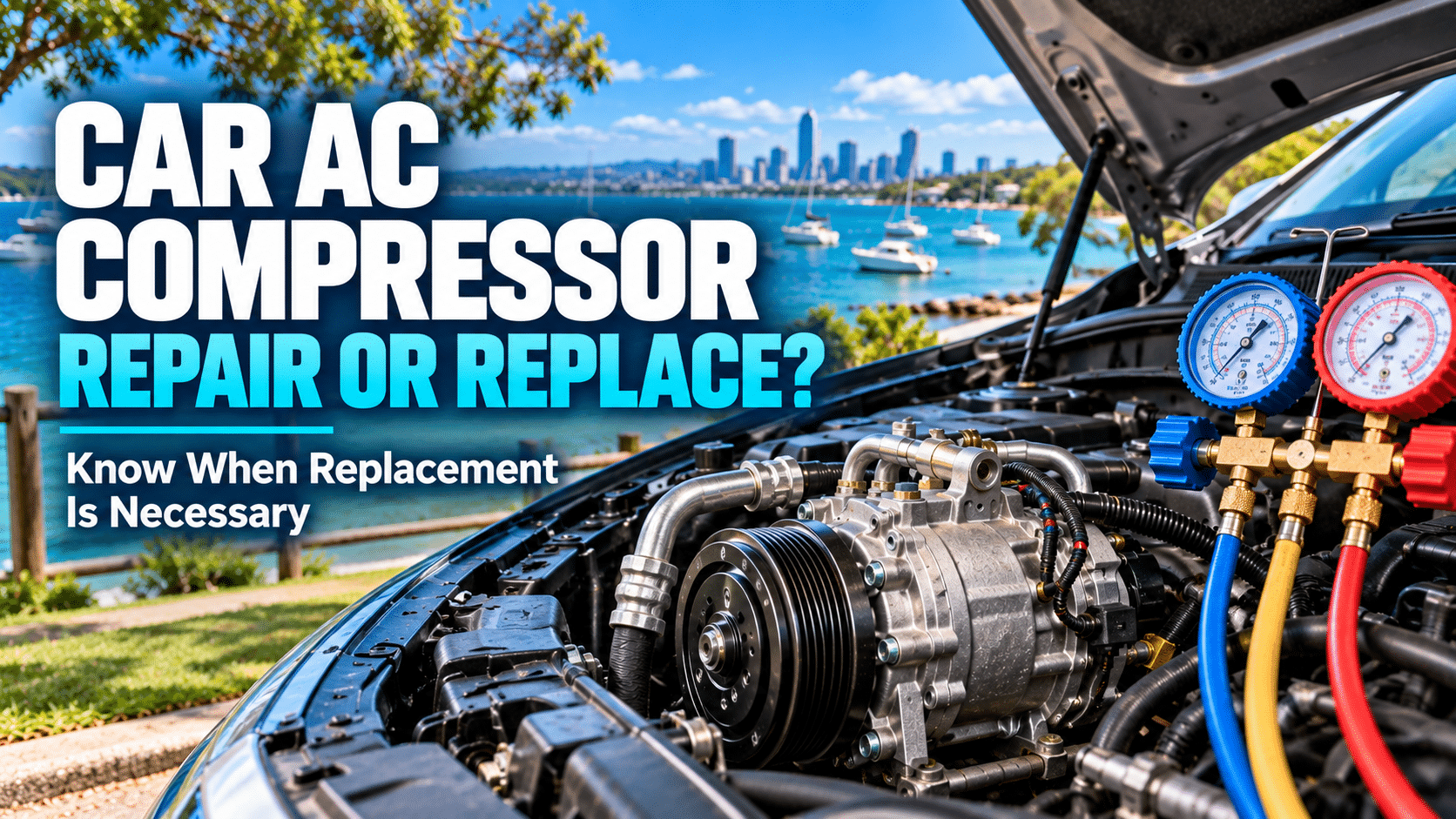
12 Jun Car AC Compressor Repair or Replace?
Car AC Compressor Repair or Replace? How to Make the Right Decision
Should you repair or replace your car AC compressor when the air conditioning stops working? The answer depends on the type of fault, whether the compressor has suffered internal damage and whether individual components can be repaired safely and reliably.
A car air conditioning compressor can be an expensive component to replace. However, not every compressor-related problem means the entire unit has failed.
At Keepin Cool Auto Air, we provide mobile car air conditioning inspections, fault diagnosis and suitable compressor replacement services across Brisbane Bayside and Redland City.
With over 40 years of automotive air conditioning experience, our approach is simple: diagnose the fault before recommending expensive replacement parts.
What Does a Car AC Compressor Do?
The compressor is an essential component of your vehicle’s air conditioning system.
Its job is to circulate and compress refrigerant, allowing the system to transfer heat from inside the cabin to the outside atmosphere.
Depending on the vehicle, the compressor may use an electromagnetic clutch, variable-displacement mechanism or electronically controlled valve.
These designs operate differently and require appropriate diagnostic procedures.
A compressor may appear faulty when another component prevents it from operating correctly. That’s why simply observing that the compressor isn’t working is not enough to confirm it needs replacing.
When Can a Car AC Compressor Be Repaired?
Certain compressor-related faults can sometimes be repaired without replacing the complete compressor assembly.
The suitability of a repair depends on the vehicle, compressor design, parts availability and the condition of the internal components.
1. Compressor Clutch Problems
Some compressors use an electromagnetic clutch that engages the compressor when air conditioning is requested.
Possible faults include:
- Failed clutch coils
- Worn pulley bearings
- Damaged clutch plates
- Electrical supply or control problems
On some compressor designs, individual clutch components can be serviced or replaced.
However, not every vehicle uses a clutch, and not every clutch assembly is separately repairable.
A compressor clutch problem should be confirmed before replacing the complete unit.
2. Electrical and Control Valve Faults
Many modern vehicle air conditioning compressors use electronic control systems.
A faulty regulating valve, wiring connection, pressure sensor or control signal can prevent correct compressor operation.
In some applications, a separately serviceable control valve may be available.
However, the replacement must be compatible with the compressor, and the internal mechanical condition should be considered before recommending repair.
An electrical or control fault does not automatically mean the compressor itself is damaged.
3. Refrigerant Leaks Around Connections
A refrigerant leak near the compressor may originate from an O-ring, hose connection or external fitting rather than the compressor body.
Where appropriate, repairing the connection may resolve the problem without compressor replacement.
However, leaks involving the compressor shaft seal or housing require a different assessment.
Some compressor seals can be serviced using specialised procedures, while other designs may require complete compressor replacement.
4. Related Components Causing Compressor Problems
Sometimes the compressor is functioning correctly, but another component prevents the air conditioning from cooling.
Examples include:
- Faulty cooling fans
- Refrigerant pressure sensor problems
- Electrical wiring faults
- Refrigerant leaks
- Expansion valve restrictions
These faults must be distinguished from actual compressor failure.
Correct diagnosis can prevent unnecessary replacement of an otherwise serviceable compressor.
When Should a Car AC Compressor Be Replaced?
Complete replacement is generally more appropriate when the compressor has suffered substantial internal mechanical damage or cannot be repaired reliably.
Internal Mechanical Seizure
A seized compressor may have damaged pistons, bearings, scroll components or other internal parts, depending on its design.
Severe mechanical damage can prevent normal rotation or compression.
Where the internal mechanism has seized, complete compressor replacement is usually the practical repair.
However, a seized pulley bearing or another external component should not automatically be confused with internal compressor seizure.
Excessive Internal Wear
A compressor can lose performance through internal wear or damage.
Symptoms may include insufficient cooling and abnormal operating conditions.
However, pressure readings alone do not establish internal wear. Other refrigerant system faults must also be considered.
Where internal damage is confirmed and the compressor cannot be repaired economically or reliably, replacement may be recommended.
Metal Contamination
Serious internal compressor failure can introduce metal particles and contaminated oil into the refrigerant circuit.
This can affect other components and create a risk of damaging a replacement compressor.
Possible consequences include:
- Contaminated refrigerant oil
- Restrictions in small refrigerant passages
- Damage to other system components
- Reduced cooling performance
- Premature failure of replacement parts
The required repair depends on the severity of contamination and the vehicle manufacturer’s procedures.
Some components can be flushed using suitable methods, while others may need replacement because contamination cannot be reliably removed.
A new compressor should not simply be installed into a contaminated system without assessing the necessary corrective work.
Car AC Compressor Repair or Replace — Key Differences
| Fault or condition | Possible outcome |
|---|---|
| Electrical supply or wiring fault | Repair electrical fault |
| Faulty clutch or pulley component | Repair where separately serviceable |
| Faulty compressor control valve | Assess suitability for component repair |
| Leaking hose connection or O-ring | Repair connection where appropriate |
| Confirmed internal compressor seizure | Compressor replacement generally required |
| Severe internal wear or damage | Replacement commonly recommended |
| Metal debris or major contamination | Replacement plus necessary system cleaning or component replacement |
These are general examples, not automatic repair decisions. Every vehicle must be assessed according to its compressor design and the confirmed fault.
How We Diagnose Compressor Problems Before Replacement
At Keepin Cool, we investigate the reported air conditioning problem before recommending compressor replacement.
Our diagnostic process may include several checks depending on the vehicle and symptoms.
Step 1 — Initial Air Conditioning Assessment
We assess the customer’s concerns and examine relevant system operation.
This may include checking:
- Cabin vent cooling performance
- Compressor operation
- Condenser fan function
- Unusual noises
- Visible damage or leakage
- Relevant electrical controls
These initial checks help determine whether the compressor requires further investigation.
Step 2 — Electrical and Compressor Control Testing
Where appropriate, we investigate compressor electrical supply, clutch operation, electronic control valves and related system signals.
A compressor that isn’t engaging may be affected by a control fault rather than internal mechanical failure.
Correct testing helps establish whether the problem involves the compressor itself or another system component.
Step 3 — Refrigerant System Assessment
The refrigerant system is checked using suitable diagnostic procedures.
If refrigerant loss is suspected, appropriate leak detection is carried out.
We use professional methods including Trace-A-Gas leak detection where appropriate.
Refrigerant loss must be investigated rather than assuming that adding gas will restore reliable cooling.
For more information, visit our car AC leak detection service.
Step 4 — Assess Compressor Condition
Where testing indicates a possible compressor fault, the relevant mechanical or electrical components are assessed.
The objective is to establish whether the compressor:
- Is operating normally
- Has a repairable associated fault
- Has suffered internal mechanical damage
- Requires complete replacement
- Has caused contamination elsewhere in the system
Not all assessments can be completed without further component access or removal.
Step 5 — Explain the Recommended Repair
Once the problem has been assessed, we’ll explain the findings and recommend the appropriate next step.
Depending on the vehicle and fault, this may involve repairing another component, arranging suitable compressor work or replacing the complete assembly.
Where replacement is necessary, we’ll quote the required work before proceeding.
Learn more about our car AC inspection and fault diagnostics service.
Why Replacing a Compressor Without Diagnosis Can Be Costly
Replacing the compressor without identifying the cause of the problem can leave an underlying fault unresolved.
For example, a cooling fan problem may affect condenser heat rejection and cause poor cooling.
An electrical control fault may prevent compressor operation even though the mechanical assembly is serviceable.
Likewise, a refrigerant leak can affect system operation and may contribute to compressor damage if the problem is left unresolved.
Installing a new compressor without assessing related faults can lead to unnecessary repair costs or further problems.
Professional diagnosis helps determine which components actually require attention.
What Happens When a Compressor Has Failed Internally?
When internal mechanical failure is confirmed, the repair may involve more than replacing the compressor itself.
Depending on the vehicle and condition of the system, additional work may be necessary to remove contamination and restore reliable operation.
This can include:
- Inspecting refrigerant lines and accessible components
- Evaluating the condition of refrigerant oil
- Replacing contaminated or non-flushable components
- Replacing the receiver-drier or accumulator where required
- Checking the expansion valve and refrigerant flow passages
- Using the correct oil specification and quantity
- Evacuating and recharging the system to manufacturer requirements
Some severe contamination conditions may require extensive component replacement rather than flushing.
The correct procedure depends on the vehicle manufacturer’s specifications and the replacement compressor supplier’s instructions.
This is why the circumstances of the original failure should be investigated before a replacement is installed.
Is It Worth Repairing or Replacing a Compressor on an Older Car?
The decision depends on more than the vehicle’s age.
Important considerations include:
- Overall vehicle condition
- The confirmed compressor fault
- Availability of suitable parts
- Whether additional components require replacement
- The cost of the required repair
- The expected reliability after repair
A vehicle in otherwise good condition may justify a compressor replacement if the air conditioning system can be restored reliably.
On the other hand, a vehicle requiring extensive repairs may need a more careful assessment of total costs.
Keepin Cool provides mobile services for suitable vehicles manufactured from 1999 onwards.
Not every compressor replacement or vehicle model is suitable for our mobile service.
We’ll assess the relevant vehicle details before confirming whether we can assist.
How Much Does Car AC Compressor Repair or Replacement Cost?
The cost depends on the vehicle, diagnosed fault, parts availability and amount of work required.
A separately repairable electrical or external component fault may require different work from a compressor that has failed internally and contaminated the refrigerant circuit.
Rather than quoting a compressor replacement solely from a symptom such as warm air, we recommend an inspection to identify the actual fault.
For a more detailed explanation of the factors affecting replacement pricing, read our Car AC Compressor Cost Brisbane guide.
For our complete service pricing, visit Car Air Conditioning Prices Brisbane.
Mobile Car AC Compressor Diagnosis Across Brisbane Bayside and Redland City
Keepin Cool Auto Air provides owner-operated mobile automotive air conditioning inspections and suitable repairs at homes and workplaces.
Our regular service areas include:
- Cleveland and Capalaba
- Alexandra Hills and Ormiston
- Birkdale and Wellington Point
- Thorneside and Thornlands
- Victoria Point and Redland Bay
- Mount Cotton and Sheldon
- Wynnum, Manly and Lota
- Tingalpa, Wakerley and surrounding serviced Bayside suburbs
We work on suitable cars, SUVs, utes, 4WDs and light-commercial vehicles manufactured from 1999 onwards.
Our services include compressor fault diagnosis, appropriate refrigerant leak detection, R134a and R1234yf servicing, and selected compressor replacement work.
With over 40 years of experience and ARCtick authorisation AU13448, Keepin Cool focuses on diagnosing the problem before recommending major repairs.
You can check authorised automotive air conditioning businesses through the official ARCtick business search.
Frequently Asked Questions
Can a car AC compressor be repaired instead of replaced?
Sometimes. Certain electrical, clutch, external seal or control valve problems may be repairable, depending on the compressor design and parts availability. Internal mechanical damage often requires replacement.
Is it worth repairing a faulty car AC compressor?
It depends on the fault, vehicle condition and reliability of the proposed repair. A relatively minor component problem may be worthwhile repairing, while serious internal damage usually requires a different approach.
Does a noisy AC compressor always need replacing?
No. Noises may originate from pulley bearings, drive belts, clutch components or internal compressor parts. The source of the noise should be identified before recommending replacement.
Can low refrigerant cause compressor problems?
Refrigerant loss can affect operating conditions and oil circulation in some systems, potentially contributing to compressor damage. However, the actual fault must be diagnosed rather than assumed.
Can a faulty compressor be fixed by regassing?
Regassing cannot repair internal mechanical compressor damage. If poor cooling is caused by refrigerant loss and the system is otherwise suitable, an appropriate regas may be carried out after any necessary repairs.
Does a replacement compressor always require system flushing?
No. The required procedure depends on whether contamination is present, the components involved and manufacturer requirements. Some severe contamination cannot be corrected through flushing alone.
Do you offer mobile car AC compressor replacement?
Yes, for suitable vehicle models and repairs throughout Brisbane Bayside and Redland City. We assess the vehicle and fault before confirming whether mobile replacement is appropriate.
Need Advice on Car AC Compressor Repair or Replacement?
If your vehicle’s air conditioning is blowing warm air, operating intermittently or making unusual noises, Keepin Cool Auto Air can help investigate the cause before recommending major repairs.
Call or SMS 0415 761 019 with your vehicle’s make, model, year, suburb and a description of the problem.
Alternatively, use the website’s existing Quick SMS Quote button to enquire about a mobile appointment.
100% Mobile | ARCtick AU13448 | 40+ Years Experience