

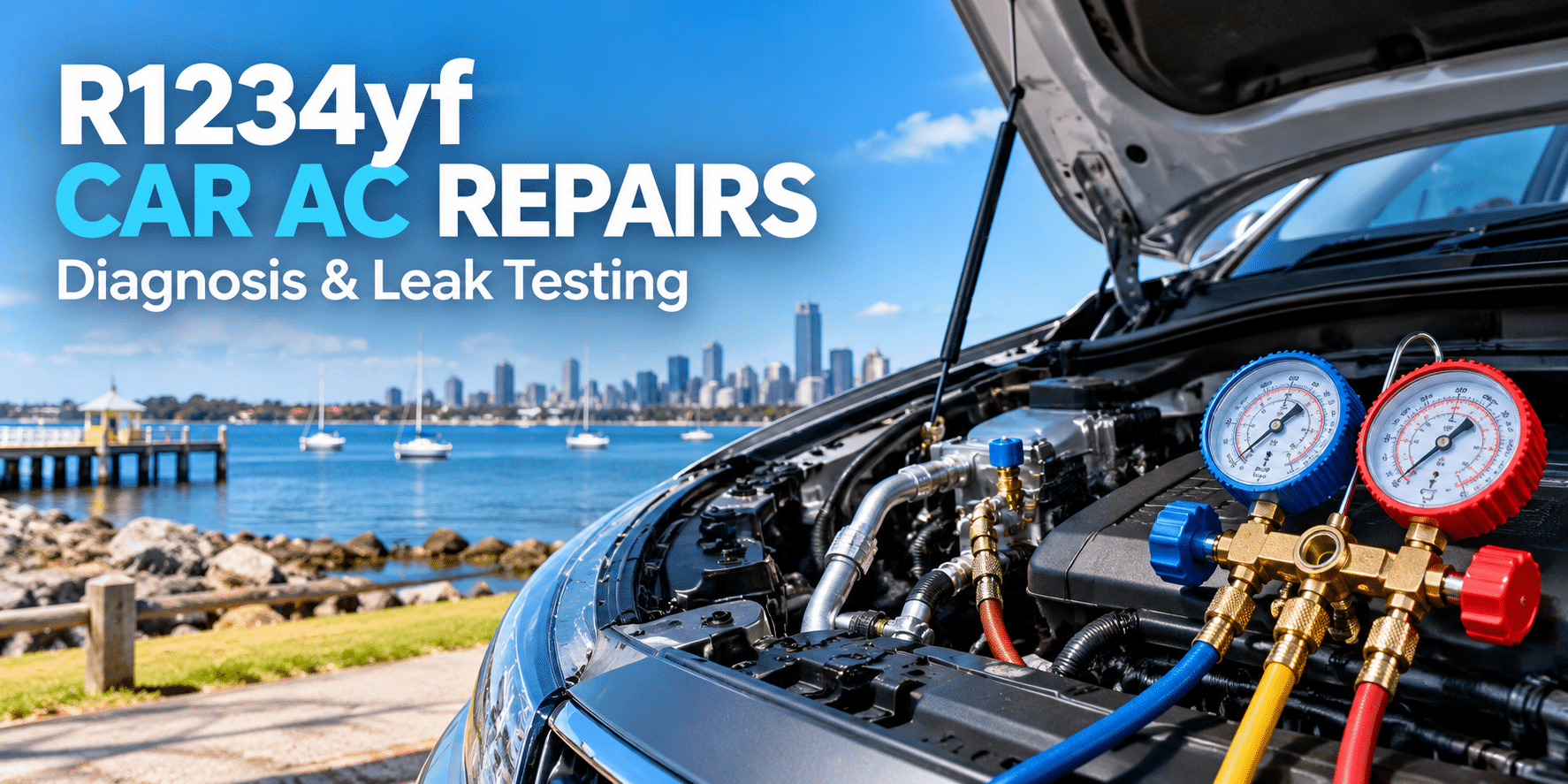
24 May R1234yf Car Air Conditioning Repairs Brisbane
R1234yf Car AC Repairs Brisbane – Mobile Diagnosis & Leak Testing
R1234yf car AC repairs in Brisbane require the correct equipment, careful diagnosis and an understanding of modern automotive air conditioning systems. If your vehicle’s air conditioning is blowing warm air, cooling intermittently or losing refrigerant, the fault should be investigated before another regas is considered.
At Keepin Cool Auto Air, we provide mobile car air conditioning inspections, leak detection, regassing and suitable repairs throughout Brisbane Bayside and Redland City.
With over 40 years of automotive air conditioning experience and ARCtick authorisation AU13448, we take a diagnostic-first approach. We don’t just add gas — we inspect and leak-test the system first, using professional methods such as Trace-A-Gas where appropriate.
What Is R1234yf Refrigerant?
HFO-R1234yf is a modern refrigerant used in many newer vehicle air conditioning systems. It was introduced as a lower-global-warming-potential alternative to R134a.
Although both refrigerants are used for automotive cooling, they have different handling and equipment requirements.
R1234yf is classified as an A2L mildly flammable refrigerant, meaning appropriate safety precautions are essential when working with it.
R1234yf systems require compatible service fittings, recovery and charging equipment, and suitable leak detection procedures.
Can R134a and R1234yf Be Mixed?
No. R134a and R1234yf must not be mixed or treated as interchangeable refrigerants.
Using the wrong refrigerant can result in:
- Refrigerant contamination
- Incorrect operating pressures or cooling performance
- Compatibility and service equipment problems
- Potential safety concerns
- Expensive corrective work
Australian refrigerant charging rules also restrict substituting a higher-global-warming-potential refrigerant into equipment designed for a lower-impact refrigerant.
The correct refrigerant should always be established from the vehicle manufacturer’s specifications and refrigerant identification label.
Common R1234yf Car Air Conditioning Problems
Modern R1234yf systems can experience many of the same faults as R134a systems. However, correct testing procedures and compatible equipment are particularly important.
1. Refrigerant Leaks
A refrigerant leak is one possible reason your car’s air conditioning gradually loses cooling performance.
Leaks may develop in:
- Condenser cores damaged by stones or corrosion
- Compressor seals and connections
- Air conditioning hoses and pipework
- O-rings and service fittings
- Evaporator cores behind the dashboard
Some leaks are extremely small and may only become noticeable after the system has lost enough refrigerant to affect cooling.
At Keepin Cool, we inspect accessible components and use suitable leak detection methods, including Trace-A-Gas where appropriate, to help locate refrigerant leaks.
If a leak is identified, we’ll explain the necessary repair before recommending a regas.
Read more about our car AC leak detection service.
2. Compressor Problems
The compressor circulates refrigerant through the air conditioning system.
Depending on the vehicle, the compressor may use an electromagnetic clutch, an electronically controlled regulating valve or another manufacturer-specific control arrangement.
Possible compressor-related faults include:
- Internal mechanical wear
- Failed compressor control valves
- Electrical control problems
- Bearing or clutch problems where fitted
- Internal compressor damage
A compressor that isn’t operating correctly does not automatically require replacement.
Other faults can prevent compressor operation, including sensor problems, refrigerant system conditions and electronic control issues.
Proper testing helps avoid replacing expensive components unnecessarily.
3. Condenser Leaks and Damage
The air conditioning condenser is normally positioned near the front of the vehicle.
Its location makes it vulnerable to:
- Stone damage
- Corrosion
- Road debris
- Vibration-related damage
- Small refrigerant leaks
A tiny condenser pinhole can allow refrigerant to escape gradually until the air conditioning stops cooling effectively.
Where a condenser is confirmed to be leaking, replacement may be necessary before regassing can proceed.
4. Cooling Fan and Electrical Faults
Not every R1234yf cooling problem is caused by low refrigerant.
Common electrical and airflow issues include:
- Radiator or condenser cooling fans not operating
- Damaged wiring and connectors
- Faulty refrigerant pressure sensors
- Electronic compressor control faults
- Related relays, control modules or electrical components
One common symptom is air conditioning that cools while driving but becomes warm when stopped in traffic.
This may indicate insufficient airflow through the condenser, although other faults can produce similar symptoms.
Checking system operation helps identify whether the problem is electrical, mechanical or refrigerant-related.
5. Expansion Valve Problems
The expansion valve regulates refrigerant flow into the evaporator.
A restricted or malfunctioning valve can affect refrigerant pressures and cooling performance.
Possible symptoms include intermittent cooling, fluctuating vent temperatures and abnormal system operating conditions.
A proper assessment is necessary because other air conditioning faults can produce similar symptoms.
How We Diagnose R1234yf Car AC Repairs Brisbane
At Keepin Cool, our approach is to identify the problem before recommending repairs or regassing.
Step 1 — Initial Air Conditioning Inspection
We assess the reported symptoms and inspect accessible system components.
Depending on the vehicle and fault, this may include checking:
- Vent cooling performance
- Compressor operation
- Condenser and cooling fan operation
- Accessible hoses and pipework
- Relevant electrical controls
- Visible signs of damage or refrigerant leakage
These checks help determine which further tests are appropriate.
Step 2 — Refrigerant Identification and System Safety
Before servicing an R1234yf system, the correct refrigerant type must be established.
The vehicle’s refrigerant identification label and manufacturer specifications provide important information.
Where refrigerant contamination is suspected or its composition is uncertain, suitable refrigerant identification testing should be considered before connecting recovery or servicing equipment.
Refrigerant identifiers help distinguish pure R1234yf from potentially contaminated mixtures.
This protects servicing equipment and helps prevent incompatible refrigerants from being introduced into the vehicle.
Step 3 — Professional Leak Detection
If refrigerant loss is suspected, the system is assessed using methods appropriate to the vehicle and the condition of the air conditioning system.
One method we use is Trace-A-Gas leak detection, where suitable for the system and test procedure.
Trace-A-Gas testing uses an appropriate tracer-gas mixture and compatible detection equipment to help locate small leaks.
Other inspection or electronic leak detection methods may also be appropriate.
Leak testing must follow relevant equipment instructions, safety precautions and manufacturer requirements. Correct pressure limits and suitable test gases are essential.
A refrigerant leak should be identified and repaired where practical before recharging the system.
Step 4 — Electrical and Mechanical Diagnosis
Where the system is not cooling correctly but refrigerant loss has not been established, further checks may be required.
These can include cooling fan operation, compressor controls, pressure sensors and other relevant electrical or mechanical components.
The objective is to identify the actual fault instead of assuming the vehicle simply needs more refrigerant.
Step 5 — Repair Recommendation
Once the fault has been assessed, we’ll explain the findings and quote the necessary repair where appropriate.
Some faults can be repaired during a mobile visit. Other repairs may require parts or additional work that must be arranged separately.
We only recommend regassing when the system’s condition makes it appropriate.
Can an R1234yf System Be Regassed Without Repairs?
Yes, provided the inspection indicates that regassing is suitable and no fault requiring repair prevents the service.
When the system is suitable, the process may include:
- Recovering existing refrigerant using compatible equipment and appropriate procedures.
- Checking the system’s condition.
- Evacuating the system and carrying out the relevant vacuum checks.
- Recharging with the manufacturer-specified quantity of R1234yf.
- Using appropriate compressor oil and compatible UV dye where permitted by manufacturer requirements.
- Completing a final operating and cooling performance check.
The refrigerant charge should be measured accurately according to the vehicle manufacturer’s specifications.
If a leak or component fault means the regas cannot proceed, we’ll explain the problem and quote the repair first.
An inspection fee may apply when regassing cannot proceed or necessary repairs are declined.
For current charges, see our car air conditioning prices Brisbane page.
Why R1234yf Requires Specialised Servicing Equipment
R1234yf is mildly flammable and must be handled using suitable equipment and safe procedures.
The Australian Refrigeration Council provides guidance on equipment for servicing R1234yf systems, including:
- Compatible refrigerant recovery and charging equipment
- Appropriate service hoses and connectors
- A2L-compatible leak detection equipment
- Suitable vacuum pumps
- Refrigerant identification equipment where required
R1234yf service connections differ from those used for R134a, helping reduce the risk of connecting incompatible equipment.
It is important that technicians follow the relevant manufacturer instructions, applicable Australian safety requirements and equipment standards.
ARCtick Licensing and R1234yf
Keepin Cool Auto Air holds ARCtick authorisation AU13448, reflecting our established work with regulated automotive refrigerants such as R134a.
Pure R1234yf is treated differently from regulated HFC refrigerants under Commonwealth ozone and synthetic greenhouse gas legislation. An ARC refrigerant handling licence is not specifically required under that legislation solely for handling pure R1234yf.
However, appropriate training, equipment and compliance with applicable workplace health and safety obligations remain essential.
You can learn more through the Australian Refrigeration Council’s R1234yf technical guidance.
Mobile R1234yf Car Air Conditioning Repairs Across Brisbane Bayside and Redland City
Keepin Cool provides owner-operated mobile vehicle air conditioning services at suitable homes and workplaces.
Our local service area includes:
- Cleveland and Ormiston
- Capalaba and Alexandra Hills
- Birkdale and Wellington Point
- Thornlands and Victoria Point
- Redland Bay and Mount Cotton
- Wynnum, Manly and Lota
- Tingalpa, Wakerley and surrounding serviced suburbs
We work on suitable cars, SUVs, utes, 4WDs and light-commercial vehicles manufactured from 1999 onwards.
Not every vehicle or repair is suitable for our mobile service. We can assess the vehicle details and reported symptoms before confirming the work.
Our focus remains on reliable diagnosis, clear repair recommendations and professional mobile service throughout Brisbane Bayside and Redland City.
Frequently Asked Questions About R1234yf Car AC Repairs
Why is my R1234yf car air conditioning blowing warm air?
Possible causes include refrigerant leaks, compressor faults, condenser damage, cooling fan problems and electrical issues. An inspection is needed to identify the cause accurately.
Is R1234yf more difficult to service than R134a?
R1234yf requires compatible service equipment and appropriate precautions because it is classified as mildly flammable. Technicians must follow suitable procedures and manufacturer specifications.
Can I replace R1234yf with R134a to reduce the cost?
No. R134a should not be substituted into a vehicle designed for R1234yf. Using the wrong refrigerant can create system compatibility, servicing, regulatory and safety problems.
Does an R1234yf system always need a regas when cooling becomes weak?
No. Reduced cooling can result from refrigerant loss, electrical faults, condenser airflow problems or mechanical component failures. Diagnosis should come before regassing.
Can Trace-A-Gas detect small refrigerant leaks?
Trace-A-Gas can help locate small leaks when used with suitable detection equipment and appropriate testing procedures. The method must be suitable for the vehicle and the condition of its air conditioning system.
How much do R1234yf car AC repairs cost?
Repair costs depend on the fault, affected components and work required. We’ll inspect the system and provide a repair quote where necessary.
Our current car AC prices explain the available regassing and inspection services.
Can you service my R1234yf car air conditioning at home?
Yes, for suitable vehicles and jobs within our Brisbane Bayside and Redland City service areas. Some repairs may require additional parts or work beyond an initial mobile visit.
Need R1234yf Car AC Repairs in Brisbane Bayside or Redland City?
If your vehicle’s air conditioning is blowing warm air, losing refrigerant or cooling intermittently, Keepin Cool Auto Air can help diagnose the problem before recommending repairs or regassing.
Call or SMS 0415 761 019, or use the website’s existing Quick SMS Quote button to enquire about a mobile appointment.
100% Mobile | ARCtick AU13448 | 40+ Years Experience