

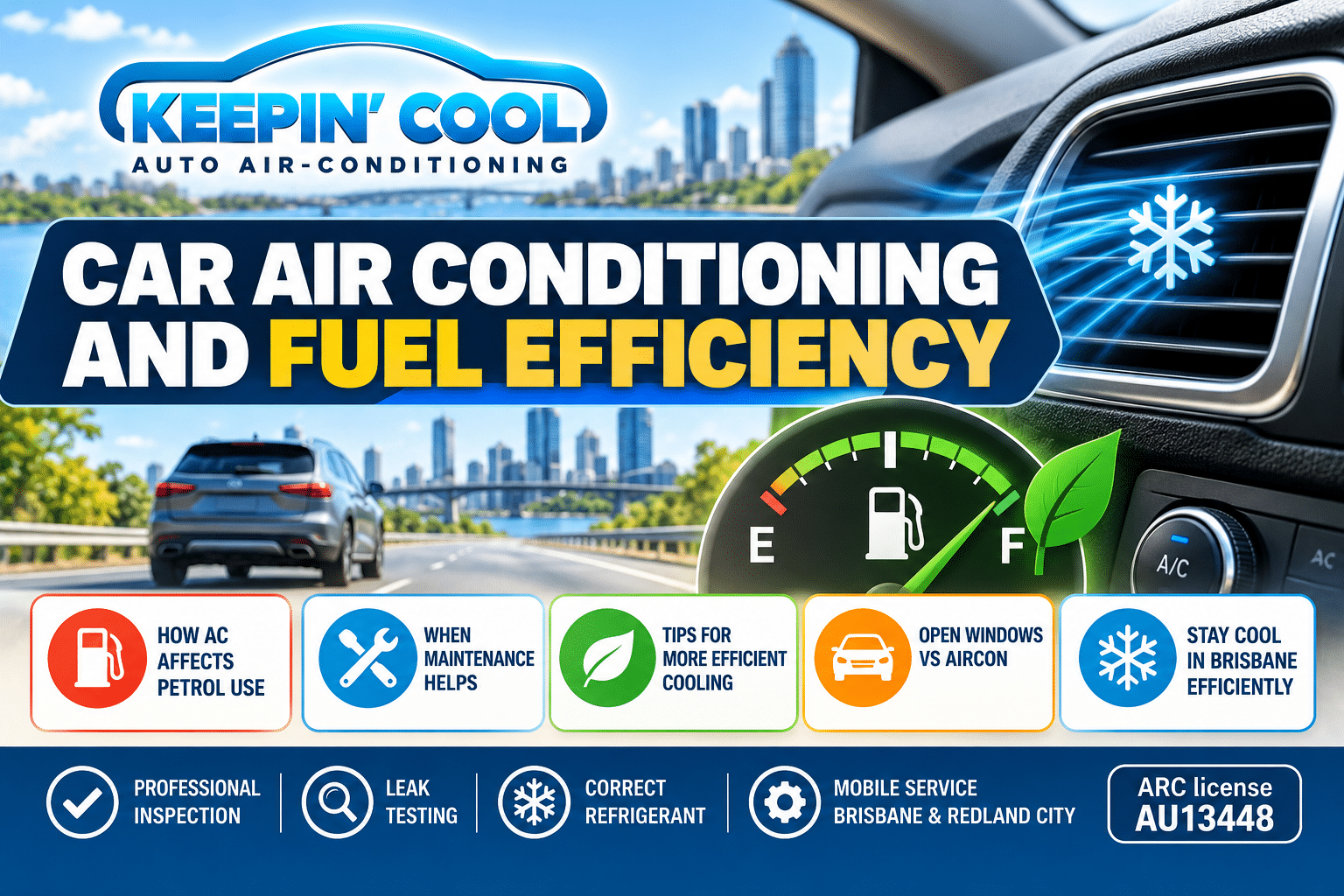
16 Jan Car Air Conditioning and Fuel Efficiency
Car AC Fuel Efficiency – Does Air Conditioning Use More Petrol?
Does running your car air conditioning increase fuel consumption? Yes. In petrol and diesel vehicles, air conditioning uses energy, placing an additional load on the engine.
However, there’s more to car AC fuel efficiency than simply turning the air conditioning off.
The amount of fuel your vehicle uses depends on the type of air conditioning system, outside temperature, driving conditions, vehicle speed and how effectively the cooling system is operating.
During Brisbane’s hot and humid summers, driving without air conditioning isn’t always a practical or comfortable option.
At Keepin Cool Auto Air, we provide professional mobile car air conditioning inspections, Trace-A-Gas leak detection, regassing and suitable repairs throughout Brisbane Bayside and Redland City.
With over 40 years of automotive air conditioning experience, our approach is to identify problems before recommending unnecessary servicing.
This guide explains how air conditioning affects fuel consumption, when maintenance may improve system efficiency and how to keep your vehicle comfortable without wasting energy.
How Does Car Air Conditioning Affect Fuel Efficiency?
Your vehicle’s air conditioning system removes heat and moisture from the cabin using a refrigeration circuit.
The compressor circulates refrigerant through the condenser, expansion device and evaporator.
In conventional petrol and diesel vehicles, operating the compressor ultimately requires engine power.
Depending on the vehicle, the compressor may be driven by a belt and controlled by a clutch, or it may use a variable-displacement design that adjusts its output.
When the air conditioning is operating, some of the engine’s available power is used to run the system.
That additional load can increase fuel consumption.
How Much Extra Petrol Does Car Aircon Use?
There isn’t one percentage that applies to every vehicle.
Fuel consumption varies according to:
- Vehicle make, model and engine size.
- Compressor design and operating load.
- Outside temperature and humidity.
- Cabin temperature settings.
- Driving speed and traffic conditions.
- Cabin size and the number of passengers.
- Cooling fan and condenser performance.
For example, maintaining a comfortable temperature on a mild day may require less cooling effort than bringing a vehicle’s extremely hot cabin down to temperature after it has been parked in the Queensland sun.
The important point is that air conditioning consumes energy, but the additional fuel used varies considerably.
An unusually high fuel-consumption reading isn’t enough on its own to diagnose an air conditioning fault.
Can Regular AC Maintenance Improve Car Fuel Efficiency?
Regular maintenance can help ensure that an air conditioning system operates as intended, but it doesn’t guarantee lower fuel consumption.
If the system has a problem that increases its operating load, correcting that fault may help restore normal efficiency.
However, if your car air conditioning is already operating correctly, servicing it won’t necessarily reduce petrol consumption.
Maintaining Correct Refrigerant System Operation
A vehicle air conditioning system requires the correct refrigerant type and manufacturer-specified charge quantity.
An incorrect charge can cause poor cooling or abnormal operating conditions.
A system with too much refrigerant may experience elevated pressures, while insufficient refrigerant can reduce cooling performance or cause protective controls to limit compressor operation.
The effect on fuel consumption depends on the system design and the fault.
It’s therefore inaccurate to assume that every vehicle with low refrigerant automatically uses more petrol.
Professional diagnosis is needed to understand what’s happening.
Keeping the Condenser Operating Correctly
The condenser releases heat from the refrigerant into the outside air.
If the condenser is obstructed or the cooling fan isn’t operating correctly, refrigerant pressures may increase and cooling performance can deteriorate.
Under certain conditions, this can increase compressor load or cause the system to reduce or stop cooling.
Inspecting condenser airflow and fan operation helps identify these faults.
Checking Cabin Airflow
A restricted cabin filter or faulty blower motor can reduce airflow through the dashboard vents.
This makes it harder to maintain cabin comfort.
Although a blocked filter doesn’t automatically mean the compressor consumes more fuel, restoring normal airflow helps the ventilation system perform properly.
The main benefit is reliable cooling and air circulation.
The goal of maintenance is to restore correct operation and prevent developing faults, not to promise fuel savings that may not occur.
Air Conditioning vs Open Windows – Which Uses Less Fuel?
This is one of the most common questions about car air conditioning and fuel consumption.
The answer depends largely on vehicle speed and aerodynamic drag.
Driving Around Brisbane Suburbs
At lower speeds, opening the windows may provide comfortable ventilation without operating the air conditioning compressor.
Because aerodynamic drag is generally less significant at lower speeds, this can sometimes use less fuel than running the AC.
However, Brisbane’s high humidity and summer temperatures can make outside ventilation uncomfortable.
If the cabin is hot and humid, air conditioning may be the more practical option.
Driving on Motorways and Highways
At higher speeds, open windows can significantly affect the way air flows around a vehicle.
That additional aerodynamic drag increases the energy required to maintain speed.
Depending on the vehicle and driving conditions, using air conditioning with the windows closed can be more efficient than driving with several windows open.
This is also reflected in Ford Australia’s advice about air conditioning and fuel economy.
Quick Comparison
| Driving situation | Practical approach |
|---|---|
| Parked in the sun | Release trapped hot air before cooling |
| Short trip in mild weather | Open windows may be sufficient |
| Slow suburban driving | Choose ventilation or AC based on comfort |
| Motorway driving | Closed windows with AC can reduce aerodynamic drag |
| Hot, humid weather | Use AC for comfortable cabin cooling and dehumidification |
| Windscreen misting | Use the vehicle’s appropriate demisting settings |
No single setting is best for every vehicle or every journey.
Seven Ways to Use Your Car Air Conditioning More Efficiently
You don’t need to stop using your air conditioning to be mindful of fuel consumption.
A few practical habits can improve comfort while avoiding unnecessary cooling demand.
1. Let Trapped Heat Escape First
A vehicle parked in direct sunlight can become considerably hotter than the surrounding air.
Before setting the air conditioning to maximum, briefly open the windows to release some of the trapped heat.
Once the hottest air has escaped, close the windows and allow the air conditioning to cool the cabin.
This can reduce the initial cooling demand compared with trying to cool a sealed cabin full of extremely hot air.
2. Use Recirculation Mode Appropriately
Recirculation mode directs air already inside the cabin back through the air conditioning system.
Once the cabin has started cooling, this can help the system maintain a comfortable temperature without continually drawing in hot outside air.
However, prolonged recirculation may not be appropriate in every situation.
Follow the vehicle manufacturer’s instructions and use fresh-air mode when needed for ventilation or demisting.
3. Choose a Comfortable Temperature
Setting the air conditioning to its coldest possible temperature isn’t always necessary.
Where the vehicle allows it, choose a comfortable cabin temperature and allow the climate-control system to regulate cooling demand.
Modern automatic climate-control systems may adjust fan speed, compressor output and ventilation settings to maintain the selected temperature.
4. Check the Cabin Air Filter
A blocked cabin filter can restrict airflow and make cooling feel less effective.
Check the filter according to the vehicle manufacturer’s servicing recommendations.
If airflow becomes unusually weak, have the filter and blower system inspected.
A clean filter helps maintain proper cabin ventilation but doesn’t guarantee a measurable improvement in fuel economy.
5. Avoid Unnecessary Engine Idling
Leaving a petrol or diesel vehicle idling for long periods while the air conditioning runs consumes fuel without covering any distance.
If you’re parked for an extended period, consider whether the engine needs to remain running.
Always prioritise passenger safety, particularly in hot weather, and never leave children or pets unattended in a vehicle.
6. Investigate Cooling Problems Early
If your air conditioning becomes noticeably less effective, don’t assume the solution is more refrigerant.
The problem may involve a condenser fan, compressor, refrigerant leak or electrical control fault.
Professional diagnosis can help identify the cause before more expensive components are damaged.
7. Keep Up With General Vehicle Maintenance
Air conditioning is only one factor influencing fuel economy.
Tyre pressures, unnecessary vehicle weight, driving style and engine condition can have a substantial impact.
Australian Government fuel-saving guidance recommends maintaining your vehicle, reducing unnecessary aerodynamic drag and using air conditioning sensibly.
A properly maintained car and appropriately operating AC system are both important, but they address different aspects of vehicle efficiency.
Can Low Refrigerant Increase Fuel Consumption?
Not necessarily.
This is one of the most misunderstood areas of automotive air conditioning.
A system with insufficient refrigerant may cool poorly, but its effect on engine load depends on the compressor type and the vehicle’s control strategy.
Some systems may reduce or stop compressor operation when pressure falls outside the permitted range.
Others may continue operating with reduced cooling performance.
What About Too Much Refrigerant?
An excessive refrigerant charge can produce abnormal operating pressures and affect heat transfer.
Depending on the system, this may increase compressor load or cause pressure-related protection controls to operate.
Overcharging can also create conditions that damage components.
The correct refrigerant quantity is therefore important for reliable system performance.
However, neither low nor high refrigerant charge can be accurately confirmed from cabin temperature alone.
The proper approach is to inspect the system and recharge to the manufacturer’s specified refrigerant weight when servicing is required.
Car AC Problems That May Affect System Efficiency
Several faults can interfere with normal air conditioning performance.
Compressor Problems
A compressor may develop mechanical, clutch or electronic control problems.
Internal mechanical wear can increase resistance, while a faulty control valve may prevent correct cooling operation.
A noisy or poorly performing compressor should be investigated before replacement.
Keepin Cool provides professional car AC compressor diagnosis and replacement for suitable vehicles.
Condenser Cooling Fan Faults
A cooling fan that isn’t operating correctly may allow refrigerant pressures to become abnormally high, especially when the vehicle is stationary.
This can reduce cooling and increase system stress.
Typical symptoms include air conditioning that works while driving but becomes warm at traffic lights.
Refrigerant Leaks
A damaged condenser, leaking hose or deteriorated seal can allow refrigerant to escape.
As the charge falls, cooling performance may deteriorate.
Repeatedly adding refrigerant won’t repair the damaged component.
Professional leak detection helps determine whether the issue is a repairable hose connection, damaged condenser or another system fault.
Electrical and Sensor Problems
Pressure sensors, compressor control circuits, cooling fans and climate-control modules all contribute to correct system operation.
A fault in one of these components can prevent efficient cooling without any refrigerant loss.
Diagnosing these problems helps avoid unnecessary regassing or compressor replacement.
Why Keepin Cool Inspects and Leak-Tests Before Regassing
At Keepin Cool Auto Air, we don’t simply add refrigerant whenever a vehicle stops cooling.
Our professional mobile service begins with an inspection and appropriate leak testing.
Depending on the vehicle’s symptoms, we may assess:
- Vent temperatures and airflow.
- Compressor operation and electrical controls.
- Refrigerant system pressures.
- Condenser cooling fan operation.
- Accessible refrigerant hoses and connections.
- Signs of damage or refrigerant leakage.
- Other components relevant to the reported fault.
If a leak is suspected, we use appropriate testing methods, including Trace-A-Gas where required.
What Is Trace-A-Gas Leak Detection?
Trace-A-Gas involves using a suitable hydrogen/nitrogen tracer mixture to help identify leaks in an appropriately prepared refrigerant system.
Specialist detection equipment is used to investigate escaping tracer gas around condensers, hoses, fittings and other components.
This can help locate small leaks that are difficult to identify visually.
You can read more about our car air conditioning leak detection service.
What Happens If the System Passes Inspection?
If the vehicle is suitable for regassing, the service includes:
- Recovering remaining refrigerant using appropriate equipment.
- Performing the required system preparation and evacuation.
- Recharging with the manufacturer’s specified refrigerant type and weight.
- Adding appropriate compressor oil and UV dye.
- Carrying out final operating and cooling-performance checks.
If repairs are required beforehand, we’ll explain the fault and provide a quote before proceeding.
If you decline the required repairs, the applicable inspection fee applies rather than charging for an unsuccessful regas.
For more information, see our car AC inspection and fault diagnostics page.
How Often Should You Regas Your Car Air Conditioning?
Keepin Cool recommends regassing your car air conditioning every two to four years, following a professional inspection and leak test.
This is our recommended preventative servicing interval, rather than a guarantee that every vehicle requires additional refrigerant at a particular age.
If the system is operating normally, an inspection can help determine whether refrigerant servicing is appropriate.
If cooling performance deteriorates before the recommended interval, the system should be checked earlier.
A refrigerant leak or electrical fault won’t be corrected simply by waiting for the next scheduled service.
Regular attention can help identify developing problems and maintain reliable cooling during Brisbane’s hot weather.
For a more detailed explanation, read our car air conditioning regas schedule guide.
R134a and HFO-R1234yf – Does Refrigerant Type Affect Efficiency?
Keepin Cool services suitable vehicles using R134a and HFO-R1234yf refrigerants.
R134a Car Air Conditioning
R134a is used in many established passenger cars, SUVs, utes and 4WDs.
We provide professional R134a car air conditioning regassing using suitable recovery and charging equipment.
HFO-R1234yf Car Air Conditioning
Many newer vehicles use HFO-R1234yf, a refrigerant with a substantially lower direct global warming potential.
Keepin Cool also provides HFO-R1234yf car aircon regassing for suitable vehicles.
Which Refrigerant Uses Less Fuel?
Neither refrigerant can be declared universally more fuel-efficient based only on its name.
Real-world performance depends on the system design, compressor, heat exchangers, charge quantity and operating conditions.
The correct refrigerant is the one specified by the vehicle manufacturer.
R134a and HFO-R1234yf must not be mixed or substituted for one another.
How Much Does a Professional Car Aircon Service Cost?
The cost of servicing depends on the vehicle, refrigerant type and whether repairs are necessary.
Rather than repeating prices across individual technical blogs, Keepin Cool maintains one dedicated pricing page.
Visit our Car Air Conditioning Prices Brisbane page for current inspection, regas and common repair charges.
We explain the findings before recommending any additional work.
This approach helps customers understand what their vehicle actually requires rather than paying for refrigerant servicing that may not solve the problem.
Mobile Car Air Conditioning Across Brisbane Bayside & Redland City
Keepin Cool Auto Air is an owner-operated mobile automotive air conditioning specialist based in Mount Cotton.
We provide professional inspections, refrigerant leak detection, regassing and suitable repairs at accessible homes and workplaces throughout Brisbane Bayside and Redland City.
Our regular service areas include:
- Cleveland, Capalaba and Alexandra Hills.
- Birkdale, Wellington Point and Ormiston.
- Thornlands, Victoria Point and Redland Bay.
- Mount Cotton and surrounding serviced suburbs.
- Wynnum, Manly, Lota and Tingalpa.
- Other selected Brisbane Bayside suburbs.
We work on suitable conventional petrol and diesel vehicles manufactured from 1999 onwards, including cars, SUVs, utes, 4WDs and selected light commercial vehicles.
Hybrid and electric vehicles are outside our current service scope.
Visit our car air conditioning service areas page to confirm local coverage.
Why Choose Keepin Cool Auto Air?
Keepin Cool was established in 2006 and specialises in mobile automotive air conditioning service across Brisbane Bayside and Redland City.
With more than 40 years of hands-on experience, Jamie focuses on identifying the actual problem before recommending regassing or replacement components.
Our services include:
- Professional mobile car air conditioning diagnostics.
- Trace-A-Gas refrigerant leak detection.
- R134a and HFO-R1234yf regassing.
- Compressor and condenser fault diagnosis.
- Suitable refrigerant hose repairs.
- Electrical and cooling-performance checks.
- Clear repair recommendations and upfront quotes.
Keepin Cool holds ARCtick business authorisation AU13448.
You can check authorised businesses through the official ARCtick Business Search.
Frequently Asked Questions About Car AC Fuel Efficiency
Does car air conditioning use more petrol?
Yes. In conventional petrol and diesel vehicles, operating the air conditioning uses engine power and can increase fuel consumption. The amount varies with the vehicle and driving conditions.
Will regassing my car aircon improve fuel economy?
Not necessarily. Regassing may restore cooling when refrigerant servicing is appropriate, but it doesn’t automatically reduce fuel consumption. The system should be inspected first.
Does turning the AC off save fuel?
It can reduce the load associated with air conditioning. However, driving at high speeds with windows open may create additional aerodynamic drag that offsets some of the saving.
Is it better to use recirculation mode?
Recirculation can help cool an already hot cabin more effectively by reusing conditioned air. Fresh-air mode may be needed for ventilation or demisting, so follow the vehicle manufacturer’s guidance.
Does a dirty cabin filter increase petrol consumption?
A dirty filter restricts airflow and can reduce comfort, but it doesn’t necessarily produce a measurable increase in fuel consumption. Replacing a restricted filter helps maintain proper ventilation.
Can a faulty compressor use more fuel?
Certain mechanical faults can increase the load on the engine. However, some compressor faults cause the system to stop operating instead. Professional diagnosis is required.
How often should car air conditioning be regassed?
Keepin Cool recommends a regas every two to four years, subject to inspection and leak testing. Additional diagnosis may be required sooner if cooling performance deteriorates.
Can you check my air conditioning at home?
Yes. Keepin Cool provides mobile car air conditioning inspections, leak testing, regassing and suitable repairs at accessible homes and workplaces throughout Brisbane Bayside and Redland City.
How long does a mobile inspection and regas take?
A straightforward appointment generally takes approximately 30–40 minutes. Additional diagnostic work or repairs may take longer.
Ready to Have Your Car Air Conditioning Checked?
If your car air conditioning isn’t cooling properly, uses an unusual amount of energy or has developed a compressor or cooling fan problem, professional diagnosis is the best starting point.
Keepin Cool Auto Air provides mobile inspections, Trace-A-Gas leak detection, regassing and suitable repairs across Brisbane Bayside and Redland City.
Call or SMS Jamie on 0415 761 019, or use the website’s existing Quick SMS Quote button.
Please include your suburb, vehicle make, model, year and a brief description of the air conditioning problem.
Keepin Cool Auto Air
100% Mobile | ARCtick AU13448 | 40+ Years Experience