

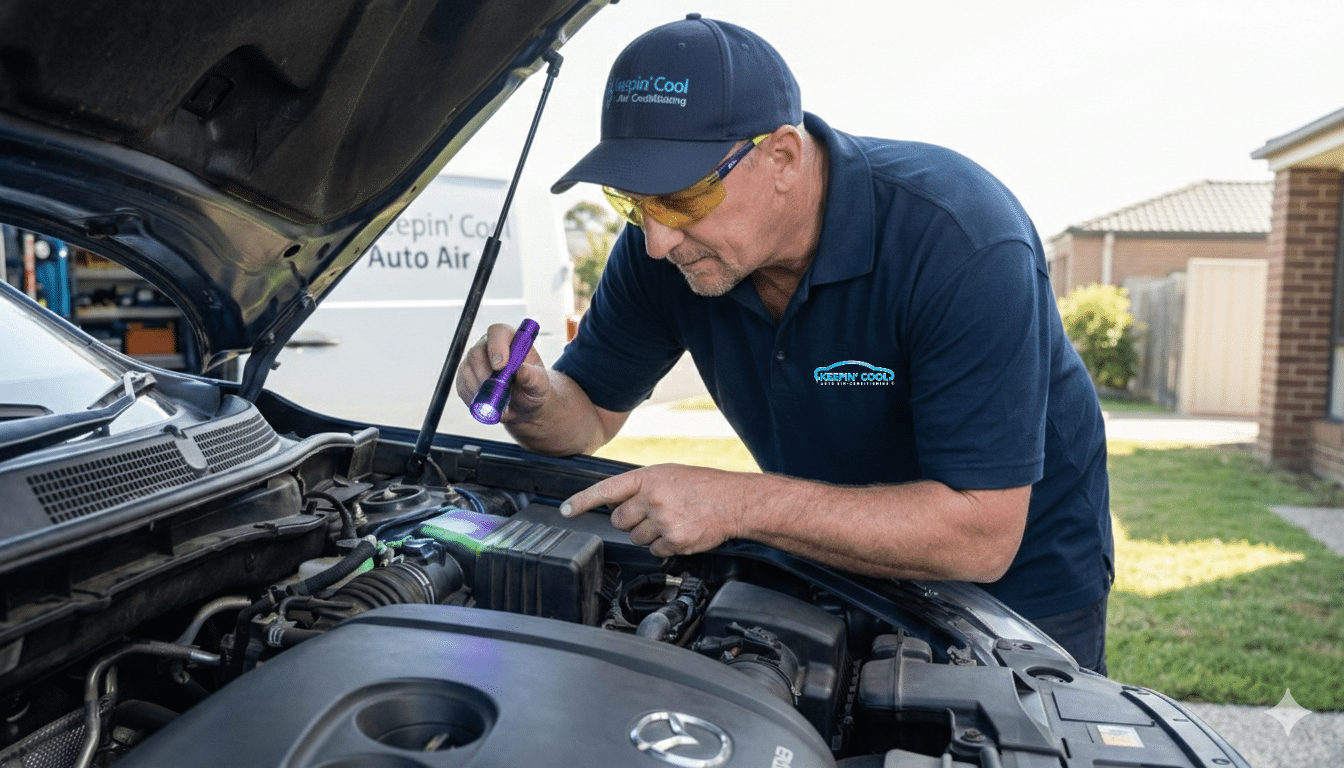
02 Jul Trace Gas Car Air Conditioning Leak Detection Brisbane
Trace Gas Leak Detection: Finding Hidden Car Air Conditioning Leaks the Right Way
If your car air conditioning keeps losing refrigerant, another regas will not repair the underlying leak. Finding where the refrigerant is escaping helps determine the repair needed.
Keepin Cool Auto Air provides mobile trace gas car air conditioning leak detection across Brisbane Bayside and Redland City, coming to your home or workplace.
With more than 40 years of experience diagnosing and repairing vehicle air conditioning systems, we use Trace-A-Gas testing, electronic refrigerant detection and UV dye inspection as appropriate for the system and suspected fault.
We explain our findings and quote for the recommended repair before proceeding. Our mobile service covers Redland City and Brisbane Bayside.
Why Does My Car Air Conditioning Keep Losing Refrigerant?
One of the most common questions we hear is:
“Why does my air conditioner need regassing every year?”
The answer is simple.
A sealed air conditioning system should not lose enough refrigerant to stop cooling.
If the system has become warm again, there’s usually a leak that needs to be found.
Some leaks are obvious, while others are so small they can be extremely difficult to locate.
That’s where professional diagnostic equipment makes all the difference.
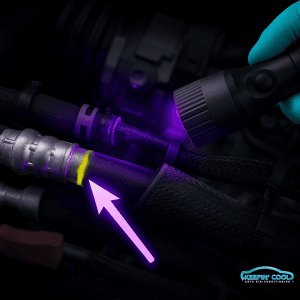
What Is Trace Gas Car Air Conditioning Leak Detection?
Trace gas testing helps locate small or difficult-to-find leaks in a vehicle’s air conditioning system.
The system is tested using a specialised nitrogen and hydrogen mixture. A sensitive electronic detector identifies escaping hydrogen, helping us locate the source of the leak.
We check accessible components and investigate suspected leak locations. Concealed components, such as an evaporator inside the dashboard, may require further testing or access to confirm the fault.
The findings help us recommend the appropriate repair before the system is recharged.
When Is Trace Gas the Best Choice?
Every air conditioning fault is different.
Sometimes UV dye quickly reveals the leak.
Other times the system may already be completely empty, making trace gas a much better option.
We often recommend trace gas testing when:
- The refrigerant has completely leaked out.
- Previous inspections haven’t located the fault.
- A very slow leak is suspected.
- Multiple leak points may exist.
- We need to confirm the exact location before replacing expensive parts.
Choosing the right testing method saves both time and money.
Common Places Car Air Conditioning Systems Leak
Over the years we’ve found leaks in almost every part of a vehicle’s air conditioning system.
The most common locations include:
- Condensers damaged by road debris
- Compressor shaft seals
- Hose crimps
- Aluminium pipe joints
- O-rings
- Service valves
- Evaporators inside the dashboard
- Pressure switches
Some leaks are immediately obvious.
Others require specialised testing equipment to find.
Why We Don’t Rely on Just One Leak Detection Method
No single testing method works perfectly on every vehicle.
That’s why we select the most appropriate diagnostic technique for each job.
UV Dye
UV dye is excellent for many refrigerant leaks.
Once added to the system, it circulates with the refrigerant and leaves a fluorescent stain wherever refrigerant escapes.
It’s particularly effective for:
- Condenser leaks
- Compressor leaks
- Hose leaks
- Pipe joint leaks

Electronic Leak Detection
Electronic detectors sense refrigerant escaping from the system.
They’re extremely useful for confirming active leaks during testing.
Trace Gas Car Air Conditioning Leak Detection
Trace gas is particularly useful when the system is empty or the leak is too small for conventional methods to identify quickly.
Using more than one diagnostic method gives us greater confidence before recommending repairs.
Our Leak Detection Process
We never replace expensive components based on guesswork.
Instead, we follow a structured diagnostic process.
Initial Inspection
We begin by inspecting the entire air conditioning system for visible damage, oil staining and signs of previous repairs.
System Testing
Operating pressures, vent temperatures and compressor performance are checked to understand how the system is behaving.
Leak Detection
Depending on the vehicle, we may use:
- UV dye
- Electronic refrigerant detection
- Trace gas leak detection
- Pressure testing
Sometimes we use more than one method to confirm the diagnosis.
Repair Recommendations
Once we’ve located the fault, we explain:
- What has failed
- Why it failed
- The recommended repair
- The expected repair cost
Our goal is always to repair the actual problem rather than replacing unnecessary parts.
Signs Your Vehicle May Have a Refrigerant Leak
Your air conditioning system may have a leak if you notice:
- Air is no longer cold.
- Cooling becomes weaker every few weeks.
- The compressor cycles on and off frequently.
- Oily residue around air conditioning components.
- The system has needed multiple regasses.
These symptoms can indicate a refrigerant leak, but poor cooling and compressor cycling can also have other causes. We inspect and test the system to determine whether refrigerant loss or another fault is responsible.
Why Accurate Diagnosis Saves Money
Repeatedly regassing a leaking air conditioning system can become expensive.
Finding and repairing the leak first helps:
- Prevent repeat failures
- Restore reliable cooling
- Reduce long-term repair costs
- Protect the environment by reducing refrigerant loss
Accurate diagnosis almost always saves money in the long run.
Why Choose Keepin Cool Auto Air?
With more than 40 years of hands-on experience, we specialise exclusively in vehicle air conditioning.
We provide:
- Fully mobile service
- ARCtick certified technician
- Professional leak detection equipment
- Trace gas testing
- UV dye diagnostics
- Electronic leak detection
- R134a servicing
- R1234yf servicing
- Honest advice based on accurate diagnosis
We proudly service customers throughout Redland City and Brisbane Bayside.
Frequently Asked Questions
Does trace gas damage my air conditioning system?
No. Trace gas is designed specifically for leak detection and is safely removed before the system is evacuated and recharged.
Is trace gas better than UV dye?
Not always. Both methods have advantages. We choose the most suitable diagnostic technique depending on the condition of your air conditioning system.
Can trace gas find tiny leaks?
Yes. Hydrogen molecules are extremely small, making trace gas one of the most sensitive leak detection methods available.
Why does my air conditioner keep needing regassing?
A properly sealed air conditioning system shouldn’t require regular regassing. Repeated refrigerant loss usually indicates a leak.
Can you perform leak detection at my home?
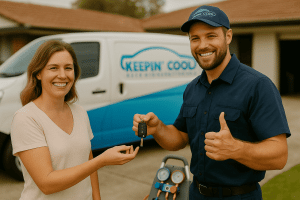
Yes. Our fully mobile service comes to your home or workplace throughout Redland City and Brisbane Bayside.
How long does leak detection take?
Most inspections take between one and two hours, depending on the fault and the testing required.
Should I repair the leak before regassing?
Yes. Repairing the leak first prevents the refrigerant from escaping again and avoids paying for repeated regassing.
Book a Professional Car Air Conditioning Leak Inspection
If your car air conditioning keeps losing refrigerant or becomes warm again after a regas, book a leak inspection with Keepin Cool Auto Air.
We use Trace-A-Gas testing, electronic leak detection and UV dye inspection as appropriate to investigate the fault. We explain our findings and quote for any recommended repairs before proceeding.
Our mobile service comes to your home or workplace across Redland City and Brisbane Bayside.
Call or text 0415 761 019 with your vehicle’s make, model, year and suburb. Tell us how long the cooling lasts and whether the system has recently been regassed or repaired.