

16 May What Is Car AC Refrigerant?
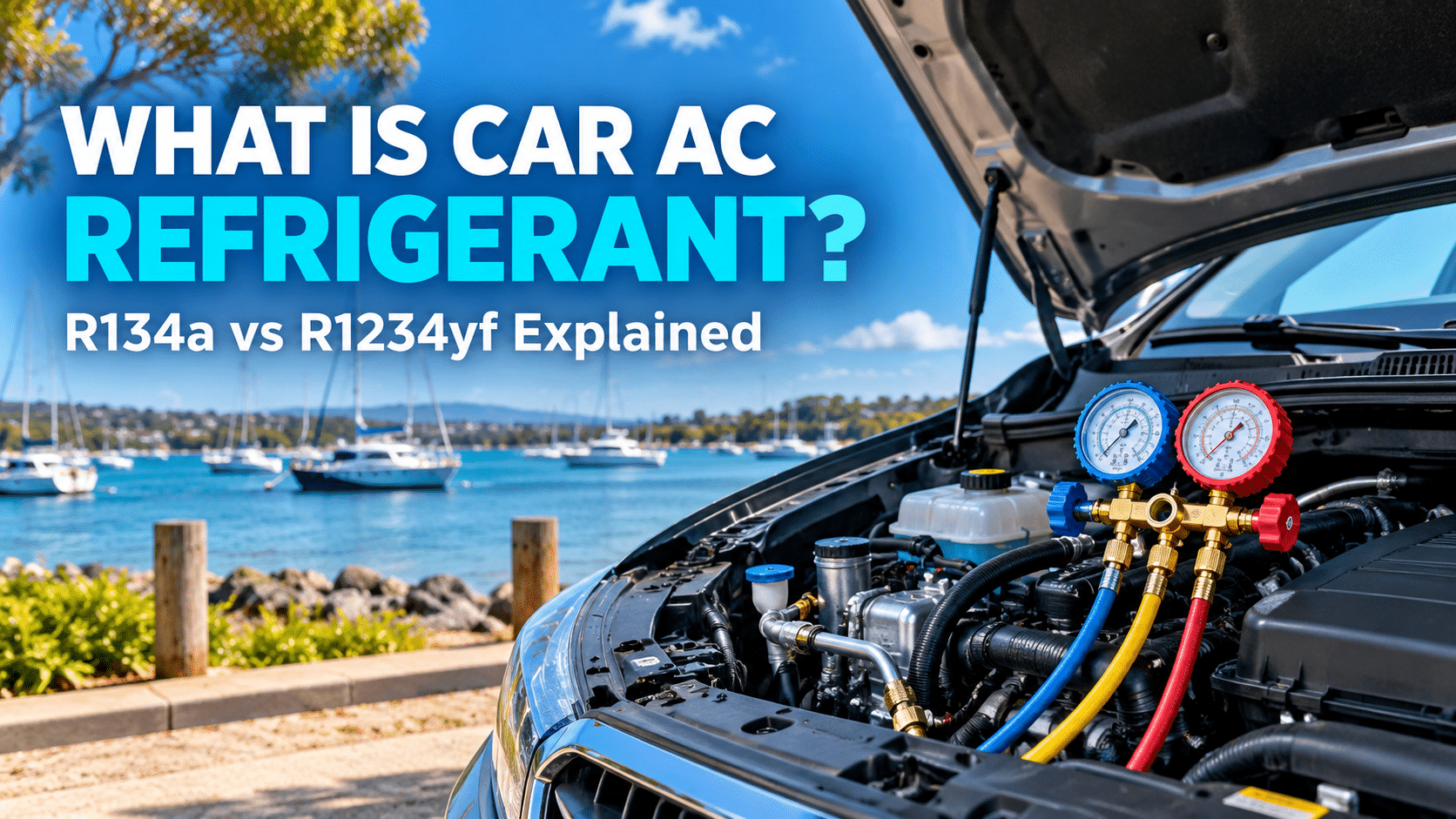
What Is Car AC Refrigerant? R134a and R1234yf Explained
What is car AC refrigerant, and why is it important for keeping your vehicle cool? Refrigerant is the substance that circulates through your car’s air conditioning system, absorbing heat from inside the cabin and releasing it outside.
Most conventional vehicle air conditioning systems serviced by Keepin Cool Auto Air use either R134a or HFO-R1234yf refrigerant. Although both perform the same basic cooling function, they have different environmental characteristics and servicing requirements.
At Keepin Cool Auto Air, we provide mobile air conditioning inspections, leak detection, regassing and suitable repairs across Brisbane Bayside and Redland City.
With over 40 years of automotive air conditioning experience, we follow an inspection-first approach. We check the system and investigate refrigerant leaks before recommending a regas.
How Does Car Air Conditioning Refrigerant Work?
Your car’s air conditioning system does not simply create cold air. It transfers heat from the vehicle’s interior to the outside atmosphere.
Refrigerant circulates through a sealed system and changes between liquid and vapour as its pressure and temperature change.
The main components involved include:
- Compressor: Circulates and compresses refrigerant.
- Condenser: Releases heat to the outside air.
- Expansion device: Controls refrigerant flow and reduces its pressure before the evaporator.
- Evaporator: Absorbs heat from the cabin air.
- Refrigerant pipes and hoses: Connect the system components.
The blower fan moves cabin air across the cold evaporator, delivering cooled and dehumidified air through the dashboard vents.
When everything operates correctly, refrigerant continuously circulates through the system rather than being consumed like petrol or diesel.
R134a vs R1234yf — What’s the Difference?
Two common refrigerants used in automotive air conditioning systems are R134a and HFO-R1234yf.
They serve similar purposes but must be handled according to their individual characteristics and the vehicle manufacturer’s specifications.
R134a Refrigerant
R134a is an HFC refrigerant widely used in vehicles manufactured over several decades.
It replaced older R12 refrigerant in many automotive applications and remains common in passenger cars, SUVs, utes and 4WDs.
R134a has an A1 safety classification and a relatively high global warming potential compared with modern R1234yf.
Vehicles designed for R134a require the correct refrigerant, compatible compressor oil and appropriate recovery and charging equipment.
For more information, visit our R134a car air conditioning regas service.
HFO-R1234yf Refrigerant
HFO-R1234yf is used in many newer vehicles because it has a substantially lower global warming potential than R134a.
It is classified as A2L — mildly flammable.
This means servicing requires appropriate safety precautions and equipment compatible with R1234yf.
R1234yf and R134a must not be mixed or substituted for each other during routine servicing.
The refrigerant specified by the vehicle manufacturer should always be confirmed before any recovery or charging work begins.
Learn more about our R1234yf car air conditioning regas service.
Comparison of R134a and R1234yf
| Feature | R134a | HFO-R1234yf |
|---|---|---|
| Common use | Many established vehicles | Many newer vehicles |
| Refrigerant type | HFC | HFO |
| Global warming potential | Higher | Much lower |
| Safety classification | A1 | A2L, mildly flammable |
| Specialised servicing equipment | R134a compatible | R1234yf compatible |
| Can be mixed with the other refrigerant? | No | No |
Both refrigerants can provide effective air conditioning when used in the systems for which they were designed.
The correct type must be established from the vehicle rather than chosen based on price or convenience.
How Do I Know Which Refrigerant My Car Uses?
The most reliable starting point is the vehicle’s air conditioning identification label.
This may be located under the bonnet or near an air conditioning system component.
The label can identify:
- The specified refrigerant type.
- The manufacturer’s refrigerant charge quantity.
- The required compressor oil specification.
- Other servicing information relevant to the system.
If the label is missing or unclear, manufacturer service information should be consulted.
Vehicle age may provide a clue, but it is not a reliable way to confirm the refrigerant. Different manufacturers adopted R1234yf at different times.
Keepin Cool confirms the appropriate refrigerant before carrying out a suitable regas.
Does Car AC Refrigerant Need Replacing Regularly?
Refrigerant circulates through a sealed system and is not normally consumed during air conditioning operation.
However, a vehicle can lose refrigerant through leaks or other system problems.
An unexplained loss of refrigerant should be investigated rather than repeatedly topped up.
At Keepin Cool, we recommend periodic air conditioning checks, generally around every two years, and a service review no later than four years where appropriate.
This is a preventative servicing recommendation, not a claim that every vehicle requires a regas at those intervals.
If the air conditioning stops cooling properly, develops abnormal noises or repeatedly loses cooling performance, have it inspected sooner.
Signs Your Car May Have a Refrigerant Problem
When refrigerant is lost, the air conditioning system may struggle to transfer heat effectively.
Common symptoms include:
- Air conditioning blowing warm or insufficiently cold air.
- Cooling becoming weaker over time.
- The system cooling intermittently.
- Cooling performance deteriorating in hot weather.
- The system losing performance again after a previous regas.
These symptoms can indicate refrigerant loss, but they do not prove that a leak is present.
Compressor problems, electrical faults, condenser cooling fan failures and refrigerant flow restrictions can produce similar symptoms.
This is why professional diagnosis matters before adding refrigerant.
Where Do Car Air Conditioning Refrigerant Leaks Occur?
Refrigerant can escape from several components within the air conditioning system.
Common leak locations include:
Condenser Leaks
The condenser is located near the front of the vehicle and is exposed to road debris, corrosion and vibration.
Small stone damage or corrosion pinholes can cause gradual refrigerant loss.
Air Conditioning Hose Leaks
Rubber hoses, aluminium pipes, connections and seals can develop leaks through age, vibration or damage.
Depending on the component and condition, a suitable hose assembly may be repairable or require replacement.
Compressor Leaks
Compressor seals, fittings and other components can develop refrigerant leaks.
Compressor-related problems should be diagnosed before replacement is recommended.
Evaporator Leaks
The evaporator sits inside the vehicle’s ventilation housing, often behind the dashboard.
An evaporator leak may be more difficult to access and identify than an external condenser or hose leak.
The correct repair depends on the location and severity of the fault.
For more information, read our car AC refrigerant leak detection guide.
Why We Leak-Test Before Regassing
At Keepin Cool, we do not simply add refrigerant to every vehicle that arrives with poor cooling.
Our inspection-first approach helps establish whether the system is suitable for regassing or requires another repair.
Depending on the vehicle and symptoms, our assessment may include:
- Checking the reported air conditioning problem.
- Inspecting accessible components for damage or leakage.
- Assessing compressor and condenser fan operation.
- Carrying out appropriate leak detection, including Trace-A-Gas where suitable.
- Explaining any necessary repairs before recharging the system.
Trace-A-Gas leak testing uses a suitable tracer-gas mixture and compatible detection equipment to help locate leaks.
A vacuum check is also part of the servicing process, but it should not be treated as a substitute for every required leak detection method.
If a leak or another fault prevents regassing, we’ll explain the findings and quote the necessary repair first.
Our car AC inspection and fault diagnostics service provides more information about this process.
What Happens During a Professional Car AC Regas?
When inspection findings indicate that the system is suitable for regassing, the appropriate servicing procedure can begin.
A typical service includes:
- Recovering remaining refrigerant using compatible equipment.
- Checking the system and investigating relevant faults.
- Evacuating the system to remove air and moisture.
- Performing appropriate vacuum checks.
- Recharging the correct refrigerant quantity by manufacturer-specified weight.
- Using compatible compressor oil and UV dye where appropriate.
- Completing final cooling and performance checks.
The exact procedure depends on the vehicle, refrigerant and system condition.
If repairs are necessary before regassing, these are discussed and quoted separately. An inspection fee may apply if regassing cannot proceed or necessary repairs are declined.
For our complete service pricing, visit Car Air Conditioning Prices Brisbane.
Why Using the Correct Refrigerant Matters
Using the wrong refrigerant can lead to system contamination, servicing difficulties, poor performance and safety concerns.
R134a and R1234yf also have different environmental and handling requirements.
Australian refrigerant charging rules restrict substituting a higher-global-warming-potential refrigerant, such as R134a, into a system designed for R1234yf.
Likewise, the lower global warming potential of R1234yf does not make it automatically suitable as a replacement in a system designed for R134a.
Any change of refrigerant type requires careful consideration of manufacturer approval, system compatibility, safety standards and applicable regulations.
For normal servicing, the correct approach is to use the refrigerant specified for the vehicle.
Mobile Car Air Conditioning Service in Brisbane Bayside and Redland City
Keepin Cool Auto Air provides owner-operated mobile automotive air conditioning services at suitable homes and workplaces throughout our regular service area.
We cover suburbs including Cleveland, Capalaba, Alexandra Hills, Ormiston, Birkdale, Wellington Point, Thorneside, Thornlands, Victoria Point, Redland Bay, Mount Cotton, Wynnum, Manly, Lota, Tingalpa and surrounding serviced areas.
Our services include:
- R134a and HFO-R1234yf regassing.
- Air conditioning inspection and fault diagnosis.
- Trace-A-Gas refrigerant leak detection.
- Suitable condenser and hose repairs.
- Compressor and electrical fault diagnosis.
- Final air conditioning performance testing.
We work on suitable conventional cars, SUVs, utes, 4WDs and light-commercial vehicles manufactured from 1999 onwards.
Not every repair is suitable for mobile servicing. We can assess the vehicle details and reported symptoms before confirming an appointment.
Keepin Cool holds ARCtick business authorisation AU13448 for its regulated refrigerant work. Pure R1234yf has different Commonwealth licensing treatment from R134a, but appropriate safety procedures and equipment are still essential.
Customers can check authorised automotive air conditioning businesses through the official ARCtick business search.
Frequently Asked Questions
What does car AC refrigerant actually do?
Refrigerant absorbs heat from inside the vehicle and releases it outside through the air conditioning system. It circulates continuously during normal operation.
Is car air conditioning refrigerant the same as coolant?
No. Engine coolant circulates through the engine cooling system, while air conditioning refrigerant operates in a separate sealed circuit.
Does refrigerant run out over time?
Refrigerant is not consumed during normal operation. Loss of refrigerant may result from leaks or other system issues and should be investigated.
Can R134a be mixed with R1234yf?
No. They are different refrigerants with different servicing and safety requirements. The correct manufacturer-specified refrigerant must be used.
How can I tell if my car needs a regas?
Poor cooling may indicate refrigerant loss, but other faults can cause the same symptoms. Inspection and appropriate leak testing help determine whether regassing is suitable.
Is R1234yf safer for the environment?
R1234yf has a much lower global warming potential than R134a. However, it is mildly flammable, so correct equipment and safety precautions are important.
How much does a car air conditioning regas cost?
Costs depend on the refrigerant type and service requirements. Our official pricing page provides current charges for regassing, inspections and other services.
Do you come to my home or workplace?
Yes. Keepin Cool provides mobile service at suitable locations throughout Brisbane Bayside and Redland City.
Need Your Car Air Conditioning Checked?
If your car is blowing warm air, losing refrigerant or not cooling properly, Keepin Cool Auto Air can investigate the problem before recommending a repair or regas.
Call or SMS 0415 761 019 with your vehicle’s make, model, year, suburb and the problem you’re experiencing.
You can also use the website’s existing Quick SMS Quote button to enquire about an appointment.
100% Mobile | ARCtick AU13448 | 40+ Years Experience