

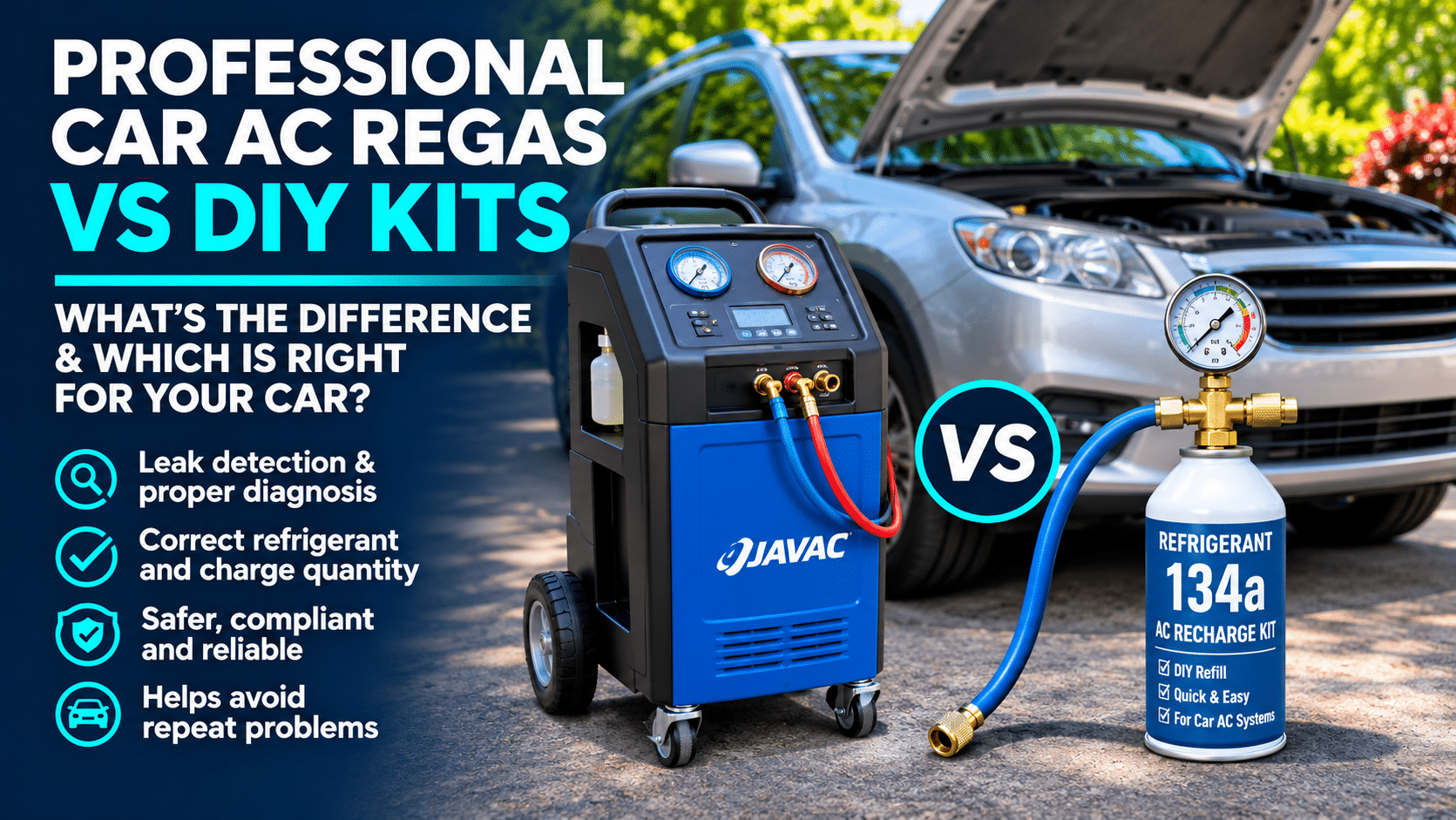
11 Jan Professional Car AC Regas vs DIY Kits
Professional Car AC Regas vs DIY Kits: What’s the Difference?
Thinking about buying a car air conditioning recharge kit because your aircon isn’t blowing cold? Before adding refrigerant yourself, it’s important to understand the difference between professional car AC regas vs DIY kits.
A DIY kit may appear to offer a cheap and convenient solution, but warm air doesn’t automatically mean your vehicle needs more refrigerant.
A leaking condenser, faulty compressor, electrical problem or cooling fan issue can produce the same symptoms. Adding refrigerant without diagnosing the problem may leave the actual fault unresolved.
Professional automotive air conditioning servicing involves more than adding gas. It includes inspecting the system, checking for leaks, identifying the correct refrigerant and ensuring the system is suitable for recharging.
At Keepin Cool Auto Air, we provide specialist mobile car air conditioning diagnostics, leak detection, regassing and repairs across Brisbane Bayside and Redland City.
With more than 40 years of hands-on automotive air conditioning experience, we focus on identifying the actual fault before recommending repairs or regassing.
What Is a DIY Car Air Conditioning Regas Kit?
A DIY car air conditioning regas kit is commonly advertised as a quick way to restore cooling by adding refrigerant or a substitute gas to a vehicle.
Some products include a pressurised container, charging hose and a basic pressure gauge.
Although the equipment may look straightforward, using it doesn’t provide the same information as a professional air conditioning inspection.
For example, a basic gauge may show pressure at one point in the system, but it cannot reliably establish the exact quantity of refrigerant already inside the vehicle.
It also cannot diagnose all the electrical, mechanical or refrigerant-flow problems that can cause warm air.
A car AC system should never be charged simply because its vents are blowing warm air.
In Australia, there are also refrigerant-handling regulations and safety requirements that vehicle owners need to understand.
Professional Car AC Regas vs DIY Kits: Key Differences
The biggest difference is that professional servicing evaluates the air conditioning system before deciding whether refrigerant needs to be replaced.
| Service consideration | DIY recharge kit | Professional AC service |
|---|---|---|
| Initial fault diagnosis | Usually very limited | Visual, operational and relevant electrical checks |
| Leak detection | Often not included | Appropriate professional leak testing |
| Refrigerant identification | Depends on the product | Manufacturer specifications checked |
| Refrigerant quantity | May rely on basic pressure readings | Charged to the specified weight |
| Refrigerant recovery | Usually not included | Suitable recovery equipment |
| Vacuum evacuation | Usually not included | Performed where appropriate |
| Compressor and electrical faults | Generally not diagnosed | Can be investigated |
| Final performance testing | Limited | System cooling and operation assessed |
These differences matter because incorrect refrigerant charging can cause poor cooling and may create additional servicing problems.
A proper inspection helps determine whether the fault involves refrigerant loss or something else entirely.
Seven Risks of DIY Car Aircon Regas Kits
There are several reasons why a DIY recharge can create problems instead of providing a reliable repair.
1. Adding Refrigerant Without Finding the Leak
Car air conditioning refrigerant circulates through a sealed system. It isn’t consumed during normal operation.
If the refrigerant charge becomes insufficient, leakage is one possible explanation.
Common leak locations include:
- Condenser tubes damaged by stones or corrosion.
- Deteriorated refrigerant hoses.
- Compressor seals and connections.
- Damaged O-rings.
- Leaking evaporator components.
- Poorly sealed refrigerant fittings.
Adding more gas doesn’t repair any of these faults.
The air conditioning may cool temporarily before losing performance again.
At Keepin Cool, we use specialist methods, including Trace-A-Gas testing where appropriate, to investigate suspected refrigerant leaks.
Learn more about our Car AC Leak Detection service.
2. Incorrect Refrigerant Charge
Every vehicle has a manufacturer-specified refrigerant charge quantity.
This quantity is normally measured by weight, in grams.
The correct amount can vary between vehicle makes, models and air conditioning system configurations.
A DIY charging gauge cannot reliably determine the complete refrigerant charge simply from one pressure reading.
Operating pressures are affected by outside temperature, compressor performance and other conditions.
Both insufficient and excessive refrigerant can affect air conditioning performance.
Professional servicing uses suitable equipment to recover refrigerant where required and recharge the system according to the manufacturer’s specifications.
3. Using the Wrong Refrigerant
Different vehicles use different automotive air conditioning refrigerants.
Two common types are R134a and HFO-1234yf.
These refrigerants have different handling requirements and must not be treated as interchangeable.
Using the wrong refrigerant may cause:
- Refrigerant contamination.
- Unpredictable cooling performance.
- Problems with recovery and recycling equipment.
- Additional servicing costs.
- Potential component compatibility or safety issues.
The correct refrigerant should be confirmed from manufacturer information before servicing.
If you’re unsure which refrigerant your vehicle requires, read our R134a Car Aircon Regas and HFO-1234yf Regas service information.
4. Missing an Electrical or Compressor Fault
A car air conditioner can blow warm air even when the refrigerant charge is correct.
For example, the compressor may not operate because of a faulty relay, damaged clutch coil, electronic control valve problem or another electrical fault.
Some vehicles also use pressure sensors and electronic controls to regulate compressor operation.
A basic recharge kit won’t diagnose these faults.
You may spend money adding refrigerant without improving the cooling.
Our Car AC Inspection and Fault Diagnostics service is designed to identify the cause before parts or refrigerant are recommended.
5. Ignoring Condenser and Cooling Fan Problems
The condenser removes heat from refrigerant as it circulates through the system.
If the condenser cooling fans aren’t operating properly, the air conditioning may struggle when the vehicle is stationary.
A common complaint is air conditioning that cools while driving but becomes warmer in traffic.
Although this can sometimes be associated with refrigerant problems, a cooling-fan or condenser airflow fault is another possibility.
Adding more refrigerant won’t repair an inoperative cooling fan.
The system requires proper operational testing to distinguish between these faults.
6. Refrigerant Handling and Safety Risks
Automotive air conditioning systems operate under pressure.
Incorrect handling can create risks involving pressurised refrigerant, frostbite injuries and unsuitable equipment.
There are also important Australian legal requirements.
R134a is a regulated refrigerant, and handling it in circumstances that could cause refrigerant leakage requires an appropriate refrigerant handling licence.
The Australian automotive code of practice also prohibits simply topping up an existing refrigerant charge without proper assessment.
Some products marketed as DIY alternatives contain different gases. These may have their own safety, flammability and compliance considerations.
Not every product is governed by identical rules, so the refrigerant type matters.
Buying a recharge kit doesn’t automatically make its use safe, suitable or lawful for your vehicle.
For appropriate professional servicing, choose a suitably authorised automotive air conditioning specialist.
7. Creating Additional Repair Costs
A DIY recharge may initially appear less expensive than professional servicing.
However, it may become costly if the original fault isn’t identified.
For example, an unresolved leak can cause refrigerant to escape again after recharging.
Incorrect refrigerant, unsuitable oil or contamination may also complicate subsequent repairs.
An inspection-first approach can help avoid unnecessary work by identifying whether the vehicle actually needs regassing or a different repair.
Is DIY Car Aircon Regassing Legal in Australia?
This is an important question because refrigerant handling is regulated in Australia.
The legal requirements depend on the refrigerant involved and the work being carried out.
R134a is a regulated hydrofluorocarbon refrigerant.
Handling regulated refrigerant in a way that could cause leakage requires the appropriate licence under Australian requirements.
The automotive code of practice also requires suitable inspection and leak-testing procedures before regassing.
Pure HFO-1234yf is treated differently under the Commonwealth scheduled-refrigerant licensing framework, but it still requires appropriate safety procedures and refrigerant-specific equipment.
Other substitute gases may raise separate concerns, including flammability and vehicle compatibility.
For car owners, the safest approach is to use a qualified automotive air conditioning specialist with the correct equipment and knowledge.
Keepin Cool Auto Air holds ARCtick business authorisation AU13448.
You can check authorised businesses through the Australian Refrigeration Council’s ARCtick business search.
Why Does Professional Car Aircon Regassing Involve More Than Adding Gas?
Professional regassing involves assessing the refrigeration system and carrying out the appropriate servicing procedures.
The exact process depends on the vehicle and the faults identified.
Initial System Inspection
The technician checks the vehicle’s air conditioning components and operating condition.
Depending on the symptoms, this may include compressor operation, electrical controls, refrigerant connections and condenser cooling fans.
The goal is to identify issues that could prevent successful regassing.
Refrigerant Leak Testing
If refrigerant loss is suspected, appropriate leak-detection procedures are required.
Visible oil residue, damaged components and deteriorated seals can provide useful clues.
Additional testing may be necessary to confirm a leak.
At Keepin Cool, we use professional leak-detection methods, including Trace-A-Gas where suitable.
Refrigerant Recovery
Where necessary, remaining refrigerant is recovered using appropriate equipment.
This allows the system to be assessed and serviced without intentionally venting regulated refrigerant into the atmosphere.
Vacuum Evacuation
When the system is suitable for recharging, vacuum evacuation helps remove air and moisture from the refrigerant circuit.
Vacuum testing forms part of the servicing process, but a vacuum hold alone cannot reliably identify every possible refrigerant leak.
Additional leak testing may still be required.
Recharging by Weight
The system is charged with the correct refrigerant quantity according to the vehicle manufacturer’s specification.
Suitable compressor oil and UV dye may be used where required.
The correct procedures depend on the system and work performed.
Final Cooling Performance Check
After servicing, the air conditioning is checked for appropriate cooling and operation.
This may involve monitoring system performance, cooling fan behaviour and other relevant operating conditions.
Professional regassing is intended to restore the correct refrigerant charge after the system has been assessed and found suitable for servicing.
What If Your Car Aircon Is Blowing Warm Air but Doesn’t Need a Regas?
Warm air from the dashboard vents doesn’t always indicate refrigerant loss.
Other possible causes include:
- Faulty compressor clutch or control valve.
- Electrical relay or wiring problem.
- Condenser cooling fan failure.
- Expansion valve restriction.
- Cabin temperature blend-door fault.
- Pressure sensor or control module problem.
These faults require diagnosis rather than automatically adding refrigerant.
For example, if the system still contains its correct charge but the compressor isn’t engaging, an electrical or compressor-control fault may be preventing normal operation.
Similarly, a faulty air-mix door can allow warm air to enter the cabin even when the evaporator is cold.
Our Car Air Conditioner Repairs service focuses on identifying these problems before recommending repairs.
Will a DIY Recharge Fix Aircon That Stops Cooling After a Few Weeks?
If the air conditioning becomes cold after regassing but loses performance again, an unresolved refrigerant leak is one possible cause.
The time it takes for cooling to deteriorate depends on the size and location of the leak.
Some leaks may cause refrigerant loss relatively quickly, while smaller leaks can take considerably longer to affect performance.
Repeatedly adding refrigerant without identifying the problem is not an appropriate long-term solution.
The leak needs to be located and the repair requirements assessed.
This is where professional testing can help distinguish between a leaking condenser, damaged hose, faulty seal or another component.
How Often Should Your Car Air Conditioning Be Regassed?
There is no universal rule requiring refrigerant replacement every two years.
Automotive refrigerant is not consumed through normal use.
However, periodic air conditioning inspections can be useful, particularly as vehicles age.
An inspection every two to four years may be a reasonable maintenance consideration, depending on the vehicle and its operating condition.
An inspection does not automatically mean the vehicle needs regassing.
If cooling has deteriorated or refrigerant loss is suspected, appropriate testing should determine the next step.
To understand when refrigerant servicing is worthwhile, read our Regassing Your Car Air Conditioner guide.
How Much Does Professional Car AC Regassing Cost?
The cost depends on the refrigerant your vehicle uses and whether the system requires additional diagnosis or repairs.
For example, a vehicle suitable for routine R134a regassing has different servicing requirements from one with a damaged condenser or an HFO-1234yf system.
At Keepin Cool, we inspect and assess the vehicle before recommending refrigerant charging.
If a fault is found, we explain the repair requirements and provide a quote before additional work is carried out.
For our complete service pricing, visit Car Air Conditioning Prices Brisbane.
Mobile Professional Car Aircon Regas Across Brisbane Bayside and Redland City
Keepin Cool Auto Air provides mobile car air conditioning inspections, regassing, leak detection and suitable repairs at your home or workplace.
We service conventional cars, SUVs, utes, 4WDs and light commercial vehicles manufactured from 1999 onwards.
Our service covers common makes including Toyota, Mazda, Ford, Holden, Hyundai, Kia, Honda, Suzuki, Volkswagen, Subaru, Mitsubishi and Nissan.
Regular service areas include Cleveland, Capalaba, Alexandra Hills, Thornlands, Birkdale, Wellington Point, Ormiston, Victoria Point, Redland Bay, Mount Cotton, Wynnum, Manly, Lota, Tingalpa and surrounding Brisbane Bayside and Redland City suburbs.
With more than 40 years of automotive air conditioning experience, we focus on explaining what is actually wrong with the system before recommending work.
Our service is 100% mobile, with suitable repairs carried out on-site where practical.
For further information, visit our Mobile Car Air Conditioning Service page.
Frequently Asked Questions About Car AC Regas vs DIY Kits
Are DIY car AC regas kits worth buying?
A basic kit cannot provide the same fault diagnosis, refrigerant recovery, leak testing and charge-by-weight servicing as professional equipment.
It may also involve licensing or safety concerns, depending on the refrigerant.
Can I just add more gas when my aircon gets warm?
Adding refrigerant without checking the system is not an appropriate diagnosis.
Warm air may result from refrigerant loss or another fault entirely.
Can too much refrigerant damage the air conditioning?
An excessive charge can cause abnormal operating pressures and poor performance. The system should be charged to the manufacturer’s specified quantity.
Can a DIY kit find an air conditioning leak?
A basic pressure gauge cannot reliably locate a leak.
Professional leak testing uses suitable methods and equipment to help identify the source.
Does my car aircon need regassing every year?
Not automatically. Refrigerant isn’t consumed during normal operation. The need for servicing should be determined by the system’s condition.
Is R134a the same as HFO-1234yf?
No. They are different refrigerants and must not be mixed or substituted without an appropriate, approved system configuration.
Can Keepin Cool regas my car at home?
Yes. We provide mobile car air conditioning inspections and suitable regassing services throughout Brisbane Bayside and Redland City.
What if my car needs repairs before regassing?
We explain the fault, discuss the repair options and provide a quote before additional work is carried out.
Car Aircon Blowing Warm? Book a Professional Mobile Inspection
If your car air conditioning has stopped cooling, don’t risk adding the wrong refrigerant or spending money on a DIY kit before the problem has been diagnosed.
Keepin Cool Auto Air comes to your home or workplace across Brisbane Bayside and Redland City, providing professional mobile car air conditioning diagnostics, leak detection, regassing and repairs.
Whether the problem is a refrigerant leak, compressor fault, condenser fan or electrical issue, we’ll inspect the system before recommending work.
Ready to get your car air conditioning cooling properly again?
Use the Call or Quick SMS Quote button to arrange a mobile inspection. Simply provide your suburb, vehicle make, model, year and a brief description of the problem.
40+ Years Experience | 100% Mobile | ARCtick AU13448