



Mobile Car AC Leak Detection Brisbane – Professional Trace-A-Gas Testing
Is your car air conditioning blowing warm air, losing refrigerant or needing regassing again shortly after a previous service?
A refrigerant leak may be the cause, but the problem needs to be properly diagnosed before adding more refrigerant.
At Keepin Cool Auto Air, we specialise in mobile car AC leak detection Brisbane Bayside and Redland City, using professional Trace-A-Gas leak testing, system inspections and specialist automotive air conditioning diagnostic equipment.
With over 40 years of hands-on automotive air conditioning experience, we focus on finding the source of refrigerant loss before recommending repairs or regassing.
We don’t just add gas — we inspect and leak-test first, then regas if the system passes.
Our fully mobile service comes to suitable homes and workplaces across Brisbane Bayside and Redland City, including Cleveland, Capalaba, Alexandra Hills, Victoria Point, Wynnum, Manly and surrounding serviced suburbs.
Call or SMS Jamie on 0415 761 019 to arrange a mobile inspection, or use our website’s existing Quick SMS Quote button.
Professional Trace-A-Gas Car Aircon Leak Detection
One of the most important parts of correctly diagnosing refrigerant loss is locating the actual leak.
At Keepin Cool, Trace-A-Gas is a key part of our professional leak-detection process.
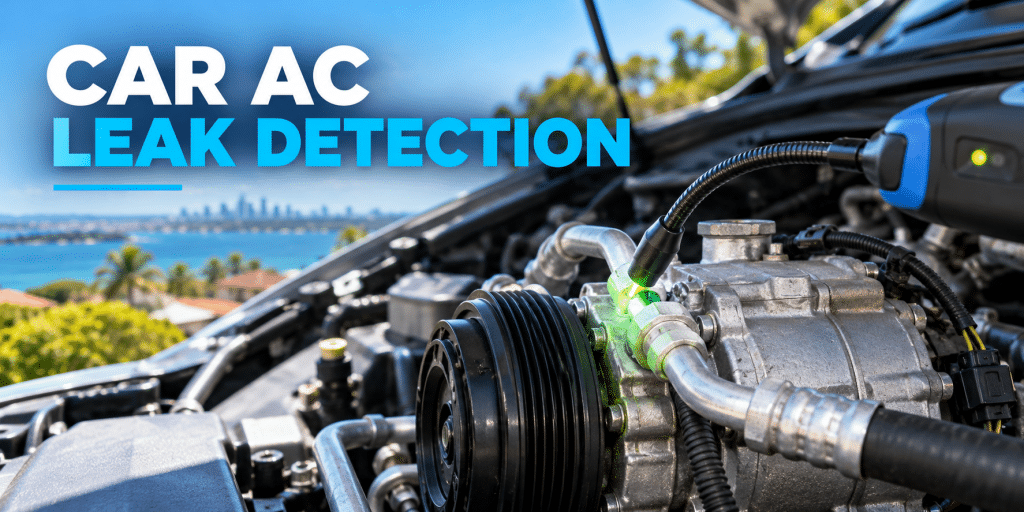
This method uses a suitable hydrogen/nitrogen tracer mixture and specialist electronic detection equipment to help identify escaping gas from the air conditioning system.
How Trace-A-Gas Testing Works
When appropriate for the vehicle and system condition, the process involves:
- Initial inspection: Assess the air conditioning fault and inspect accessible components.
- System preparation: Recover remaining refrigerant where required and prepare the circuit for testing.
- Tracer-gas testing: Introduce the suitable Trace-A-Gas mixture using equipment and pressures appropriate for the vehicle.
- Electronic leak detection: Check suspected leak locations using a specialist gas detector.
- Fault assessment: Investigate any detected leak and determine whether repair or further testing is required.
- Repair recommendation: Explain the findings and quote necessary repairs before proceeding.
Trace-A-Gas testing can be particularly helpful when refrigerant is escaping through a small opening that cannot be identified visually.
The aim is to find the faulty component before recommending another regas.
Some leaks are concealed or intermittent, so further investigation may occasionally be required. No single leak-testing method can guarantee that every leak will be found during one appointment.
What Types of Car Air Conditioning Leaks Can We Find?
We investigate suspected refrigerant leaks in the main components of an automotive air conditioning system.
Condenser Leaks
The condenser is normally located towards the front of the vehicle.
It can develop refrigerant leaks from road debris, stone damage, corrosion and vibration.
Even a small pinhole can cause the refrigerant charge to decrease.
Real repair example: Keepin Cool identified a condenser pinhole leak on a 2017 Toyota Kluger in Victoria Point.
Although the opening was small, the condenser could no longer reliably retain the refrigerant charge.
Finding the leak helped establish why regassing alone would not solve the problem.
Refrigerant Hose and Connection Leaks
Automotive air conditioning hoses experience engine heat, movement and vibration.
Leaks may develop around:
- Crimped hose fittings.
- Flexible rubber hose sections.
- Metal-to-rubber connections.
- Damaged pipework.
- O-rings and sealing connections.
Some hose assemblies may be suitable for professional repair rather than complete replacement.
For further information, see our Car Air Conditioning Hose Repairs service.
Compressor Seal Leaks
A compressor may leak refrigerant around its shaft seal, housing or refrigerant connections.
However, a refrigerant leak near the compressor doesn’t automatically mean the complete compressor needs replacing.
The problem may involve a serviceable hose fitting or sealing connection.
Proper diagnosis helps distinguish a leaking connection from an internal compressor fault.
Learn more about our Car AC Compressor Replacement and Diagnostics service.
Evaporator Leaks
The evaporator is usually hidden inside the vehicle’s dashboard or heating and ventilation housing.
This can make refrigerant leaks more difficult to identify.
Specialist electronic detection, appropriate testing and inspection through accessible openings may be required.
In some situations, a camera inspection can help investigate concealed areas.
Evaporator replacement may require extensive dismantling, and some major repairs are outside the scope of a routine mobile appointment.
Service Valve and O-Ring Leaks
The refrigerant service valves and pipe connections contain seals designed to retain refrigerant.
Leaks can develop when valves become damaged or seals deteriorate.
Where suitable, the affected valve or sealing component may be repairable without replacing a major air conditioning assembly.
Confirming the exact leak location helps avoid unnecessary parts replacement.
Signs Your Car Aircon May Have a Refrigerant Leak
Refrigerant loss doesn’t always produce an obvious warning.
Some leaks develop gradually over months, while others affect cooling performance much more quickly.
Common warning signs include:
- Air conditioning gradually becomes less cold.
- Cooling stops shortly after a previous regas.
- The system struggles to cool the cabin in hot weather.
- Air from the vents becomes warm.
- Oily residue appears around an AC hose or fitting.
- Refrigerant system components show visible damage.
- The compressor stops operating because of a pressure-related protection condition.
These symptoms can suggest refrigerant loss, but they don’t confirm a leak.
A compressor control fault, cooling fan problem or electrical issue can produce similar complaints.
Professional diagnosis helps establish whether the problem is a refrigerant leak or another air conditioning fault.
For a more detailed explanation of symptoms and causes, read our Car AC Refrigerant Leaks – Signs, Causes and Detection guide.
Why We Inspect Before Regassing Your Car Aircon
A vehicle air conditioning system is designed to contain a specified quantity of refrigerant.
Refrigerant circulates through the system rather than being consumed during normal operation.
If the charge becomes insufficient, the cause should be investigated.
At Keepin Cool, inspection and appropriate leak testing are performed before regassing.
This helps identify problems such as:
- A leaking condenser.
- Damaged refrigerant hose.
- Compressor seal fault.
- Failed service valve.
- Electrical or compressor problem.
- Condenser cooling fan fault.
- Other issues affecting normal air conditioning operation.
Why Not Simply Add More Refrigerant?
A quick refrigerant top-up doesn’t establish how much refrigerant is already in the system or why cooling performance has deteriorated.
It can also leave a refrigerant leak unresolved.
Australia’s Automotive Code of Practice requires appropriate inspection and leak testing and prohibits simply adding refrigerant to an existing charge as a top-up.
If system integrity is in doubt, necessary repairs must be completed before regassing.
Finding the fault first protects customers from paying for a regas that cannot properly resolve the problem.
Read the official ARCtick Australian Automotive Code of Practice for further information.
Trace-A-Gas, UV Dye and Vacuum Testing – What’s the Difference?
Different testing methods can help investigate car air conditioning faults.
They provide different types of information and are not interchangeable.
Trace-A-Gas Leak Detection
Trace-A-Gas helps locate escaping tracer gas from suitable refrigerant circuits using professional electronic detection equipment.
It can assist with investigating small leaks around condensers, hoses, connections, compressor seals and other components.
UV Dye Leak Detection
UV dye can help identify refrigerant leaks when compatible dye has circulated through the system and left visible fluorescent residue.
However, UV dye isn’t a substitute for appropriate initial leak detection.
Australia’s Automotive Code of Practice states that adding UV dye must not be used as the first diagnostic method for a suspected leak.
At Keepin Cool, suitable UV dye is included during successful regassing to assist with identifying future refrigerant leaks, where compatible with the vehicle manufacturer’s requirements.
Pressure Testing
Professional pressure testing can help assess whether a refrigerant system retains a suitable applied test pressure.
The equipment, testing gas and pressure must be appropriate for the vehicle.
Pressure loss can indicate leakage, but it doesn’t always identify where the leak is located.
Vacuum-Hold Testing
A vacuum-hold check helps assess certain system conditions during servicing.
However, passing a vacuum test does not guarantee that every small refrigerant leak has been eliminated.
Some leaks may behave differently under positive pressure.
This is why professional leak detection is important before recharging.
Our Mobile Car Air Conditioning Diagnostic Process
Every vehicle is assessed according to its symptoms, condition and system design.
Step 1 – Confirm the Cooling Problem
We discuss the symptoms and assess relevant operating conditions.
This may include checking vent temperatures, airflow and compressor operation.
Step 2 – Inspect the System
We inspect accessible refrigerant hoses, condenser connections, service valves and relevant components.
Where appropriate, we also assess compressor operation, cooling fans and electrical controls.
Step 3 – Perform Suitable Leak Testing
If refrigerant loss is suspected, we carry out appropriate testing.
Trace-A-Gas is used where suitable to help identify the source of refrigerant leakage.
The testing method depends on the vehicle’s refrigerant type, system condition and suspected fault.
Step 4 – Explain the Findings
We’ll explain what we have identified and whether the vehicle requires:
- A suitable refrigerant hose repair.
- Condenser replacement.
- Service valve or seal repair.
- Compressor-related repairs.
- Further leak investigation.
- Another type of air conditioning diagnostic or repair work.
If repairs are needed before regassing, we’ll provide a quote before proceeding.
Step 5 – Regas If the System Passes
When the refrigerant system is suitable for regassing, professional servicing includes the necessary refrigerant recovery, evacuation, correct recharge and final performance checks.
We use the vehicle manufacturer’s specified refrigerant type and charge quantity.
Suitable compressor oil and UV dye are added as appropriate.
A regas is charged only when successfully completed.
If repairs are necessary before regassing and you choose not to proceed, the applicable inspection fee applies instead.
For faults not involving refrigerant loss, see our Car AC Inspection and Fault Diagnostics service.
How Much Does Mobile Car AC Leak Detection Cost?
The cost of leak testing depends on the vehicle, the testing required and the difficulty of locating the problem.
Some leaks can be identified relatively quickly during the initial inspection.
Others involve concealed components, intermittent faults or additional diagnostic work.
At Keepin Cool, initial inspection and appropriate leak testing are included with a successfully completed regas.
If repairs are required first, we’ll explain the findings and quote the necessary work.
If you don’t proceed with the repairs required for regassing, the applicable inspection fee applies rather than charging for an unsuccessful regas.
For our current inspection, leak-detection, regas and repair charges, visit the Official Keepin Cool Car Air Conditioning Prices Brisbane page.
This is our central pricing page, ensuring customers can view the latest advertised charges in one place.
Car AC Leak Detection for R134a and HFO-R1234yf
Keepin Cool provides mobile leak detection and refrigerant servicing for suitable vehicles using R134a and HFO-R1234yf.
R134a Air Conditioning Systems
R134a is used in many established passenger cars, SUVs, utes and 4WDs.
We provide professional leak detection, diagnosis and R134a Car Aircon Regassing for suitable vehicles.
HFO-R1234yf Air Conditioning Systems
Many newer vehicles use HFO-R1234yf refrigerant.
HFO-R1234yf has different safety characteristics and requires suitable servicing equipment and procedures.
We provide appropriate leak detection and HFO-R1234yf Car Aircon Regassing for eligible vehicles.
Refrigerants must be correctly identified and must not be mixed or substituted for one another.
Mobile Car Aircon Leak Testing Across Brisbane Bayside & Redland City
Keepin Cool Auto Air is based in Mount Cotton and specialises in fully mobile automotive air conditioning services.
We come to suitable homes and workplaces, providing professional inspections, leak detection, regassing and eligible repairs without the need for a workshop drop-off.
Brisbane Bayside
Our regular Bayside service areas include:
- Wynnum and Wynnum West.
- Manly and Lota.
- Tingalpa and Wakerley.
- Hemmant and surrounding serviced suburbs.
For further information, visit our Brisbane Bayside Car Air Conditioning page.
Redland City
Our Redland City service areas include:
- Cleveland and Capalaba.
- Alexandra Hills and Birkdale.
- Wellington Point and Ormiston.
- Thorneside and Thornlands.
- Victoria Point and Redland Bay.
- Mount Cotton and surrounding serviced suburbs.
For local coverage, visit our Redland City Car Air Conditioning page.
Vehicles We Service
We inspect and service suitable conventional petrol and diesel vehicles manufactured from 1999 onwards, including:
- Passenger cars.
- SUVs.
- Utes and 4WDs.
- Selected light commercial vehicles.
Hybrid and electric vehicles are outside our current service scope.
Some extensive repairs requiring major dismantling or workshop facilities may not be suitable for mobile completion.
Why Choose Keepin Cool Auto Air for Leak Detection?
Keepin Cool Auto Air is a locally owned and operated mobile automotive air conditioning specialist established in 2006.
With over 40 years of hands-on industry experience, Jamie provides professional automotive air conditioning inspections, leak detection, regassing and suitable repairs across Brisbane Bayside and Redland City.
Specialist Leak Detection Equipment
We use Trace-A-Gas and appropriate electronic leak detection equipment to help investigate suspected refrigerant loss.
Diagnosis Before Regassing
We inspect and leak-test first rather than automatically adding refrigerant.
Owner-Operated Mobile Service
Your vehicle is assessed by an experienced specialist at a suitable home or workplace.
Clear Repair Recommendations
We explain the findings and provide quotes for necessary repairs before additional work proceeds.
Correct Refrigerant Servicing
We use suitable equipment for R134a and HFO-R1234yf systems and recharge to manufacturer specifications.
ARCtick Authorised Business
Keepin Cool holds ARCtick business authorisation AU13448.
This business authorisation is separate from an individual technician’s refrigerant-handling licence.
You can check authorised businesses through the official ARCtick Business Search.
Frequently Asked Questions About Car AC Leak Detection
How do you find a car air conditioning refrigerant leak?
We use professional inspection and appropriate testing methods, including Trace-A-Gas leak detection where suitable. The process helps identify leaking condensers, hoses, fittings and other refrigerant-system components.
Can Trace-A-Gas detect small refrigerant leaks?
Yes. Trace-A-Gas can help locate small leaks that aren’t obvious during a visual inspection. Some concealed or intermittent faults may require additional testing.
Is leak testing included in a car aircon regas?
Yes. Initial inspection and appropriate leak testing are included with a successfully completed Keepin Cool regas. If repairs are needed first, we’ll explain the problem and provide a quote.
What happens if you find a refrigerant leak?
We’ll explain the fault and recommend the appropriate repair. If the system needs repair before regassing, we’ll quote the work first.
What happens if I decide not to proceed with repairs?
If repairs are necessary for regassing and you choose not to proceed, the applicable inspection fee applies instead of charging for an unsuccessful regas.
Will regassing fix a refrigerant leak?
No. A regas restores the correct refrigerant charge when the system is suitable for servicing. It doesn’t repair a leaking condenser, hose, compressor seal or evaporator.
Does a vacuum test guarantee the system has no leaks?
No. A vacuum-hold check is useful, but some leaks only become apparent under different pressure conditions. Appropriate professional leak testing is still important.
Can you find a leak behind the dashboard?
Some concealed evaporator leaks can be investigated using specialist detection methods and accessible inspection points. Additional work may be required depending on the vehicle.
How long does mobile leak testing take?
A straightforward inspection and regas appointment generally takes approximately 30–40 minutes. More complex refrigerant leaks or intermittent faults may require additional diagnostic time.
How often should I have my car aircon regassed?
Keepin Cool recommends regassing every two to four years, subject to inspection and leak testing. If the system loses cooling earlier, it should be diagnosed rather than waiting for the next scheduled service.
Do you offer mobile car AC leak testing at home?
Yes. We provide mobile leak detection and suitable repairs at accessible homes and workplaces throughout Brisbane Bayside and Redland City.
How much does car AC leak detection cost?
Our latest advertised charges are available on the Official Keepin Cool Car Air Conditioning Prices Brisbane page.
Book Your Mobile Car AC Leak Detection Service
If your vehicle is blowing warm air, gradually losing cooling performance or becoming warm again after a regas, professional leak detection is the best starting point.
Keepin Cool Auto Air provides mobile Trace-A-Gas leak testing, air conditioning inspections, R134a and HFO-R1234yf regassing and suitable repairs across Brisbane Bayside and Redland City.
Call or SMS Jamie on 0415 761 019, or use the website’s existing Quick SMS Quote button to request an appointment.
Please include your suburb, vehicle make, model, year and a brief description of the problem.
Keepin Cool Auto Air
100% Mobile | ARCtick AU13448 | 40+ Years Experience