

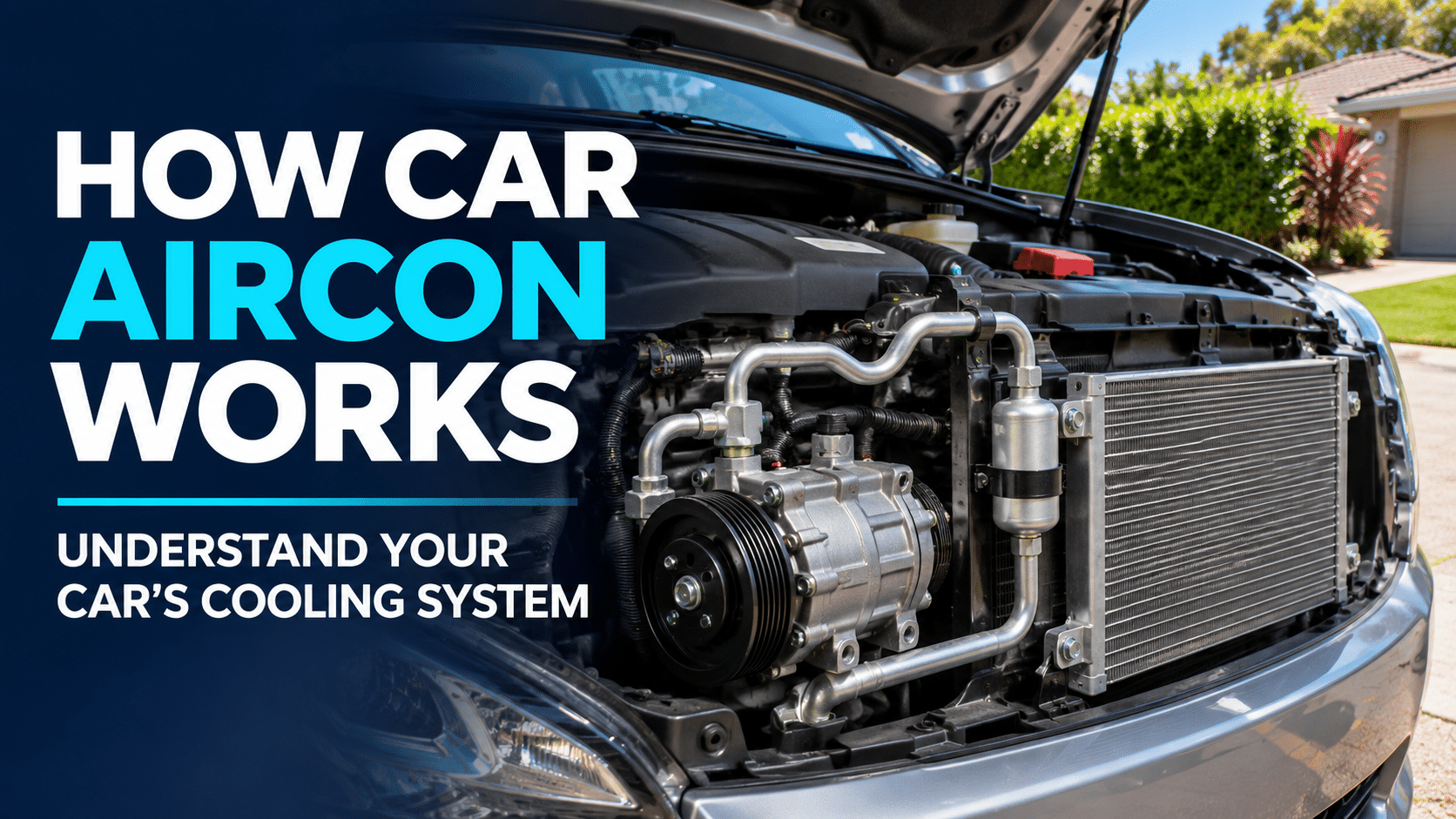
26 Jan How Car Aircon System Works
How Your Car Aircon System Actually Works
Your car aircon system removes heat from inside your vehicle to keep the cabin comfortable. When you switch on the air conditioning, refrigerant circulates through several components that work together to cool the air flowing through your dashboard vents. Understanding how this process works can help you recognise cooling problems before they become more serious.
Your car air conditioning system doesn’t create cold air. It removes heat from inside the vehicle and releases that heat outside.
To achieve this, refrigerant circulates through a sealed system of pipes, hoses and specialised components. Changes in refrigerant pressure and temperature allow the system to absorb heat inside the cabin and release it through the condenser at the front of the vehicle.
Understanding this process can help you recognise early signs of trouble, whether you’re experiencing weak cooling, unusual noises or air conditioning that only works occasionally.
At Keepin Cool Auto Air, we specialise in mobile car air conditioning diagnostics and repairs across Brisbane Bayside and Redland City. Here is how the system operates and what can go wrong.
How Car Air Conditioning Works in Six Stages
Most conventional vehicle air conditioning systems use the same basic refrigeration cycle, although individual components and control systems vary between manufacturers.
The main components work together continuously while cooling is requested.
1. The Compressor Circulates and Pressurises Refrigerant
The compressor is one of the most important components in your car’s air conditioning system.
It draws in low-pressure refrigerant vapour returning from the evaporator and compresses it into a hot, high-pressure gas.
This pressure difference allows the refrigerant to circulate through the system and transfer heat.
On many vehicles, the compressor is driven by an engine belt. Some compressors use an electromagnetic clutch, while others have variable-displacement controls that regulate refrigerant flow.
Certain hybrid and electric vehicles use electrically driven compressors instead.
What happens when the compressor fails?
A faulty compressor may produce poor cooling, unusual noises or no cooling at all. However, an electrical fault, incorrect refrigerant charge or control problem can produce similar symptoms.
The compressor should always be tested before replacement is recommended.
Learn more about Car AC Compressor Replacement.
2. The Condenser Releases Heat Outside the Car
After leaving the compressor, the hot refrigerant gas travels through the condenser.
The condenser resembles a small radiator and is usually mounted towards the front of the vehicle, often near the engine radiator.
As outside air flows through the condenser fins, heat is removed from the refrigerant. The refrigerant then changes from a hot gas into a high-pressure liquid.
Airflow comes from the vehicle moving forward and from electric cooling fans when required.
Why does condenser airflow matter?
If the condenser cannot release enough heat, the system may struggle to cool the cabin.
Possible problems include:
- A damaged or leaking condenser.
- Cooling fans not operating correctly.
- Dirt or debris restricting airflow.
- Corrosion or stone damage to condenser tubes.
- Refrigeration faults affecting operating pressures.
A vehicle that cools reasonably well while driving but becomes warm when stopped may have a condenser airflow problem.
However, pressure testing and fan-operation checks are needed before identifying the actual fault.
3. The Receiver-Drier Helps Protect the System
Many car air conditioning systems use a receiver-drier, sometimes incorporated into the condenser assembly.
Its purpose is to help remove moisture and trap small contaminants within the refrigerant circuit.
Moisture inside an air conditioning system is undesirable because it can contribute to corrosion, freezing restrictions and damage to internal components.
Some systems use an accumulator on the low-pressure side instead of a conventional receiver-drier arrangement.
The correct component layout depends on the manufacturer’s design.
Why is this component important?
When a refrigeration system has been opened for major repairs, the condition of the drier or accumulator must be considered.
Replacing a compressor without addressing contamination or moisture inside the system can result in further problems.
That is why correct repair procedures matter just as much as the replacement part.
4. The Expansion Valve Controls Refrigerant Flow
Next, the high-pressure liquid refrigerant reaches the expansion device.
Many vehicles use a thermostatic expansion valve, commonly called a TX valve. Others use a fixed orifice tube or a different metering arrangement.
The expansion device controls the movement of refrigerant into the low-pressure side of the system.
As the refrigerant passes through this restriction, its pressure drops considerably. This allows it to absorb heat and evaporate at a much lower temperature.
What happens if the expansion valve develops a fault?
A restricted or malfunctioning expansion valve can interfere with refrigerant flow.
Possible symptoms include reduced cooling, unstable cooling performance or abnormal system pressures.
However, low refrigerant charge, compressor regulation faults and other restrictions can produce similar readings.
The correct diagnosis requires testing rather than replacing the expansion valve based on symptoms alone.
5. The Evaporator Absorbs Heat Inside the Cabin
The evaporator is usually located inside the dashboard, enclosed within the vehicle’s heating and ventilation housing.
It resembles a small radiator, but instead of releasing heat, it absorbs heat from air passing across its fins.
As refrigerant evaporates inside the evaporator, it absorbs heat from the surrounding metal surfaces.
The cabin blower pushes air across these cooled surfaces before delivering the air through your dashboard vents.
This is the part of the system responsible for the cooling you feel.
Why does water drip underneath a car when the aircon is running?
When humid air contacts the cold evaporator, moisture condenses on its surface.
This water normally drains through a tube beneath the vehicle.
A small puddle of clear water under your parked car after using the air conditioning is therefore usually normal.
However, a blocked drain may allow water to accumulate inside the vehicle.
Evaporators can also develop refrigerant leaks or become restricted by dirt, affecting performance.
6. Refrigerant Returns to the Compressor
After absorbing heat inside the evaporator, the refrigerant returns towards the compressor as low-pressure vapour.
The compressor draws it in and begins the process again.
This continuous cycle allows the vehicle to keep removing heat from the passenger compartment.
The refrigerant circulates through the sealed system rather than being consumed during normal operation.
Every component must work correctly for the system to deliver reliable cooling.
A fault affecting refrigerant flow, heat transfer, electrical controls or cabin airflow can reduce overall performance.
How Does Cold Air Reach Your Dashboard Vents?
The refrigeration circuit is only one part of your vehicle’s cooling system.
The dashboard ventilation system also plays a major role.
Even when the evaporator is cold, the air conditioning may not feel cold if the ventilation controls aren’t operating correctly.
Three important components are involved.
Cabin Blower Motor
The blower motor pushes air through the ventilation housing and out through your dashboard vents.
If the blower motor fails or its speed controller develops a fault, you may have little or no airflow even when the refrigeration system is operating normally.
Cabin Air Filter
Many vehicles have a cabin air filter designed to capture dust and other airborne particles before they enter the passenger compartment.
A badly restricted filter can reduce airflow through the vents.
Replacing a blocked filter may improve airflow, but it won’t repair a refrigerant leak or faulty compressor.
Air-Mix Doors and Temperature Controls
Modern vehicles use air-mix doors, sometimes called blend doors, to control how much heated or cooled air reaches the cabin.
If a temperature actuator or door becomes stuck, warm air may mix with air cooled by the evaporator.
This can produce symptoms such as:
- Cold air from one side and warm air from the other.
- Cooling that gradually becomes warmer.
- Incorrect air temperature despite selecting maximum cooling.
These symptoms do not automatically indicate that the air conditioning needs regassing.
Professional diagnosis can distinguish a temperature-control problem from a refrigeration fault.
Why Your Car Aircon May Stop Cooling Properly
Once you understand how car air conditioning works, it becomes easier to see why different faults produce different symptoms.
Here are some common examples.
| What you notice | Possible causes |
|---|---|
| Warm air from every vent | Refrigerant leak, compressor or electrical control fault |
| Cold while driving, warm when stopped | Condenser airflow or cooling-fan problem |
| Starts cold, then becomes warm | Intermittent compressor control, evaporator icing or temperature-door fault |
| Weak airflow from vents | Blocked cabin filter, blower problem or airflow restriction |
| Unusual noises with AC operating | Compressor, pulley, belt or bearing problem |
| Cooling deteriorates after a previous regas | Unresolved refrigerant leak or another underlying fault |
These are diagnostic clues, not confirmed causes.
For example, warm air from the vents does not prove that the refrigerant charge is low. Similarly, a compressor that doesn’t appear to engage may be responding to an electrical or pressure-related control issue.
Our detailed Car AC Not Cooling Troubleshooting Guide explains these symptoms and what should be checked before replacing parts.
Does Your Car Air Conditioning Need Regassing?
One of the most common misunderstandings about vehicle air conditioning is that refrigerant must be replaced at fixed intervals.
Unlike petrol or engine oil, air conditioning refrigerant is not consumed as the system operates.
However, refrigerant can escape through deteriorating seals, damaged condensers, leaking hoses or other faults.
If the refrigerant charge becomes insufficient, the air conditioning may lose cooling performance.
Simply adding more gas without checking the system is not the correct solution.
At Keepin Cool, we carry out appropriate inspections and leak testing before recommending regassing.
Where necessary, our Car AC Leak Detection service uses specialist equipment, including Trace-A-Gas testing, to help locate leaks.
Some leaking hoses may be suitable for Car AC Hose Repairs, while damaged condensers or other components may require replacement.
If the system passes the relevant checks, refrigerant can be recovered, the system evacuated and recharged to the manufacturer’s specified quantity.
For a more detailed explanation, read Regassing Your Car Air Conditioner.
R134a and HFO-1234yf: What’s the Difference?
Different vehicles use different types of automotive air conditioning refrigerant.
Two refrigerants commonly encountered in the vehicles we service are R134a and HFO-1234yf.
R134a Refrigerant
R134a has been widely used in automotive air conditioning systems for many years.
It remains common in vehicles across Brisbane Bayside and Redland City.
When servicing an R134a system, the correct refrigerant quantity and lubricant requirements must be followed.
Learn more about our R134a Car Air Conditioning Regas service.
HFO-1234yf Refrigerant
HFO-1234yf is used in some newer vehicles and has a much lower global warming potential than R134a.
It requires equipment and procedures suitable for that refrigerant.
Although both refrigerants perform a similar cooling function, they are not simply interchangeable.
The correct refrigerant must be identified from the vehicle manufacturer’s information.
Read about our HFO-1234yf Car Air Conditioning Regas service.
Using the wrong refrigerant or incorrect charge can lead to poor performance and potential system damage.
How We Diagnose Car Air Conditioning Problems
Knowing how your air conditioning works is useful, but identifying an actual fault requires the appropriate testing equipment and experience.
At Keepin Cool, we use an inspection-first approach rather than assuming that every cooling problem needs a regas.
Our diagnostic process may include:
- Initial inspection: Checking visible components, hoses, connections, belts and overall system condition.
- Electrical and operational testing: Assessing compressor operation, cooling fans, controls and relevant electrical circuits.
- Refrigerant leak testing: Checking for possible leaks using suitable methods, including Trace-A-Gas where appropriate.
- System servicing: When justified, recovering refrigerant, evacuating the system and recharging by the correct specified weight.
- Performance testing: Checking cooling operation after servicing or repairs.
Not every vehicle requires every procedure.
Once the problem has been identified, we explain the findings and recommend suitable repairs before proceeding.
Our Car AC Inspection and Fault Diagnostics service is designed to identify the cause rather than replace parts unnecessarily.
For our complete service pricing, visit Car Air Conditioning Prices Brisbane.
How to Look After Your Car Air Conditioning
A few simple habits can help you recognise problems early and keep the ventilation system working properly.
- Use the air conditioning regularly: Periodic operation can help keep appropriate components functioning, subject to the vehicle manufacturer’s recommendations.
- Keep ventilation openings clear: Avoid blocking cabin air intakes and remove debris from accessible external intake areas.
- Check the cabin filter: Have it inspected or replaced when required for your vehicle.
- Pay attention to cooling changes: Gradually weakening cooling can indicate an issue that deserves investigation.
- Listen for unusual noises: New squealing, rattling or grinding sounds should be assessed.
- Avoid DIY refrigerant top-ups: Incorrect charging or refrigerant handling can damage the system and create safety or environmental risks.
These simple steps help with everyday care, but they don’t replace professional leak detection or fault diagnosis.
If you notice a change in performance, arranging an inspection before the problem becomes more serious is a sensible approach.
Mobile Car Air Conditioning Specialists in Brisbane Bayside and Redland City
If your car air conditioning isn’t working as it should, Keepin Cool Auto Air provides mobile inspections, diagnostics, regassing and suitable repairs at your home or workplace.
We service cars, SUVs, utes, 4WDs and light commercial vehicles from 1999 onwards.
Our service area includes Cleveland, Capalaba, Alexandra Hills, Thornlands, Victoria Point, Redland Bay, Birkdale, Wellington Point, Ormiston, Wynnum, Manly, Lota and surrounding areas within Brisbane Bayside and Redland City.
With more than 40 years of hands-on automotive air conditioning experience and ARCtick authorisation AU13448, we focus on identifying the actual problem before recommending repairs.
You can check authorised businesses through the Australian Refrigeration Council’s ARCtick business search.
Learn more about our Mobile Car Air Conditioning Services Across Redland City and Brisbane Bayside.
Frequently Asked Questions About Car Air Conditioning
How does a car aircon system make the air cold?
The system circulates refrigerant through a compressor, condenser, expansion device and evaporator. Refrigerant absorbs heat from cabin air at the evaporator and releases that heat outside through the condenser.
The dashboard blower then circulates the cooled air throughout the vehicle.
Why is my car aircon cold while driving but warm when stopped?
A condenser cooling-fan or airflow problem is one possible cause.
When driving, airflow through the front condenser may be greater. At idle, the vehicle depends more heavily on its cooling fans.
However, refrigerant-charge or compressor-performance problems can also cause this symptom, so testing is needed.
Does the car aircon gas eventually run out?
Refrigerant is not used up during normal operation.
If the system loses enough refrigerant to affect cooling, leakage or another charge-related problem needs investigation.
Why does my car drip water when the air conditioning is running?
Moisture from humid cabin air condenses on the cold evaporator and drains beneath the vehicle.
Clear water dripping underneath the car after air conditioning use is generally normal.
Does air conditioning help demist windows?
Yes. Air conditioning removes moisture from air passing across the evaporator.
When combined with the correct ventilation and temperature settings, this can help clear condensation from the windscreen.
Does every car aircon compressor make a clicking noise?
No. Some compressors use an electromagnetic clutch, while others have different control arrangements.
The absence of a clicking sound isn’t enough to confirm a compressor failure.
How often should I service my car air conditioner?
We recommend having your car air conditioning system inspected approximately every 2–4 years, or sooner if you notice reduced cooling, unusual noises, unpleasant smells or other problems.
A car air conditioning inspection helps identify refrigerant leaks, electrical faults and worn components before they lead to more expensive repairs. Regassing is not automatically required at every inspection. We assess the system’s condition first and recommend only the work needed.
How long will a car aircon regassing last?
There is no fixed expiry date for a car air conditioning regas. A properly sealed system should retain its refrigerant and may continue cooling effectively for many years without needing a top-up.
If your car air conditioning loses cooling performance because of low refrigerant, the system should be inspected for leaks. Simply regassing a leaking system without addressing the underlying fault may only provide temporary cooling.
At Keepin Cool Auto Air, we inspect and test the system before recommending regassing or repairs.
Does car air conditioning have a coolant reservoir?
Car air conditioning uses refrigerant in a sealed, pressurised circuit. It does not have a reservoir that you fill like the engine coolant expansion tank. Engine coolant and AC refrigerant have different jobs and must not be mixed.
Some air conditioning systems contain a receiver-drier or accumulator. These are sealed components within the refrigerant circuit, not tanks for adding coolant. If your aircon is blowing warm air, the system needs inspection and appropriate leak testing before any refrigerant recharge.
Get Your Car Air Conditioning Checked Before Replacing Parts
Understanding how your car aircon system works is helpful, especially when cooling problems begin.
But whether the problem involves a refrigerant leak, condenser fan, compressor, expansion valve or cabin temperature control, an accurate diagnosis is the best starting point.
Keepin Cool Auto Air provides professional mobile Car Air Conditioner Repairs and diagnostics throughout Brisbane Bayside and Redland City.
Is your car aircon blowing warm air or not cooling properly?
Use our Quick SMS Quote option and provide your suburb, vehicle make, model, year and a brief description of the problem.
We’ll help you arrange the appropriate next step.