

10 Aug Noisy Car AC Fix
Noisy Car AC Fix: Squealing, Clicking, Grinding or Rattling?
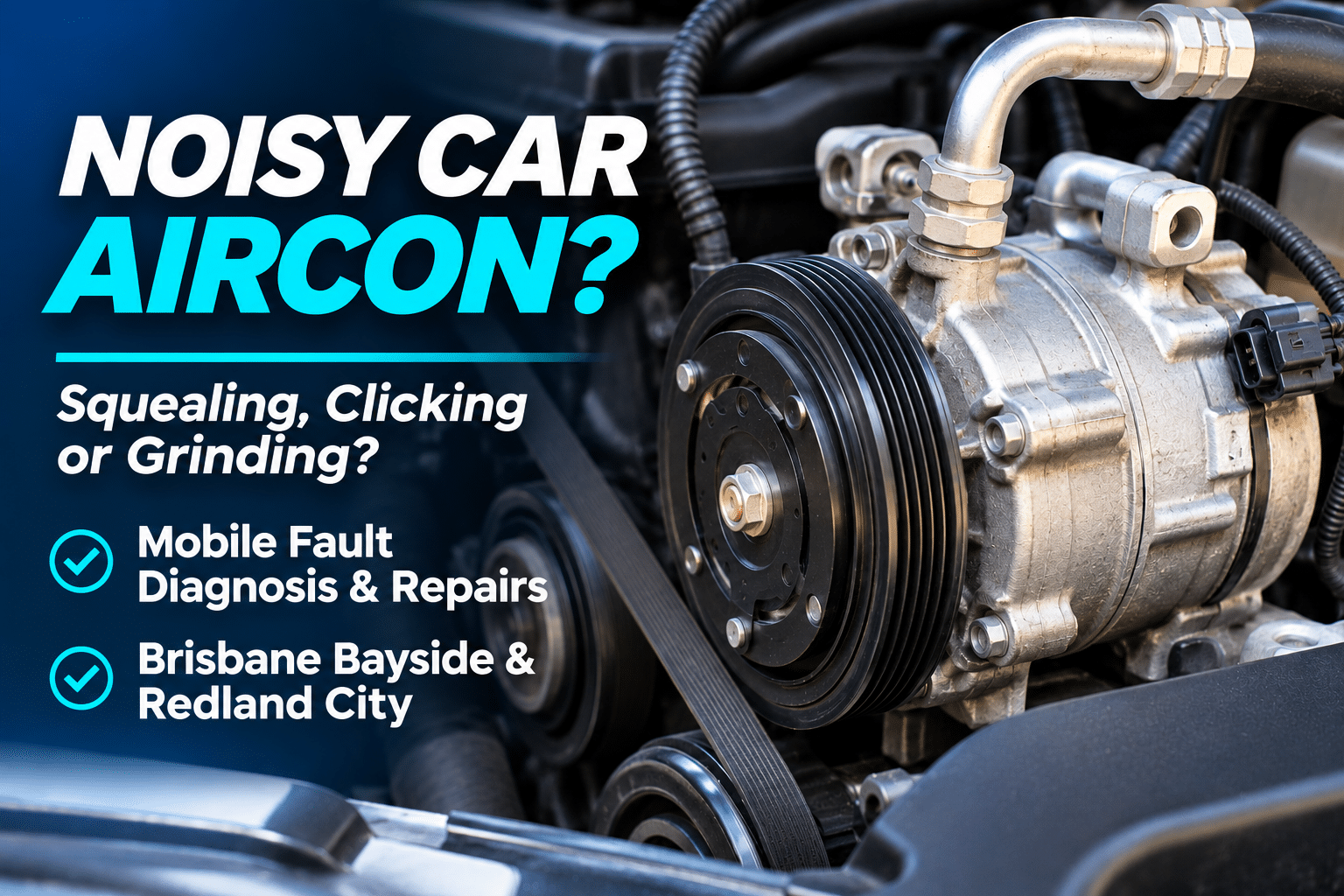
Need a noisy car AC fix because your air conditioning has started squealing, grinding, clicking or rattling?
The sound may come from the AC compressor, a worn pulley bearing, slipping drive belt, faulty dashboard actuator or another component. Some noises are minor, while others can indicate a developing mechanical fault.
A noisy car air conditioner does not automatically mean the compressor needs replacing. The correct repair starts with identifying the source of the noise.
Keepin Cool Auto Air provides professional mobile car air conditioning diagnostics and repairs throughout Brisbane Bayside and Redland City.
With over 40 years of automotive air conditioning experience, we investigate unusual noises, explain the findings and recommend suitable repairs before replacing expensive parts.
Our fully mobile service comes to your home or workplace for suitable AC inspections and repairs.
What Do Different Car Air Conditioning Noises Mean?
The sound and when it occurs can provide valuable clues about the fault.
| Noise | Possible causes |
|---|---|
| High-pitched squealing | Drive belt, tensioner, idler pulley or compressor load |
| Chirping or squeaking | Pulley misalignment, belt wear or bearing problems |
| Grinding or growling | Compressor damage, clutch bearing or another rotating component |
| Repeated clicking under the bonnet | Compressor clutch, electrical controls or operating pressure issues |
| Clicking behind the dashboard | Blend-door or air distribution actuator |
| Rattling or vibration | Loose brackets, pipes, compressor components or cooling fan |
| Hissing or whistling | Refrigerant pressure equalisation, expansion valve or possible system fault |
| Buzzing or scraping inside the cabin | Blower motor, fan wheel or debris |
The noises in this table are possible symptoms, not confirmed diagnoses.
For example, a worn idler pulley can produce a grinding noise similar to compressor damage. Clicking behind the dashboard may involve the ventilation system rather than the refrigerant circuit.
The best noisy car AC fix depends on an accurate inspection, not simply matching a sound to a replacement part.
Noisy Car AC Fix for Squealing When the Aircon Starts
A high-pitched squealing noise is often most noticeable when the air conditioning is switched on.
It may disappear after a few seconds, continue while driving or become louder when accelerating.
Worn or Slipping Accessory Drive Belt
On many vehicles, an engine-driven accessory belt operates the air conditioning compressor.
When the compressor starts working, additional load is applied to the belt.
If the belt is worn, glazed, contaminated or slipping, you may hear a squealing sound.
Common symptoms include:
- Squealing when switching on the air conditioning.
- Noise that changes with engine speed.
- A brief screech when the compressor engages.
- Belt vibration or visible wear.
- Intermittent cooling associated with belt slip.
However, replacing the drive belt without checking the other components may not resolve the problem.
Weak Belt Tensioner or Worn Idler Pulley
A faulty belt tensioner may not maintain sufficient belt tension under operating load.
A damaged idler pulley bearing can also produce squealing, chirping, growling or rattling.
Pulley misalignment can create similar noises.
DENSO and Gates technical guidance identify belts, bearings, pulley alignment and tensioners as possible causes of abnormal compressor-area noises.
A squealing sound does not prove that the AC compressor has failed.
The appropriate noisy car AC fix may involve a belt-drive component rather than the refrigerant system.
Where a fault involves mechanical components outside our mobile air conditioning repair scope, we’ll explain the findings and recommend suitable workshop attention.
Grinding or Growling From the Car AC Compressor
A metallic grinding or deep growling sound should be taken seriously.
It can indicate damage to a compressor-related component or another rotating part near the compressor.
Possible causes include:
- Worn compressor internal bearings.
- Damaged compressor mechanical components.
- Faulty pulley or magnetic clutch bearing.
- Loose or damaged mounting components.
- Worn accessory drive pulleys.
A compressor may continue cooling even while a mechanical fault is developing.
In other cases, the noise becomes worse, the compressor stops operating or the AC begins blowing warm air.
Does Grinding Mean the Compressor Must Be Replaced?
No.
A damaged pulley bearing or clutch component may produce a similar noise to an internally damaged compressor.
Depending on the compressor design and parts availability, some external components may be repairable without replacing the entire compressor.
However, if there is significant internal mechanical damage, complete compressor replacement may be necessary.
Our Car AC Compressor Repair or Replace Guide explains how we assess different compressor faults.
What Happens if the Compressor Fails Internally?
A compressor suffering severe internal damage can release metal particles and other contamination into the refrigerant circuit.
Depending on the fault and system design, contamination may affect the condenser, expansion valve, hoses and other components.
This can make repairs more involved than replacing the compressor alone.
If you hear loud grinding or metallic knocking, switch off the AC and arrange professional diagnosis.
Why Does My AC Compressor Make Noise When the Aircon Is Off?
This is an important question because not every compressor-area noise happens while the air conditioning is operating.
On vehicles with a conventional magnetic compressor clutch, the pulley normally continues rotating with the engine even when the AC is switched off.
The compressor may not be pumping refrigerant, but the pulley bearing can still be turning.
A worn pulley bearing may therefore produce noise when the air conditioning is off.
Typical symptoms include:
- Rumbling or grinding from the compressor area.
- Noise that increases with engine speed.
- A sound that continues when the AC button is switched off.
- Noise associated with a worn pulley or clutch bearing.
Other engine accessories can produce similar symptoms.
Modern variable-displacement and clutchless compressors also operate differently from conventional clutch-driven units.
There is no universal noisy car AC fix for every compressor design. The vehicle’s specific system must be identified before diagnosing the fault.
Why Is My Car Air Conditioning Clicking Repeatedly?
Some clicking is normal.
On vehicles fitted with a magnetic compressor clutch, you may hear a click when the clutch engages or disengages.
However, rapid clicking, abnormal cycling or clicking accompanied by poor cooling can indicate a problem.
Possible causes include:
- Compressor clutch or clutch-coil faults.
- Electrical relay or wiring problems.
- Pressure sensor or switch faults.
- Refrigerant pressure abnormalities.
- Cooling fan problems.
- Compressor control-system faults.
Is Repeated Clicking Caused by Low Refrigerant?
Not necessarily.
Refrigerant loss can affect compressor operation, but clicking alone does not confirm that the system needs regassing.
A faulty relay, sensor, clutch circuit or electrical connection may produce similar symptoms.
Some compressor designs do not use a conventional clutch, so diagnosis differs between vehicles.
Keepin Cool checks relevant electrical and operating conditions before recommending repairs.
Our Car AC Inspection & Fault Diagnostics service is designed to identify these faults.
Clicking Behind the Dashboard When Changing AC Settings
If the noise comes from inside the dashboard rather than under the bonnet, a different component may be responsible.
Modern climate-control systems use electric actuators to position the air distribution and temperature-control flaps.
These include blend-door and mode-door actuators.
An actuator with damaged gears or a faulty position mechanism can repeatedly click while trying to move.
Symptoms may include:
- Clicking when starting the vehicle.
- Noise when changing the temperature setting.
- Clicking when selecting demist or face vents.
- Air coming from the wrong vents.
- Temperature settings not responding correctly.
A faulty dashboard actuator is not the same as a compressor fault.
Regassing or replacing the AC compressor will not repair damaged actuator gears.
Some dashboard actuator repairs require considerable interior dismantling or workshop facilities.
We can assess whether the suspected fault is suitable for our mobile service and advise on the appropriate next step.
Rattling or Vibrating When the Car Aircon Runs
Rattling can occur when the compressor starts operating, when the engine is idling or when a condenser cooling fan switches on.
Possible causes include loose mounting brackets, compressor components, unsecured refrigerant pipes or damaged fan assemblies.
Loose AC Pipes and Hose Mountings
Automotive refrigerant hoses and pipes must be secured correctly and kept clear of moving or vibrating engine components.
A loose bracket or poorly positioned pipe can create a buzzing or rattling sound.
The noise may become more noticeable when compressor load or engine vibration changes.
Hoses can also develop refrigerant leaks due to damage, deterioration or vibration.
High-pressure and discharge hose leaks are among the faults we commonly encounter during automotive air conditioning repairs.
Where suitable, Keepin Cool can repair or replace damaged AC hoses.
Learn more about our Car AC Hose Repairs service.
Condenser Cooling Fan Noise
The condenser cooling fan may operate when the air conditioning is switched on.
A damaged fan bearing, loose mounting or cracked fan blade can create unusual sounds.
If the noise appears only when the fan operates, the fan and associated components should be inspected before condemning the compressor.
Hissing or Whistling From Your Car Air Conditioning
A short hissing sound may occur as refrigerant pressures equalise after the system switches off.
Some expansion valves and refrigerant-flow conditions can also produce audible noises.
However, persistent or unusual hissing accompanied by reduced cooling may require investigation.
Possible causes include abnormal pressures, restrictions or refrigerant loss.
A noise alone cannot confirm the presence of a refrigerant leak.
If the cooling performance has deteriorated or testing suggests refrigerant loss, professional leak detection may be required.
Keepin Cool uses suitable automotive leak-testing methods, including Trace-A-Gas where appropriate, to investigate leaks in condensers, hoses, evaporators and other components.
Our Car AC Leak Detection service explains the inspection process.
Buzzing or Scraping From the Dashboard Vents
Not every noise is associated with the refrigerant compressor.
If the sound changes as you adjust the interior fan speed, the cabin blower motor may be involved.
Possible causes include:
- Worn blower motor bearings.
- Debris inside the fan housing.
- A damaged blower wheel.
- An obstructed cabin filter.
- A loose or incorrectly fitted ventilation component.
For example, leaves or debris caught in a blower wheel may produce a scraping or ticking sound.
If the noise becomes faster when you increase the cabin fan speed, this provides an important clue.
A blower motor can also make noise when the AC cooling function is switched off.
Is It Safe to Drive With a Noisy Car Air Conditioner?
This depends on the fault.
Minor clicking behind the dashboard is different from loud grinding around a compressor pulley or accessory drive belt.
If your air conditioning begins making unusual grinding, screeching or heavy rattling noises, switch the AC off and arrange an inspection.
If the noise continues when the AC is off, it may involve a belt, tensioner, pulley or another engine-driven component.
Stop driving when safe if you notice severe mechanical noise, smoke, a burning smell, warning lights or signs of accessory belt damage.
A failed accessory belt can affect other vehicle systems, depending on the engine design.
Never place hands or tools near moving belts, pulleys or cooling fans while the engine is running.
For additional guidance, read Can You Drive With a Noisy AC Compressor?.
How Keepin Cool Diagnoses Noisy Car Air Conditioning
A reliable noisy car AC fix starts with identifying exactly where the sound originates and what operating conditions cause it.
We follow a practical inspection-first process rather than replacing components based on assumptions.
Step 1 — Discuss the Symptoms
We ask when the noise occurs.
Useful details include whether it happens at idle, during acceleration, when switching the AC on or when changing the cabin fan speed.
We also ask whether the air conditioning is still cooling properly.
Step 2 — Inspect Relevant Components
Depending on the vehicle and suspected fault, we inspect accessible compressor components, mounting points, refrigerant hoses, electrical connections and condenser fans.
The purpose is to establish whether the sound is related to the automotive air conditioning system or another mechanical component.
Step 3 — Check Electrical and Compressor Operation
Where appropriate, we investigate compressor controls, electrical supply, sensors and system operating pressures.
The tests performed depend on the vehicle and fault symptoms.
We do not assume that every clicking noise is low refrigerant or that every grinding noise requires a new compressor.
Step 4 — Perform Refrigerant Testing Where Required
If cooling performance or other symptoms indicate a refrigerant-system issue, further testing may be needed.
This can include appropriate leak detection and refrigerant servicing procedures.
Trace-A-Gas is used where suitable to help locate leaks.
A purely mechanical noise does not automatically require refrigerant recovery or regassing.
Step 5 — Explain the Repair Options
Once the fault has been assessed, we explain the findings and recommend an appropriate repair.
Depending on the vehicle and diagnosis, this may involve a suitable component repair, electrical work, refrigerant leak repair or compressor replacement.
If a compressor requires replacement, see our Mobile Car AC Compressor Replacement service.
For other suitable faults, we provide Mobile Car Air Conditioner Repairs throughout our service area.
We provide a quote before carrying out additional repair work.
Will Regassing Provide a Noisy Car AC Fix?
Not if the noise comes from a worn bearing, damaged pulley, slipping belt or faulty blower motor.
Regassing cannot repair mechanical damage.
However, abnormal refrigerant conditions can affect compressor operation in some systems.
This is why inspection and diagnosis come before deciding whether refrigerant servicing is appropriate.
Preventative Car AC Regassing Every 2–4 Years
Keepin Cool recommends car air conditioning regassing approximately every 2–4 years as part of preventative maintenance, following a system inspection.
This is our recommended maintenance approach for suitable vehicles, rather than a universal manufacturer requirement.
During servicing, we assess system performance and check for faults or suspected leaks.
If regassing is appropriate, we recover the refrigerant as required, carry out the suitable vacuum and testing procedures, and recharge the system using the correct manufacturer-specified refrigerant weight.
A system that repeatedly loses refrigerant or produces unusual mechanical noises should be diagnosed rather than simply regassed.
Regular maintenance can help identify developing problems, although it cannot prevent every mechanical failure.
How Much Does a Noisy Car AC Fix Cost?
The cost depends on what is actually causing the noise.
A damaged compressor pulley bearing, failing compressor, faulty relay or blower motor problem can require very different repairs.
Parts availability, vehicle design and accessibility also affect the cost.
Keepin Cool carries out its own inspection and diagnosis before recommending repairs.
We do not quote solely from another workshop’s diagnosis because the suspected component may not be the actual cause.
For current car air conditioning prices and service inclusions, visit our Car AC Prices Brisbane page.
Mobile Car AC Diagnosis Across Brisbane Bayside & Redland City
Keepin Cool Auto Air is a fully mobile automotive air conditioning specialist serving Brisbane Bayside and Redland City.
We visit suitable homes and workplaces in Cleveland, Capalaba, Alexandra Hills, Thornlands, Birkdale, Wellington Point, Ormiston, Victoria Point, Redland Bay, Mount Cotton, Wynnum, Manly, Lota, Tingalpa, Wakerley and surrounding serviced suburbs.
We work on suitable cars, SUVs, utes, 4WDs and light commercial vehicles manufactured from 1999 onwards.
Vehicle makes regularly serviced include Toyota, Mazda, Ford, Holden, Hyundai, Kia, Honda, Suzuki, Volkswagen, Subaru, Mitsubishi and Nissan.
Our mobile service covers suitable R134a and HFO-1234yf refrigerant systems.
With more than 40 years of specialist automotive air conditioning experience, our focus is accurate diagnosis, appropriate repairs and clear customer advice.
Keepin Cool holds ARCtick business authorisation AU13448. You can check business authorisations using the official ARCtick Look for the Tick Business Search.
Appointments are available Monday to Friday during business hours, subject to availability.
Frequently Asked Questions About Noisy Car AC
Why does my car AC squeal when I turn it on?
A slipping drive belt, worn tensioner, damaged pulley bearing or excessive compressor load may cause squealing. The source should be checked before replacing the compressor.
Can a faulty AC compressor still blow cold air?
Yes. Some compressor and pulley faults may produce abnormal noise while the system continues cooling. Continued cooling does not prove that all components are functioning correctly.
Why is my AC making a clicking sound?
Clicking can come from compressor clutch operation, electrical controls or a dashboard air flap actuator. The location and timing of the sound help determine the next diagnostic steps.
Can I keep driving with a noisy compressor?
That depends on the cause. Switch off the AC if it produces severe noise. If the noise continues, or there are signs of belt damage or another mechanical problem, stop driving when safe and arrange appropriate assistance.
Can low refrigerant cause AC compressor noise?
Abnormal refrigerant conditions can affect compressor operation, but noise alone does not confirm low refrigerant. Electrical and mechanical faults must also be considered.
Is there a noisy car AC fix without replacing the compressor?
Sometimes. The problem may involve an external pulley bearing, clutch component, belt, tensioner or electrical fault. Whether a separate repair is practical depends on the component and vehicle design.
Can you diagnose car air conditioning noises at my home?
Yes. Keepin Cool provides mobile automotive air conditioning inspections throughout Brisbane Bayside and Redland City.
Some repairs may require specialist workshop facilities, depending on the fault.
Book a Noisy Car AC Fix in Brisbane Bayside & Redland City
If your car air conditioning is squealing, grinding, clicking or rattling, don’t assume you need a complete compressor replacement.
An accurate diagnosis can help identify the real problem and avoid unnecessary repairs.
Keepin Cool Auto Air provides experienced mobile air conditioning fault diagnosis and suitable repairs at your home or workplace throughout our service area.
Ready to have your noisy car air conditioning checked?
Use our Quick SMS Quote and Contact Form and include your vehicle’s make, model, year, suburb and a description of when the noise occurs.
You can also call or text 0415 761 019.
Keepin Cool Auto Air — Mobile car air conditioning diagnostics and repairs across Brisbane Bayside and Redland City.